Diamond Python
The Diamond Python (Morelia spilota spilota) — Sydney's Iconic Native Python
If there is one snake that belongs to Sydney, it is the Diamond Python (Morelia spilota spilota). Found nowhere else in the world outside of New South Wales and a small part of eastern Victoria, the Diamond Python is the city's signature reptile — a stunning, large, completely harmless native python that has held onto its place in the urban landscape better than almost any other large native species. They are one of the few large reptiles you can genuinely encounter in a Sydney backyard, and for those of us who work with them, they are one of the most rewarding species in the Australian fauna.
At Urban Reptile Removal we relocate more Diamond Pythons than any other species. In 2025 alone, we attended over 150 Diamond Python jobs across the Greater Sydney region — second only to the Red-bellied Black Snake in our call volume. Almost every one of those pythons was relocated calmly and safely, with no harm to the snake, the homeowner or anyone else. They are genuinely one of the easiest, most pleasant species to work with — and one of the most misunderstood by homeowners who find one on their roof or in their shed. Most calls were received for the Upper North Shore in suburbs like Killara, Roseville, St Ives and Wahroonga
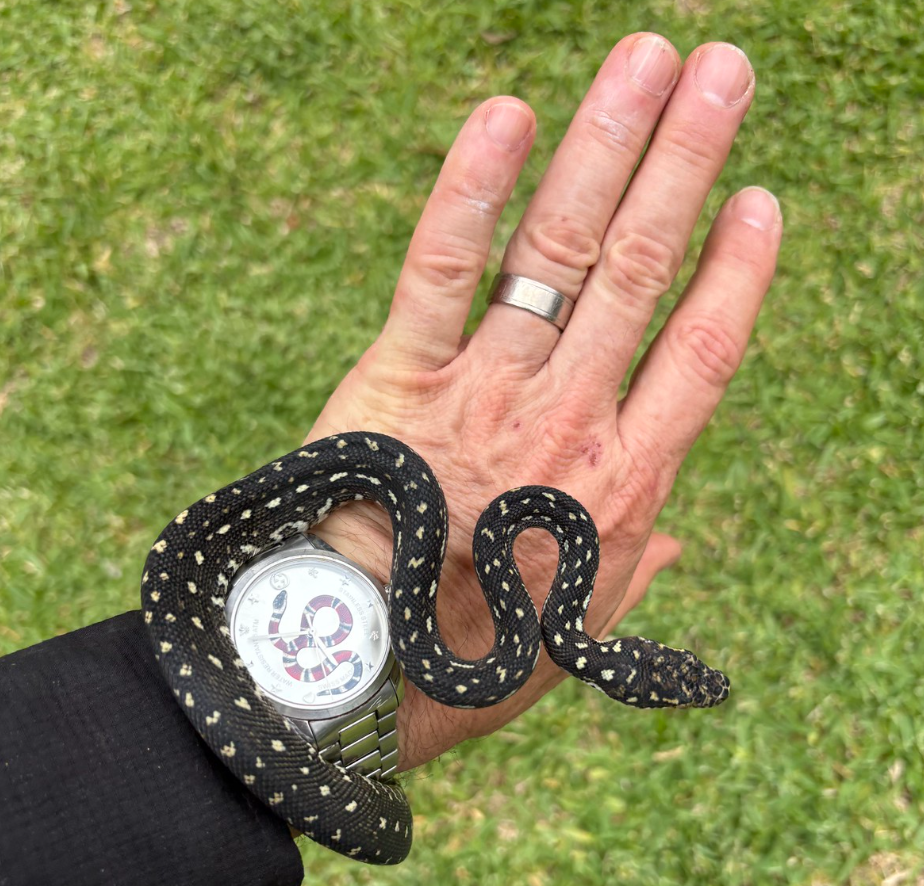
This baby Diamond python was relocated from a pool filter box in East Killara, NSW.
What is the Diamond Python?
The Diamond Python (Morelia spilota spilota) is a subspecies of carpet python endemic to coastal and adjacent eastern New South Wales and a small part of eastern Victoria. They are the southernmost-distributed python species in the world, adapted to cooler conditions than any of their tropical relatives, and one of the most beautiful snakes anywhere on the planet.
Venom rating: Non-venomous and harmless to humans, although large pythons can still inflict serious bites if mishandled
Total length: Up to 2,500mm (2.5 metres) typically, with larger individuals occasionally recorded
Conservation status: IUCN Least Concern
Urban Adaptation Rating: ★★★★★
Activity: Most active in warmer months from September to February
Distribution in Sydney: All five zones — Sydney Basin, Illawarra, Southern Highlands, Blue Mountains and Central Coast
How to identify a Diamond Python
The Diamond Python is one of the most distinctive snakes in the Sydney region:
Large, heavily built python with smooth, glossy scales
Dark olive to black base colour
Yellow or cream spots on most dorsal scales
Spots cluster into rosettes — pale-centred groupings of scales surrounded by dark — the species' signature feature
Rosettes larger but fewer in southern populations
More vibrant and densely patterned north of Gosford
Intergrades with the Coastal Carpet Python (Morelia spilota mcdowelli) on the NSW Mid North Coast
Triangular head clearly distinct from neck
Heat-sensing pits along the upper and lower lip scales
Long, prehensile tail used for climbing
Slim, elegant body shape despite the size
The rosette pattern is the defining feature. No other snake in Australia has quite this combination of yellow rosettes on a dark background. Once you have seen a Diamond Python in good light, you will never confuse it with anything else.
How to tell a Diamond Python from other Sydney snakes
The Diamond Python is large enough and distinctive enough that confusion is rare, but a few species can be mistaken for them in poor light:
Coastal Carpet Python (Morelia spilota mcdowelli): Has a more banded or blotched pattern rather than rosettes. Occurs mainly north of the Sydney region.
Brown Tree Snake (Boiga irregularis): Much more slender, with very large eyes and vertical pupils. Brown Tree Snakes are nocturnal and never have the rosette pattern.
Red-bellied Black Snake (Pseudechis porphyriacus): Glossy black with no rosettes. Much smaller and more slender. Has a vivid red belly.
The combination of large size, heavy build, rosette pattern and triangular head makes Diamond Pythons unmistakable in clear conditions.
Where do Diamond Pythons live?
Natural habitats:
Wet sclerophyll forest
Dry sclerophyll forest
Rainforest and rainforest margins
Coastal heathland
Sandstone escarpments and outcrops
Subalpine areas at higher elevations
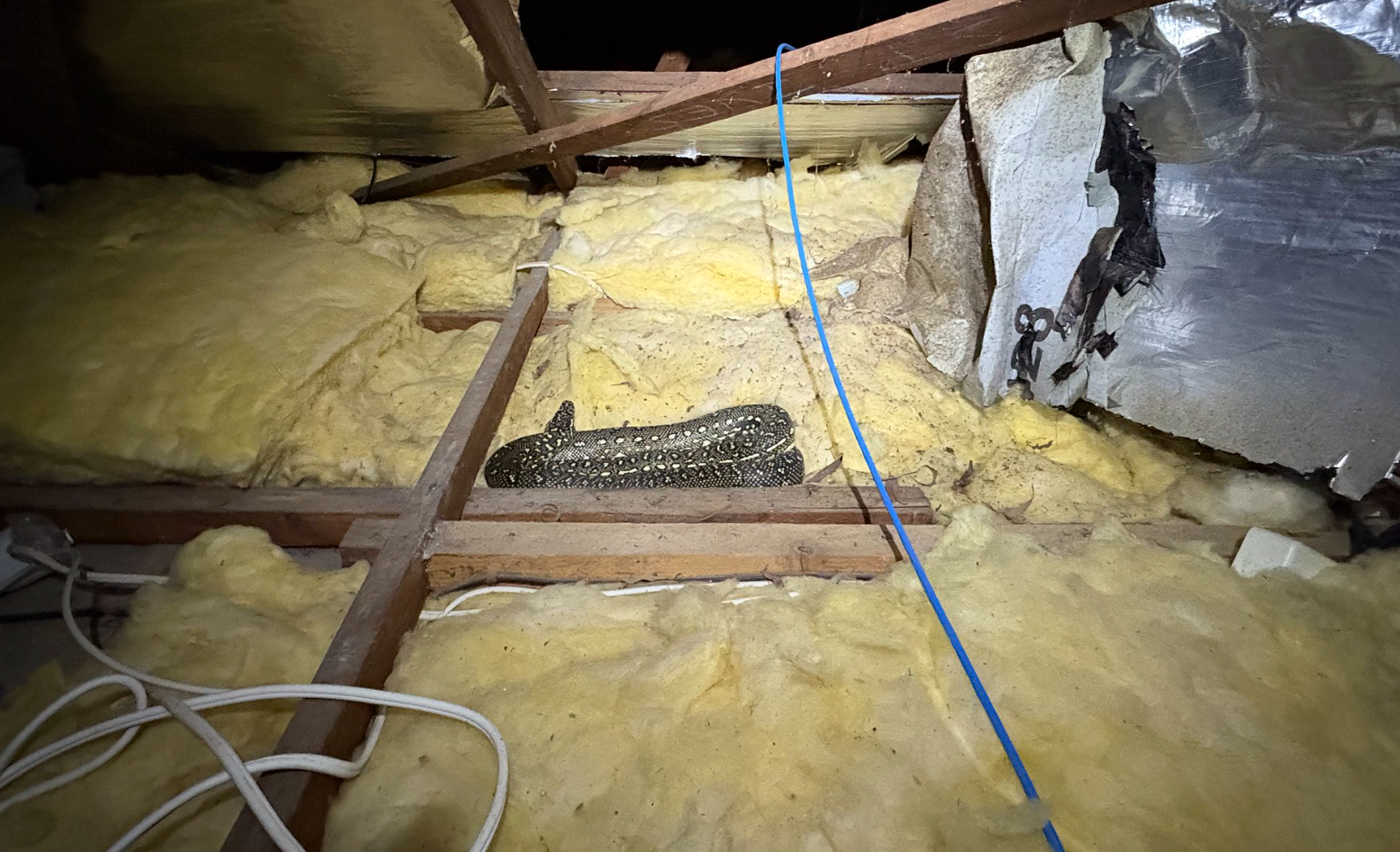
This python was spotted by an electrician in the roof cavity in Dural, NSW. We believe hundreds of Diamond pythons across Sydney would be spending winter in homes li this, with the owners completely unaware. The snake is no danger to pets, or children and we’d love to see more owners co-existing with these beautiful pythons.
Urban habitats:
Established suburban gardens with mature trees
Roof cavities and ceiling spaces
Sheds, garages and outbuildings
Pergolas and verandahs
Garden walls and rockeries
Aviaries and chicken coops (a problem situation)
Properties bordering bushland
Leafy suburbs from the Upper North Shore through to the Northern Beaches, the Sutherland Shire, the Inner West and beyond
A property does not need to be on the bush edge to host Diamond Pythons. We regularly attend jobs in densely settled suburbs where the local python population has been quietly living in roof cavities and garden corners for years without the homeowners ever realising.
The roof cavity connection
One of the defining features of urban Diamond Pythons in Sydney is their use of roof cavities and ceiling spaces. The pattern is consistent across decades of observation:
Pythons enter roof cavities through gaps in tiles, around vents and along soffits
They use these warm, dry, protected spaces as winter brumation refuges
A single roof can host the same python year after year
They feed on the rats and possums that share the cavity
Homeowners often have no idea until a python is seen entering or exiting
This habit is genuinely beneficial. A Diamond Python in your roof is the most effective rodent control system you can have — quiet, free, and ecologically appropriate. The downside is that the same python may also take roof-dwelling possums, which some homeowners value.
If you have a Diamond Python in your roof and you can tolerate its presence, the best thing to do is leave it alone. If you cannot tolerate it, a licensed reptile catcher can remove and relocate it — but be aware that an attractive roof will likely be recolonised by another python in due course.
Behaviour and the famous calm temperament
Diamond Pythons are one of the calmest, most placid snakes in Australia. We have relocated hundreds of them, and the typical experience is striking in how undramatic it is:
The python is found curled up somewhere — a verandah corner, a shed, a chook pen, a roof cavity
It is alert but unhurried
It does not strike, does not hiss, does not display defensive behaviour
It can usually be picked up by hand with minimal protest
It coils gently around the catcher's arms but does not constrict
It rides quietly in a bag back to the catcher's vehicle
This temperament is one of the reasons we recommend that homeowners who find a Diamond Python do not panic. Unlike many snakes, Diamond Pythons can often be allowed to move on of their own accord without any drama. They are simply not interested in confrontation.
The famous trick we sometimes recommend to homeowners is this: name the snake. Once a homeowner has called their resident python "Bruce" or "Stella" or "Diamond Jim," they tend to develop a relationship with the animal rather than a problem with it. The python's status shifts from "scary intruder" to "garden character," and the next time it appears, the response is curiosity rather than fear.
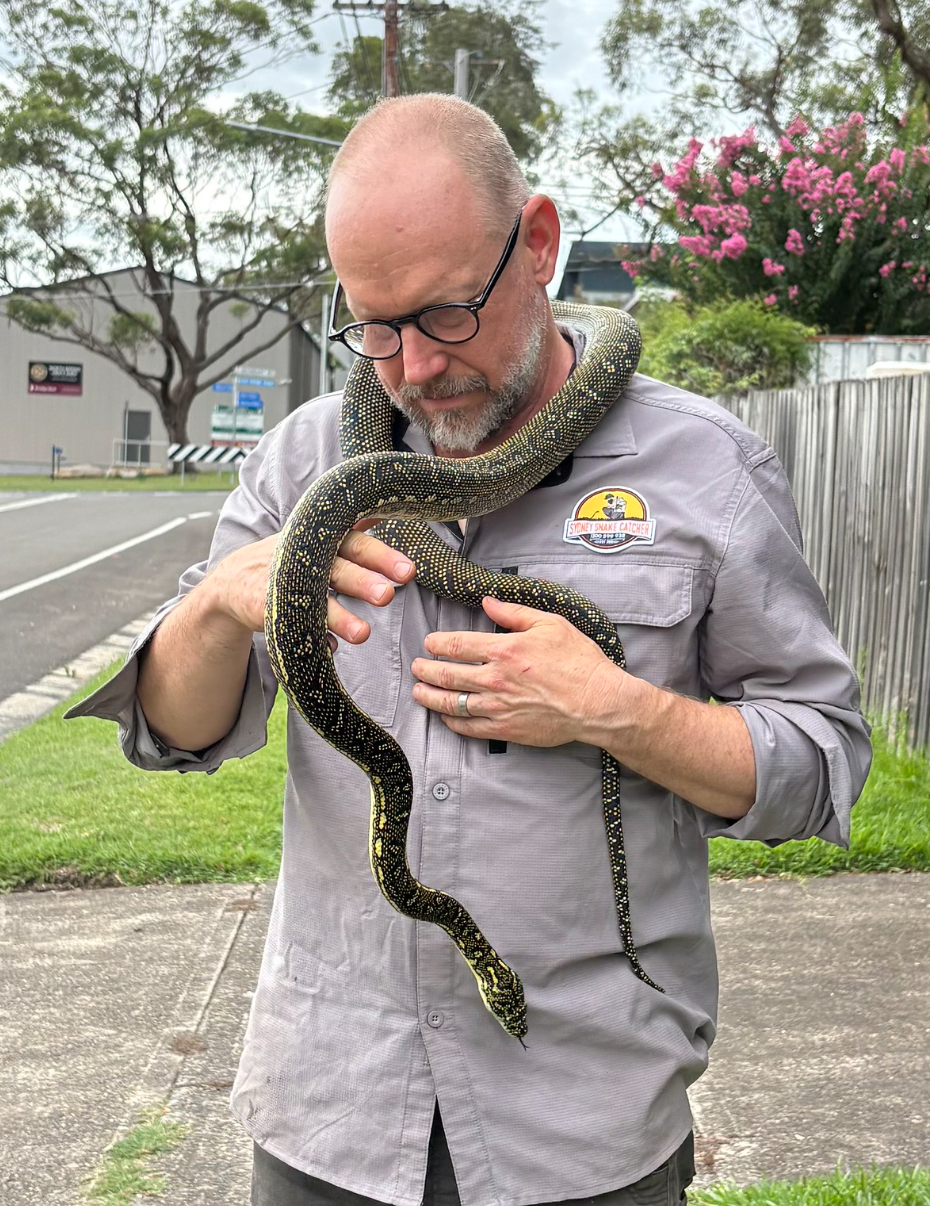
This completely wild Diamond python was relocated from a home in North Epping. We make it look easy, but please never attempt this yourself! We had plenty of bites before this level of competence was achieved.
Diet and lifestyle
Diamond Pythons are constrictors. They have no venom and rely on overpowering and constricting their prey. Their diet shifts with age and circumstance:
Juveniles:
Small lizards, particularly skinks
Frogs
Small rodents
Small birds
Adults:
Possums (a particular favourite — both ringtail and brushtail)
Rats and mice
Birds of various sizes
Other small mammals
Occasionally other reptiles
The taste for possums is one of the reasons Diamond Pythons do so well in suburban Sydney. A leafy suburb supporting a healthy possum population is essentially a Diamond Python buffet. We regularly find pythons with enormous food bulges from a recent possum meal — sometimes the meal is so large the snake cannot move properly and needs to be left to digest.
The famous "possum food coma" is one of the more reliable ways to encounter a Diamond Python. After a large meal, the snake will retreat to a quiet basking spot and remain there, almost immobile, for days or even weeks while the meal digests. Many of our call-outs are to homeowners who have found a python in this state and assumed something is wrong with it. Nothing is wrong — it has just eaten a possum.
Are Diamond Pythons dangerous?
For humans, no. Diamond Pythons are non-venomous, and the calm temperament means bites are extraordinarily rare. We have never had a serious human injury from a Diamond Python relocation in over thirty years of doing this work.
That said, a few caveats are worth noting:
A large Diamond Python (over two metres) has a serious bite, with long, recurved teeth. A defensive bite from a large python — usually only happening if the snake is grabbed or trapped — can cause significant tearing injuries that may need medical attention.
Diamond Python bites are not venomous but can become infected from oral bacteria.
A python in defensive coils can constrict around an arm or leg. While they cannot suffocate an adult human, the experience can be alarming and the snake may need to be carefully unwound.
For pets, the picture is more nuanced:
Cats are rarely taken by Diamond Pythons in suburban settings, but it does happen
Small dogs can be at risk if a python is hungry and the dog is small enough — fortunately rare
Chickens, ducks and pet birds are very much at risk. A Diamond Python that finds an unsecured chicken coop will eat its way through it
Aviary birds are at risk for the same reason
The straightforward rule: respect Diamond Pythons, do not handle them, secure your livestock and small pet animals, and you will have no problems with them.
Breeding and reproduction
Diamond Pythons have one of the most interesting reproductive cycles among Australian snakes:
Mating: Spring, with males travelling significant distances in search of females
Male competition: Multiple males often gather around a receptive female, with intense competition through wrestling and pushing
Clutch size: 15 to 30 eggs typically, with larger females producing more eggs
Egg laying: Early to mid summer
Maternal incubation: Females coil their bodies tightly around the eggs and maintain the clutch's temperature by muscular shivering — a remarkable adaptation
Incubation period: Approximately two months
Maternal investment: The female does not feed during incubation and can lose up to 50% of her body weight
Hatching: Late summer to early autumn
Hatchling independence: Fully independent at hatching, with no further maternal care
The maternal incubation behaviour is one of the most striking features of the species. Diamond Pythons are one of the very few snakes in the world that actively warm their eggs through their own body heat. The female maintains the clutch at approximately 30°C through controlled muscle contractions, allowing the eggs to develop reliably even in the cooler conditions of southeastern Australia.
What to do if you find a Diamond Python at your home
Stop, take a breath and recognise that you have found one of Sydney's most beautiful native animals.
Practical steps:
Keep your distance. Three metres is plenty.
Photograph it from a safe distance if you want to confirm identification.
Keep pets and small children away from the area.
Watch where the snake goes. Most encounters resolve themselves within minutes as the snake moves on.
If the snake is in a problem location — in a chicken coop, in a roof cavity you cannot tolerate, in an enclosed building — call Urban Reptile Removal.
If the snake is just passing through your garden, let it go. It will not stay.
What you should not do:
Do not kill it. Diamond Pythons are protected native wildlife.
Do not handle it. Even with their calm temperament, a defensive bite from a large python can cause significant injury.
Do not corner it. A cornered python will defend itself.
Do not assume it is a venomous snake. The rosette pattern is unmistakable.
Do not try to relocate it yourself. Apart from the legal issues (relocation requires a licence), Diamond Pythons released in unfamiliar territory often do not survive.
The Diamond Python as a partner, not a problem
We end by making a case that many readers may not expect from a reptile removal service: try, if you can, to live alongside your Diamond Python rather than removing it.
A Diamond Python in your garden:
Controls rats and mice better than any commercial product
Causes no harm to humans or properly-secured pets
Is one of Australia's most beautiful animals
Is genuinely rare and increasingly threatened in much of its range
Contributes to the ecological health of your local area
Will likely be the same individual year after year — a long-term resident, not a transient visitor
Properties with resident Diamond Pythons are often the same properties with the most thriving native wildlife generally. Their presence is a sign that your garden is doing something right. We routinely encourage homeowners to think of their python not as a problem to be solved but as a partner in keeping the local ecology in balance.
That said, if removal is genuinely needed — a python in an aviary, a chicken coop being raided, a snake in a building where it cannot be safely tolerated — we are here. Urban Reptile Removal relocates Diamond Pythons routinely, professionally and humanely. Every Diamond Python we handle is released into suitable habitat away from the property of concern.
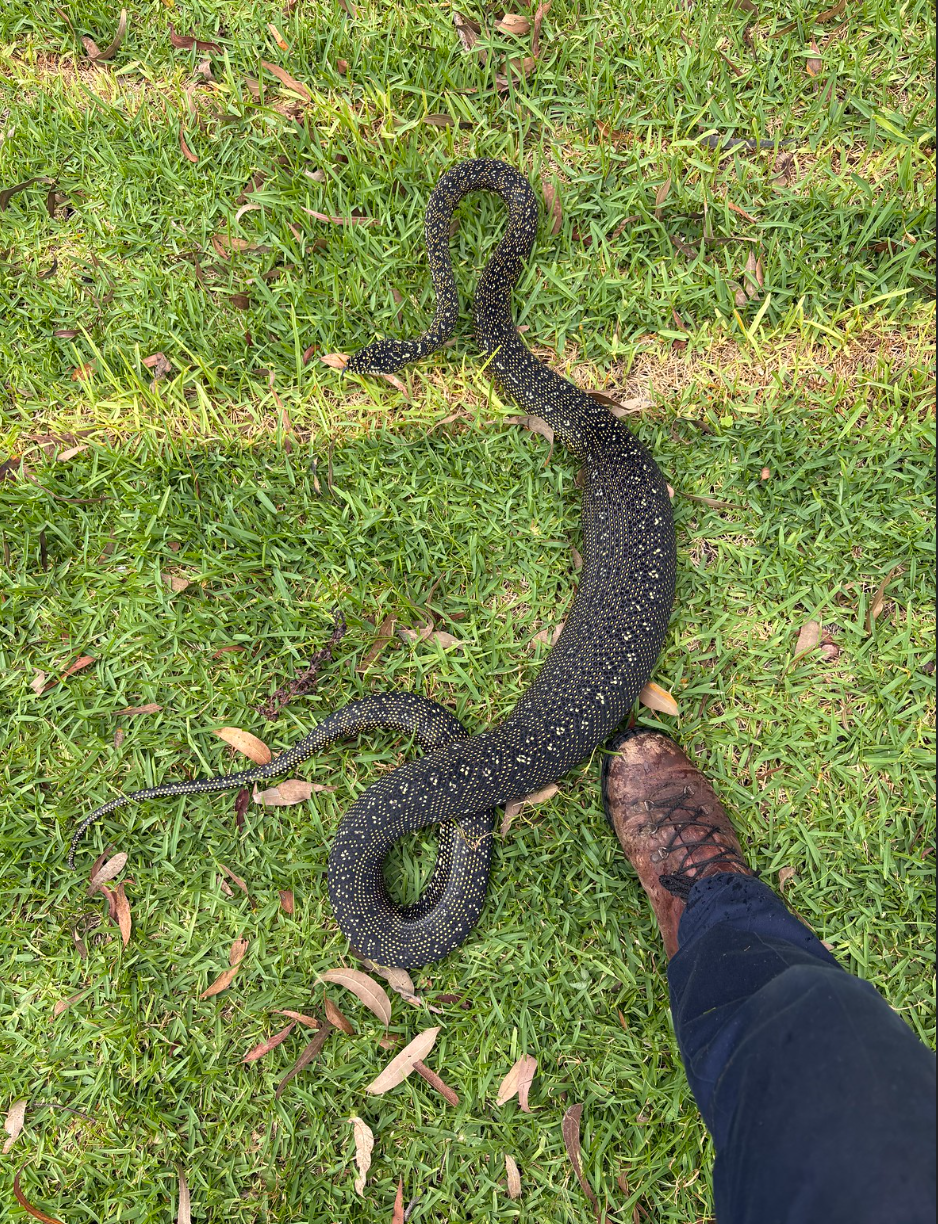
This python had just eaten a Ring-tailed possum in St Ives. Once they have eaten a meal of this size the snake isn’t very mobile and often needs to be relocated to somewhere more suitable.
Summary
The Diamond Python (Morelia spilota spilota) is Sydney's signature snake — a large, beautiful, non-venomous native python found nowhere else in the world outside of New South Wales and eastern Victoria. They are present across all five distribution zones of the Greater Sydney region, and they have adapted to suburban life better than almost any other large native reptile. Calm, charismatic and genuinely beneficial, they are one of the species that makes Sydney's wildlife distinctive. If you find one in your garden or your roof, the best response is calm appreciation rather than panic — and if you genuinely need it moved, a licensed reptile catcher can do it without harm to you, the snake or anyone else.
Found a Diamond Python or another reptile at your home? Urban Reptile Removal operates 24/7 across the Greater Sydney region. We are fully licensed and insured, and we relocate Diamond Pythons and all other native reptiles humanely. Call 0418 633 474.
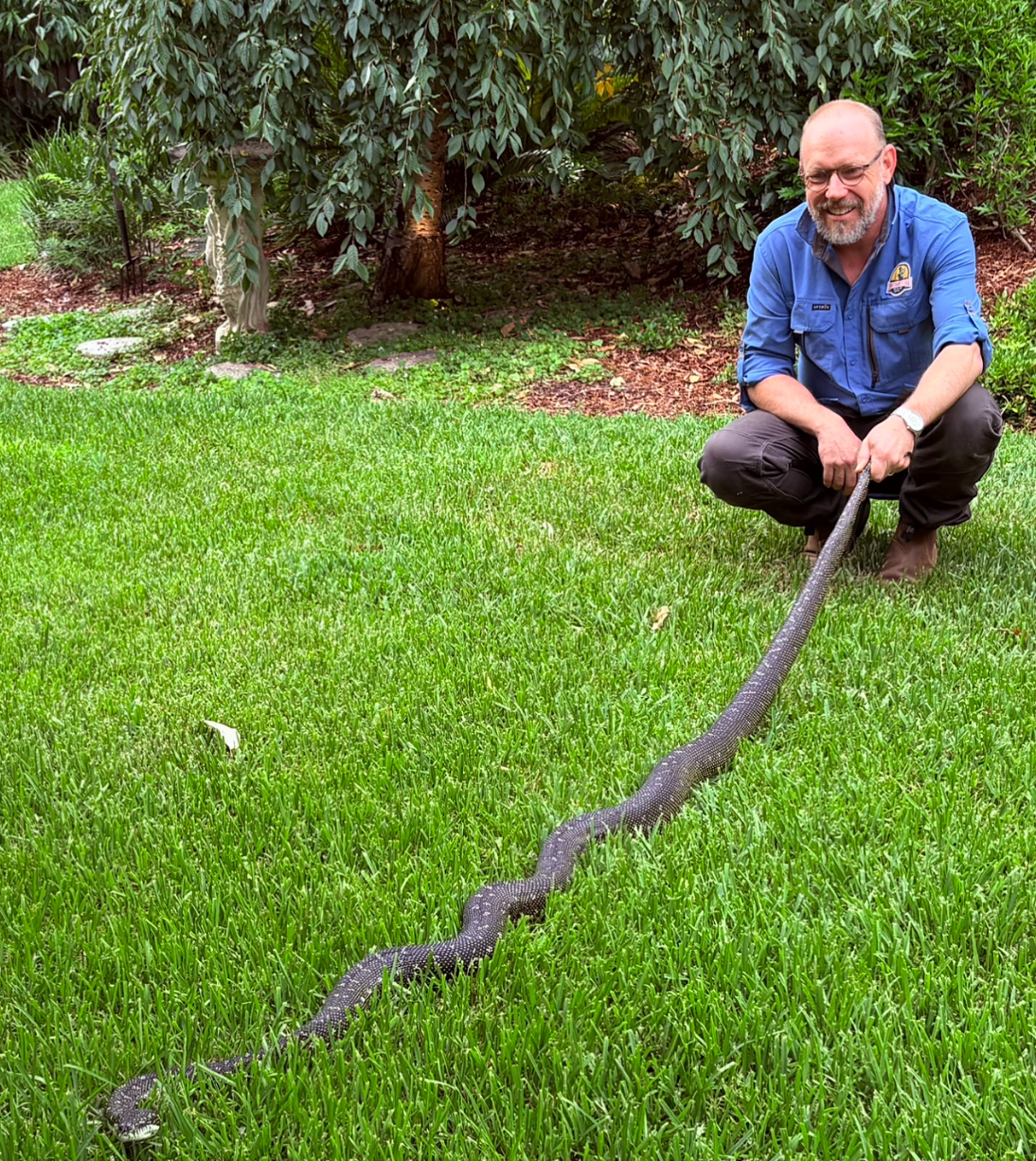
This is the largest Diamond Python we’ve relocated. It measured 2.3m and was found in North Turramurra, NSW.

Interested in Sydney Reptiles?
You can buy the book, featuring full page descriptions on over 70 species
https://sydneysnakecatcher.com.au/product/city-wildlife-guide-reptiles-of-sydney/

For the most up to date information on snakebite first aid, visit, snakebitefirstaid.com.au
