Snake removal in Baulkham Hills
If you've found a snake at your home or workplace in Baulkham Hills, call 0418 633 474. Stay calm, step back, bring children and pets indoors, and let us handle the rest. You don't need to take a photo. You don't need to identify it. You don't need to follow it or stay close. Snakes almost always move into the nearest hiding place, and a trained catcher will find it when we arrive. We stay on the phone with you and talk you through what to do until we get there.
About Baulkham Hills
Baulkham Hills is one of the busiest suburbs in The Hills Shire, with large blocks, established gardens, mature trees, and bushland corridors running between properties. The mix of old and new homes creates the conditions snakes thrive in — quiet movement pathways, hiding places at ground level, and prey species that have adapted alongside the development.
Why snakes turn up here
Snakes behave according to a short list of needs: food, shelter, warmth, shade, and safe pathways. They follow prey — frogs, skinks, insects, rodents, birds, and occasionally fish in backyard ponds. They warm themselves on driveways, pavers, retaining walls, and sunny garden edges. They hide under pot plants, inside sheds, behind hot water systems, in timber piles, and in dense vegetation.
They choose these places because the places feel safe, not because they want to be near people. Snakes avoid humans whenever they can. They move silently, find cover fast, and only behave defensively when startled, cornered, or blocked.
What not to do
Trying to trap, chase, or corner a snake makes the situation worse. The snake almost always moves into deeper hiding — retaining walls, roof cavities, complex garden beds — and then the job goes from a 20-minute relocation to a full property search.
Calling us means the removal is handled calmly, by someone who reads snake behaviour for a living, with the right equipment and the right approach to your property. 0418 633 474 Every day of the year.
Reptiles you'll see in Baulkham Hills
Baulkham Hills has five species you're most likely to come across. Each behaves differently, and recognising which one you're looking at changes nothing about what you should do — call us either way — but the detail below helps you understand what's in front of you.
Golden-crowned snake. Small and slender, mostly active at night. Pale yellow crown-shaped marking on the top of the head and a reddish or pink underside. Often mistaken for baby brown snakes because of their size and quick movement. Venomous, but bites usually cause only mild symptoms. They prefer damp, shaded spots under rocks, edging, mulch, and timber, and feed on small lizards, eggs, insects, and frogs. Most active after rain. They slip into tight crevices easily, so locating one usually needs experience.
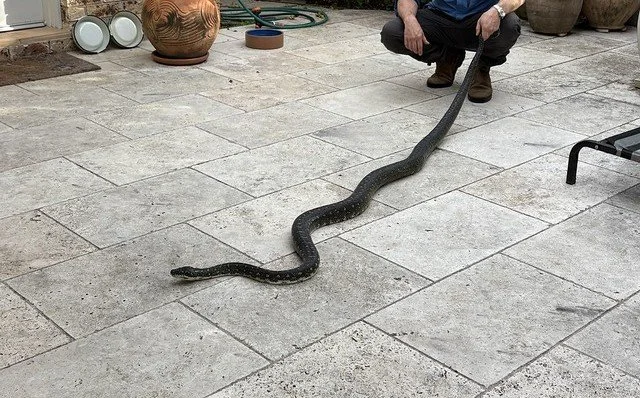
Diamond python. Large, slow-moving, non-venomous. Black scales with yellow or cream rosette patterns. Baulkham Hills has plenty of possums and rodents, which is what brings them in. They rest on verandas, gutters, warm retaining walls, and inside roof cavities. They're beneficial — they keep rodent populations down — and we encourage residents to leave them alone where it's safe to do so. When relocation is needed, their size and strength means it should be done by a trained handler.
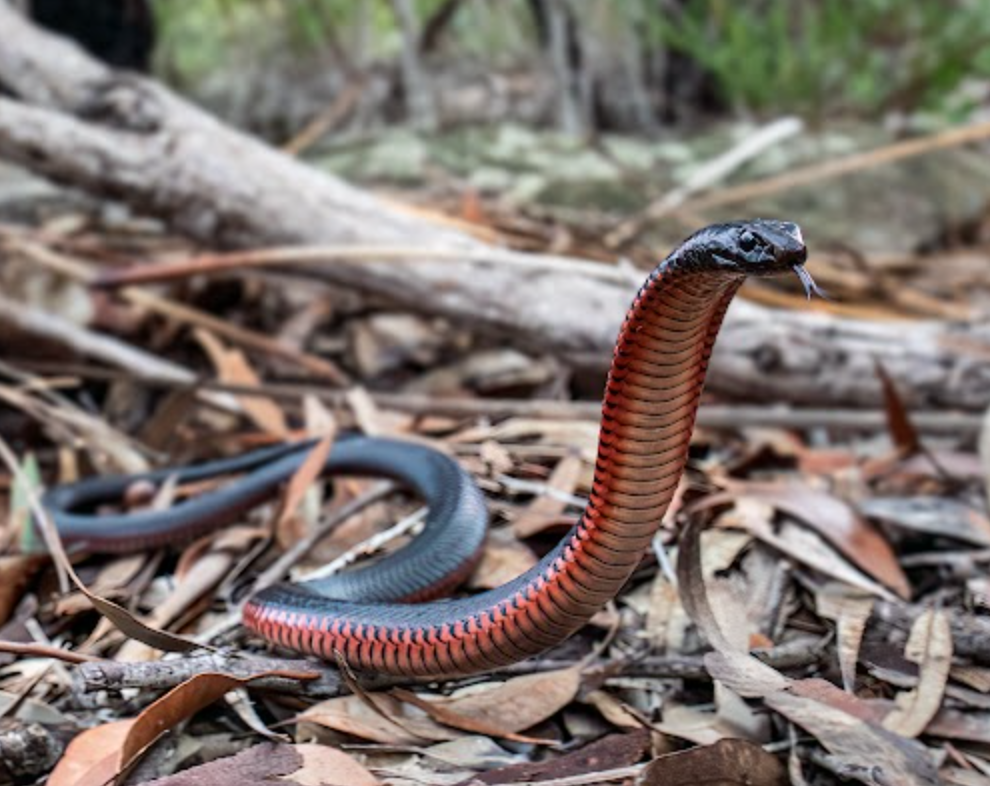
Red-bellied black snake. Glossy black on top with a bright red or pink underside. They prefer damp environments — shaded gardens, drainage lines, frog ponds, low-lying vegetation — and feed on frogs, skinks, small snakes, and fish. They bask in morning sun and retreat to cooler cover as the day warms. Venomous, but shy. They flee if given space. Cornered, they may flatten their body and hiss. Should only be handled by a professional.
Blue-tongued lizard. Not a snake, but the most common reason people call us thinking they've seen one. Heavy-bodied skinks that rustle loudly through leaf litter and display a bright blue tongue when threatened. They hide under pot plants, timber, outdoor equipment, steps, and warm sunny edges, and eat insects, fruit, snails, slugs, and pet food. We'd rather you call and find out it's a blue-tongue than not call and find out it wasn't.
Green tree snake. Slim, fast, harmless. Colour varies from bright green to olive, grey, or almost black, with a yellow underside. Large eyes, exceptional vision. When startled, they flatten their bodies and show flashes of pale blue between the scales, which can be alarming if you don't know the species. They climb well and turn up in hedges, fences, garages, pool areas, and roof edges. They feed on skinks and frogs and move fast, so removal needs an understanding of where they're likely to head.
Where snakes hide in Baulkham Hills properties
The places we find snakes most often:
Behind hot water systems and air conditioners

Under pot plants and raised tubs
Inside garages behind storage
Beneath retaining walls and garden edging
In roof cavities and wall gaps
In sheds behind tools or stored items
Under timber, tiles, or leftover building materials
In dense shrubs, bamboo, and ground covers
Around pool pumps and shaded mechanical areas
In compost heaps and mulch
Behind water features and rockeries
Along shaded, narrow paths between fences
Under outdoor furniture, tarps, and equipment
Beneath decks, stairs, and raised platforms
We search each area carefully until the snake is located and safely removed.

When you call us, you don't need to follow the snake. Following it pushes it deeper into hiding and makes removal harder. We use species behaviour, temperature, time of day, and property layout to work out where it's likely gone and locate it from there.
After we leave
We'll explain why the snake was on the property and what can be done to reduce future visits.
Chemical repellents, powders, and ultrasonic devices don't work — there's no evidence for any of them, despite the marketing. What does work is removing the conditions that brought the snake in the first place: mow regularly, trim vegetation away from walls and fences, organise sheds and garages, store timber off the ground, clear leftover building materials, control rodents, secure outdoor pet food, and keep shaded corners tidy. Most of these reduce both the hiding places and the prey.
If a snake is inside the house
A snake inside the home is an emergency. They get in through open doors, garage gaps, holes near pipes, ventilation gaps, or cracks under doors. Leave the room, close the door behind you, and call 0418 633 474.
We work across Baulkham Hills and The Hills Shire every day of the year. If you see movement, hear rustling, or notice your dog or cat fixated on one part of the yard, call us — even just to check.