Snake removal in St Ives
If you've found a snake, call 0418 633 474. Bring the kids and pets indoors. If you can safely keep an eye on the snake from a distance without disturbing it, that's a big help — a snake that isn't frightened tends to keep moving naturally rather than disappearing into hiding, which makes it much easier for us to locate and catch when we arrive. You don't need a photo and you don't need to identify the species. Just watch from a safe distance if you're able to, note roughly where it's heading, and call us. We'll stay on the phone with you and talk you through what to do until we get there.
About St Ives
St Ives sits in the heart of Ku-ring-gai, bordered by bushland reserves and threaded with leafy, shaded blocks. Mature gardens, sandstone retaining walls, deep tree canopies, and properties backing onto reserves mean snakes move through the suburb regularly, especially through the warmer months. They follow corridors of vegetation between bushland and the gardens that connect to it.
The species we see most often
Golden-crowned snake. Small, slender, and active mostly at night. Pale yellow marking across the top of the head, pink or reddish underside. Venomous, but bites usually produce only mild local symptoms. Often mistaken for baby brown snakes because of their size. They hide under rocks, garden edging, mulch, and timber, and are especially active after rain.
Red-bellied black snake. Glossy black with a red or pink underside. Common in St Ives near shaded gardens, drainage lines, frog ponds, and damp vegetation. They feed on frogs, skinks, small snakes, and fish, and bask in morning sun before retreating to cover. Venomous, shy, and usually flee if given space. Should only be handled by a professional.
Green tree snake. Slim, fast, harmless. Bright green, olive, grey, or almost black, with a yellow underside. Excellent climbers, often seen in hedges, fences, pool areas, garages, and roof edges. When startled, they flatten their bodies and show flashes of blue between the scales, which can be alarming if you don't know the species. They aren't venomous. They still need a trained catcher to safely remove from a home.
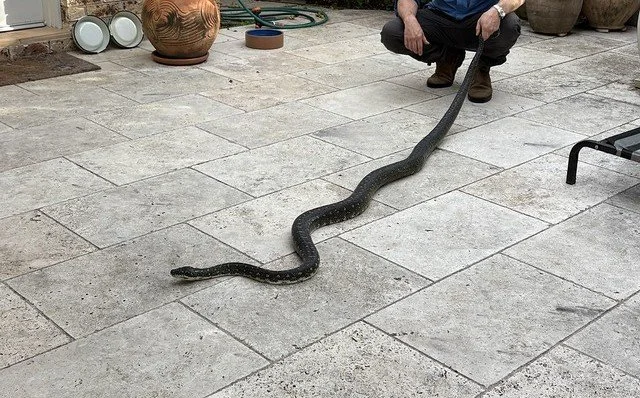
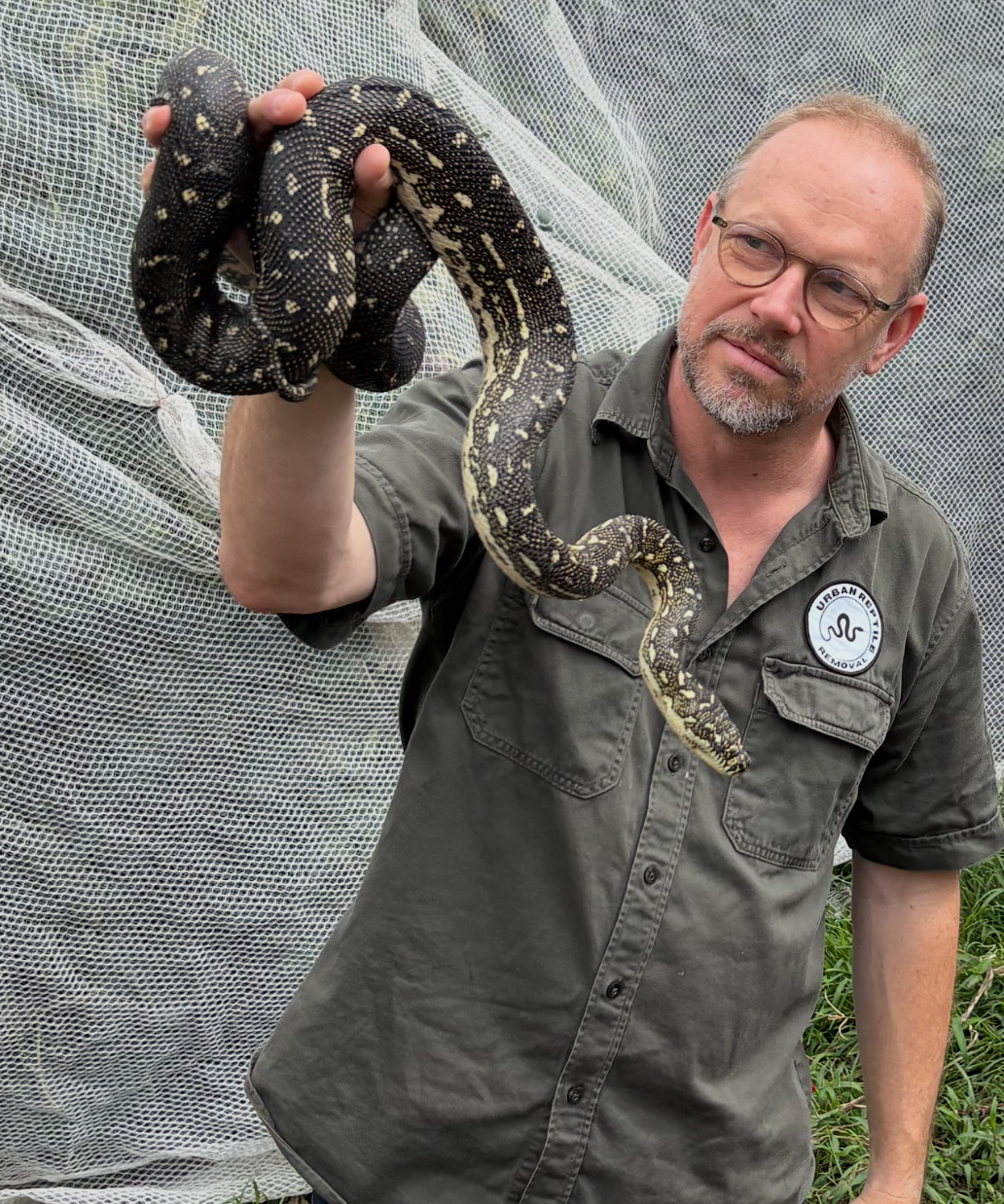
Diamond python. Large, non-venomous, calm by nature. Black scales with yellow or cream rosette patterns. St Ives properties — with their possums, rodents, mature trees, and roof cavities — provide ideal habitat. Diamond pythons rest in rafters, on verandas, on garden walls, and behind sheds, and play an important role in controlling rodent populations. We encourage residents to leave them alone where it's safe to do so. When relocation is needed, their size and strength means it should be done by a trained handler.
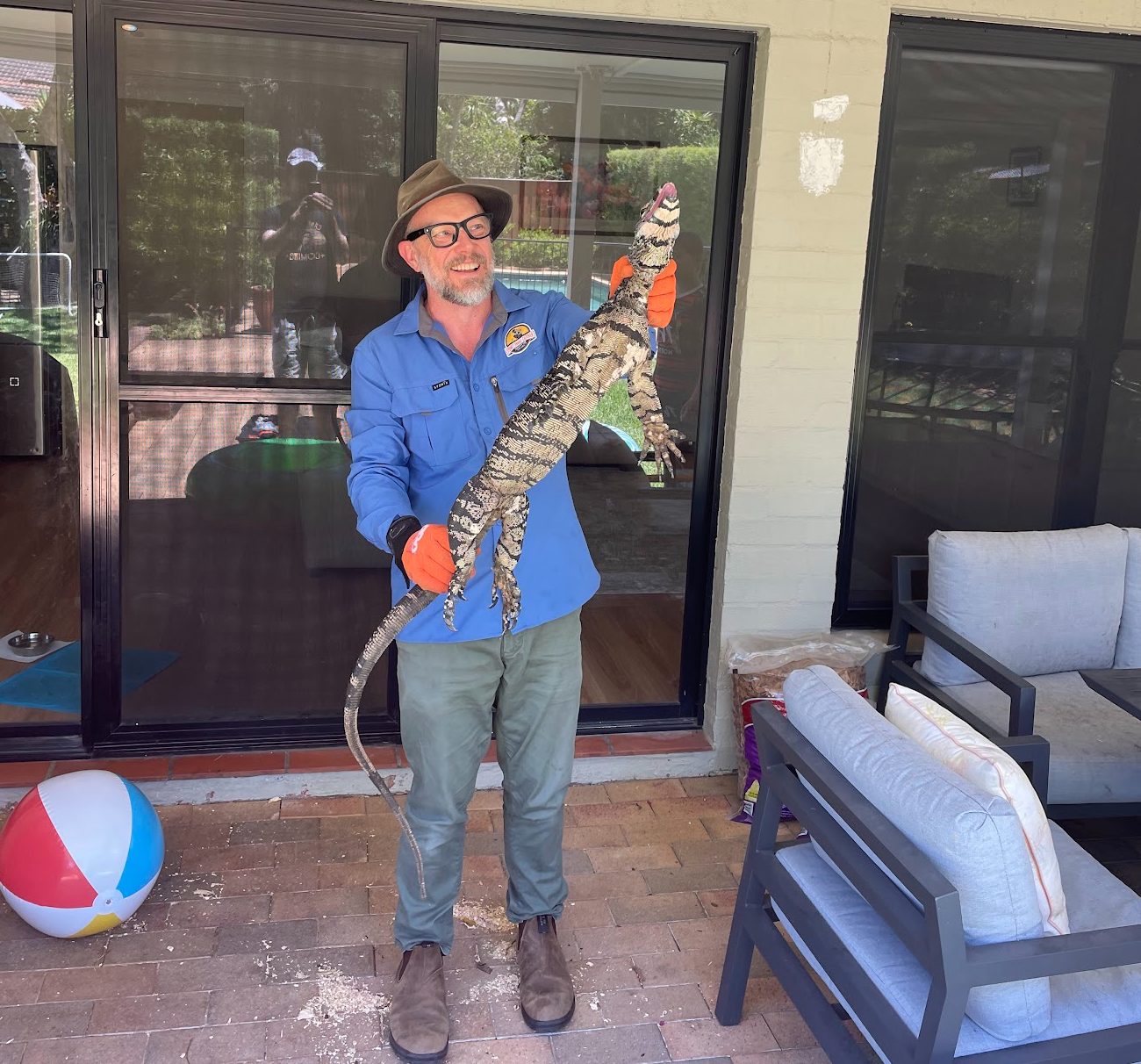
Blue-tongued lizard. Not a snake, but the most common reason people in St Ives call us thinking they've seen one. Heavy-bodied skinks that hiss, puff up, and display a bright blue tongue when threatened. They feed on snails, slugs, insects, and pet food, and are excellent for the garden. If you're not sure, call. We'd rather come out for a blue-tongue than not come out and find out it wasn't.
Where snakes hide in St Ives properties
The places we find snakes most often:
Behind hot water systems and air conditioners

Under pot plants and raised tubs
In garages behind boxes and storage
Beneath sandstone retaining walls
In roof cavities and wall gaps
In sheds behind tools or equipment
Under timber, tiles, or leftover building materials
In thick shrubs, bamboo, and ground covers
Around pool pumps and shaded mechanical areas
In compost heaps and mulch piles
Behind water features, statues, and rockeries
Along fence lines and shaded side passages
Under outdoor furniture and tarps
Beneath decks, steps, and raised platforms
When you call us, you don't need to follow the snake. Following it pushes it deeper into hiding and makes removal harder. We use species behaviour, temperature, time of day, and property layout to work out where it's likely gone, and locate it from there.
After we leave
We'll explain why the snake was on the property and what can be done to reduce future visits. Chemical repellents, powders, and ultrasonic devices don't work — there's no evidence for any of them despite the marketing. What does work is removing the conditions: mow regularly, reduce leaf litter, trim vegetation back from walls and fences, organise sheds and garages, store timber off the ground, seal small gaps where possible, clear unused building materials, secure outdoor pet food, and control rodents.
Snakebite First Aid for St Ives
Blacktown has a lot of snakes. Most of them are Red bellied Black Snakes and Eastern Brown Snakes. If you spend time outside here, in a park, a backyard, or near a creek, it is a good idea to know what to do if someone gets bitten. This page explains the basic steps. It is written to be simple and easy to remember, because in a real emergency, simple is what works.
Step 1: Call 000
If someone is bitten, call 000 immediately and ask for an ambulance. Stay on the line and follow their instructions.
Step 2: Keep the person still
Movement speeds up how quickly venom spreads through the body. The person who was bitten should stop moving straight away and sit or lie down where they are.
If you're with them, keep them calm and still. If they can't safely stay where they are, carry them rather than letting them walk.
Step 3: Apply a pressure immobilisation bandage
✔ Wrap a broad bandage firmly over the bite site, similar to bandaging a sprain.
✔ Continue wrapping up the entire limb, not just the bite area.
✔ Splint the limb so it can't bend or move.
✔ The bandage should be firm but not so tight that it cuts off circulation — if fingers or toes turn pale or feel cold, ease it slightly.
Step 4: Note the time
Note the time of the bite if you can. It helps hospital staff assess how things are progressing once treatment begins.
For more information on snakebite first aid, visit snakebitefirstaid.com.au.
A few things people often ask
Did I do something wrong? No. Snakes move through every suburb in northern Sydney. St Ives just has more of them than most because of the surrounding bushland.
Does one snake mean more are nearby? No. Snakes don't travel in pairs, don't form groups, and don't nest in suburban yards. One sighting almost always means one snake.
If a snake is inside the house
A snake inside the home is an emergency. Leave the room, close the door behind you, and call 0418 633 474.
We work across St Ives and the wider Ku-ring-gai area every day of the year. If you see movement, hear rustling, or notice your dog or cat fixated on one part of the yard, call us — even just to check.
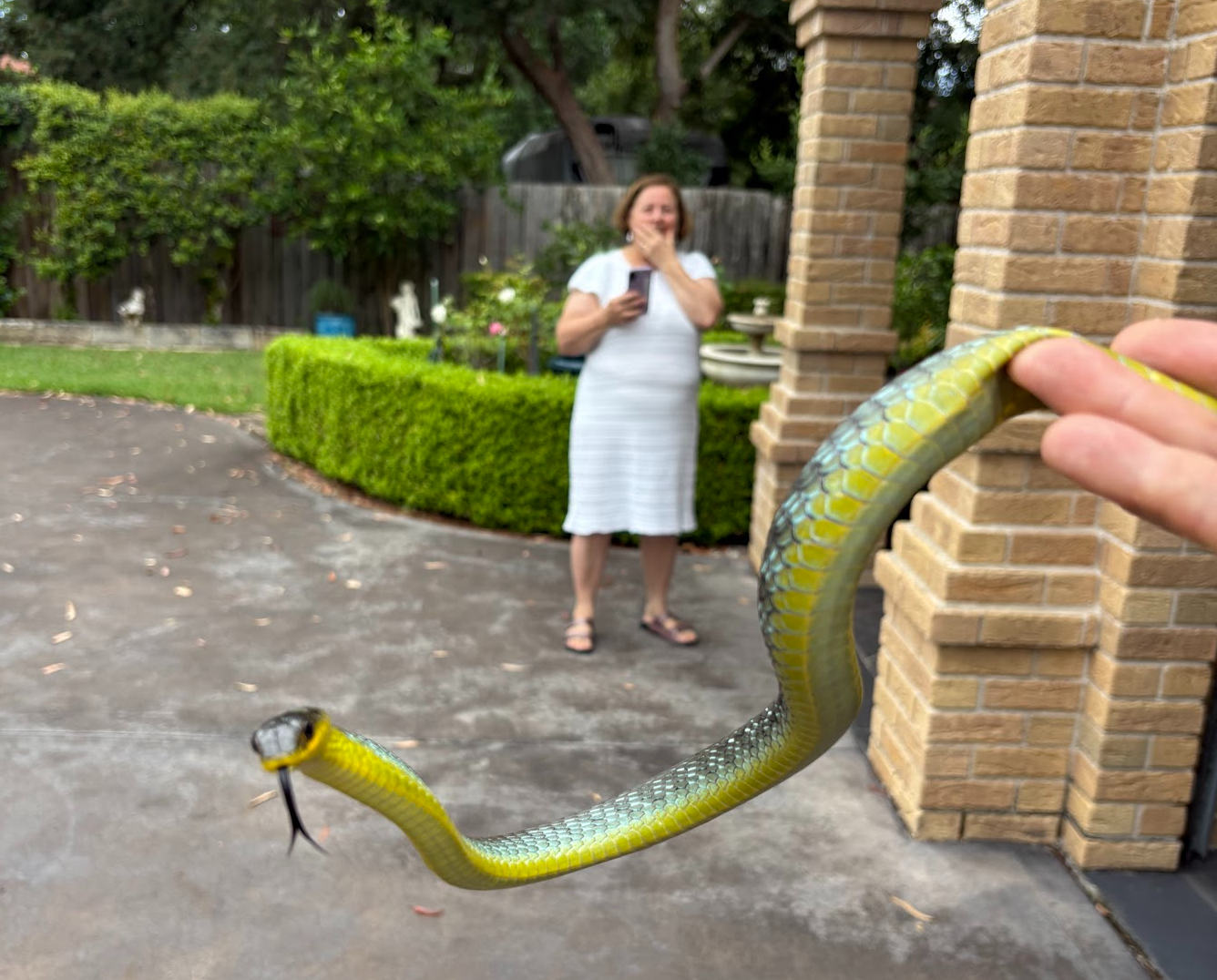
Green Tree Snakes, like this one, are one of St Ives most common species.