Snake Catcher Cheltenham
Snake in your yard. Call 0418 633 474. Urban Reptile Removal typically responds to Cheltenham within 30 minutes. While you wait, keep your distance and maintain visual contact with the snake if possible. Move children and pets to safety. A snake that's being watched is far simpler to locate than one that's disappeared into the garden or under the house. Do not attempt to catch it, spray it, or identify it. Simply note where it has gone and keep watching.
Cheltenham and local snakes
Cheltenham's geography creates predictable conditions for the snakes we encounter here. The suburb sits backed by bushland reserves and connected foreshore areas, with mature tree coverage throughout and established residential properties — most with rear access to natural areas. That combination sustains a reliable year-round snake population. The three species we attend most frequently are diamond pythons, red-bellied black snakes, and golden-crowned snakes. Each has its own pattern and its own reason for being on your property.
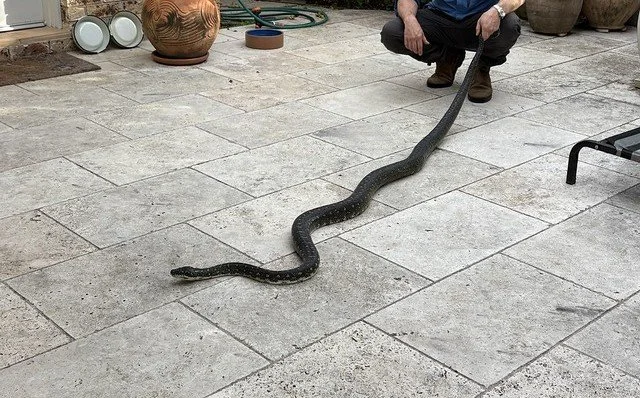
Diamond pythons are the resident python species in Cheltenham, sustained by the bushland reserves that run through and behind the suburb. They're non-venomous constrictors, typically one to one-point-five metres, with distinctive diamond-shaped scale markings and a stocky build. They hunt at night for small birds, small mammals and sleeping lizards. They shelter during the day in rock crevices, tree hollows, and when available, roof cavities and ceiling spaces in houses.
Roof space and ceiling cavities account for the majority of our diamond python callouts through the warmer months, particularly from September through April. Garages with enclosed roof spaces, pergolas, garden sheds, pool sheds and similar structures are regular locations. They move into these spaces for the shelter and the hunting opportunities. Once they've found a good spot they tend to return, which is why you might see the same snake in your roof on more than one occasion.
The best time to encounter a diamond python in Cheltenham is spring and early summer, when they're moving into roof spaces to shelter and hunt. Once settled, they'll stay if conditions suit them. Cooler months push them to ground level — thick garden beds, under decking, under stored items, dense mulch areas.
Red-bellied black snakes are the most common callout we attend across Cheltenham. They're medium-sized venomous snakes, typically one to one-point-five metres, with a glossy black upper body and distinctive red colouring on the lower belly and flanks. That red underside is the identifying feature — it's the reason for the name.
Red-bellied blacks are attracted to water and the small animals that congregate around it. Properties with pools, ponds, or frog-friendly gardens see them regularly, particularly through summer and early autumn when water levels and frog activity peak. They hunt frogs, lizards, small mammals and occasionally other snakes. The presence of a good frog population in your garden is almost a guarantee you'll see red-bellied blacks at some point.
They shelter under loose bark, in rock crevices, under ground level debris, in garden sheds, under pool pumps and filtration equipment, and in the damp spaces around water features. A red-bellied black in your yard is usually there because it's following the frogs or small animals it feeds on. Remove the attraction and you remove the reason they visit.
Golden-crowned snakes are smaller than the pythons and red-bellied blacks — typically 60 to 90 centimetres — with a distinctive orange or golden-yellow crown marking on the head. They're venomous but the bite risk is medically minor. They're rear-fanged, meaning they have to chew to deliver venom, and they're not aggressive. Most bites occur when people are handling them, which you shouldn't be doing anyway.
Golden-crowned snakes emerge in leaf-litter, mulched garden beds and shaded areas following heavy rain. They hunt small skinks, small frogs and insect larvae. They're cryptic and shy — you won't often see one unless you're moving garden mulch or leaf litter by hand. Most people aren't aware they're even in their garden until they find one actively moving. They're completely harmless and will move away if given the opportunity.
Blue-tongued lizards and Eastern water dragons are also common in Cheltenham properties, particularly those with established gardens, water features and ground cover. A significant portion of our Cheltenham callouts turn out to be one of these rather than a snake. We attend regardless to confirm identification and provide you with clarity about what you're seeing.
Why snakes are on your property
A snake on your property isn't an accident. It's there because something there is feeding it. Usually that's insects or small frogs. Often it's rodents living in garden beds, under sheds, in roof cavities or through wall spaces. Sometimes it's other snakes. Removing the snake solves the immediate problem. Understanding what attracted it prevents the next visit.
Where they hide on Cheltenham properties
Roof cavities and ceiling spaces, garages, pergolas, garden sheds, pool sheds and pool pump equipment, under decking, behind hot water systems, under garden edging and mulch, along fence lines, behind air conditioning units, in compost areas, under stored items, in thick planted garden beds, and in the gaps between the house and the rear reserve boundary.
After we leave
We complete every job with a property walk-through. We explain what drew the snake in, show you the likely entry points and hiding spots, and discuss the practical changes that actually reduce future activity: maintaining short grass, clearing clutter from fence lines, storing items clear of the ground, sealing gaps where rodents travel, and removing outdoor pet food bowls overnight. There are no repellent sprays or gimmicks that work. These measures do.
Urban Reptile Removal, Cheltenham
0418 633 474 — 365 days a year
About Chris Williams
Chris Williams founded Urban Reptile Removal and oversees its operations across Sydney and regional New South Wales. He brings more than three decades of professional experience with Australian reptiles and amphibians, including roles with Taronga Zoo and the Australian Reptile Park. He founded Snake Ranch, which became Australia's largest reptile breeding facility, and has authored seven books on Australian reptile biology and wildlife. Since 2014 he has served as President of the Australian Herpetological Society.