
Golden-crowned Snake
The Golden-crowned Snake (Cacophis squamulosus) — Sydney's Harmless Suburban Night-Hunter
If you have ever walked out to the bins on a warm, humid evening after rain and seen a small, dark snake with a pale yellowish marking on its head sliding across your driveway, you have probably met a Golden-crowned Snake (Cacophis squamulosus). They are one of the most commonly encountered nocturnal snakes in Sydney's leafy suburbs — quiet, slow, mildly venomous but not dangerous to humans, and one of the most misidentified species we get called about.
At Urban Reptile Removal we get a steady stream of Golden-crowned Snake calls — around 67 in 2025 alone. They tend to come in clusters during humid summer nights, particularly after rain, when these small snakes emerge to hunt across suburban driveways, gardens and bushland edges. Despite being a member of the elapid family — the same family as brown snakes and tiger snakes — they are genuinely harmless and one of the calmer species we work with. Suburbs like Roseville, Wahroonga and even suburbs closer to the city like Mosman and Chatswood regularly find these little snakes at night.
What is the Golden-crowned Snake?
The Golden-crowned Snake (Cacophis squamulosus) is a small to medium-sized elapid found along the east coast of Australia from northern New South Wales into Queensland. They are the largest of the three Australian Cacophis species and the most common in the Sydney region. Despite their elapid heritage, their small size, mild venom and gentle temperament make them very low risk to humans.
Venom rating: Mildly venomous, normally causes only local symptoms in humans
Total length: 500mm average, 750mm maximum
Conservation status: IUCN Least Concern
Urban Adaptation Rating: ★★★★★
Activity: Nocturnal, most active in warm humid weather from spring through autumn
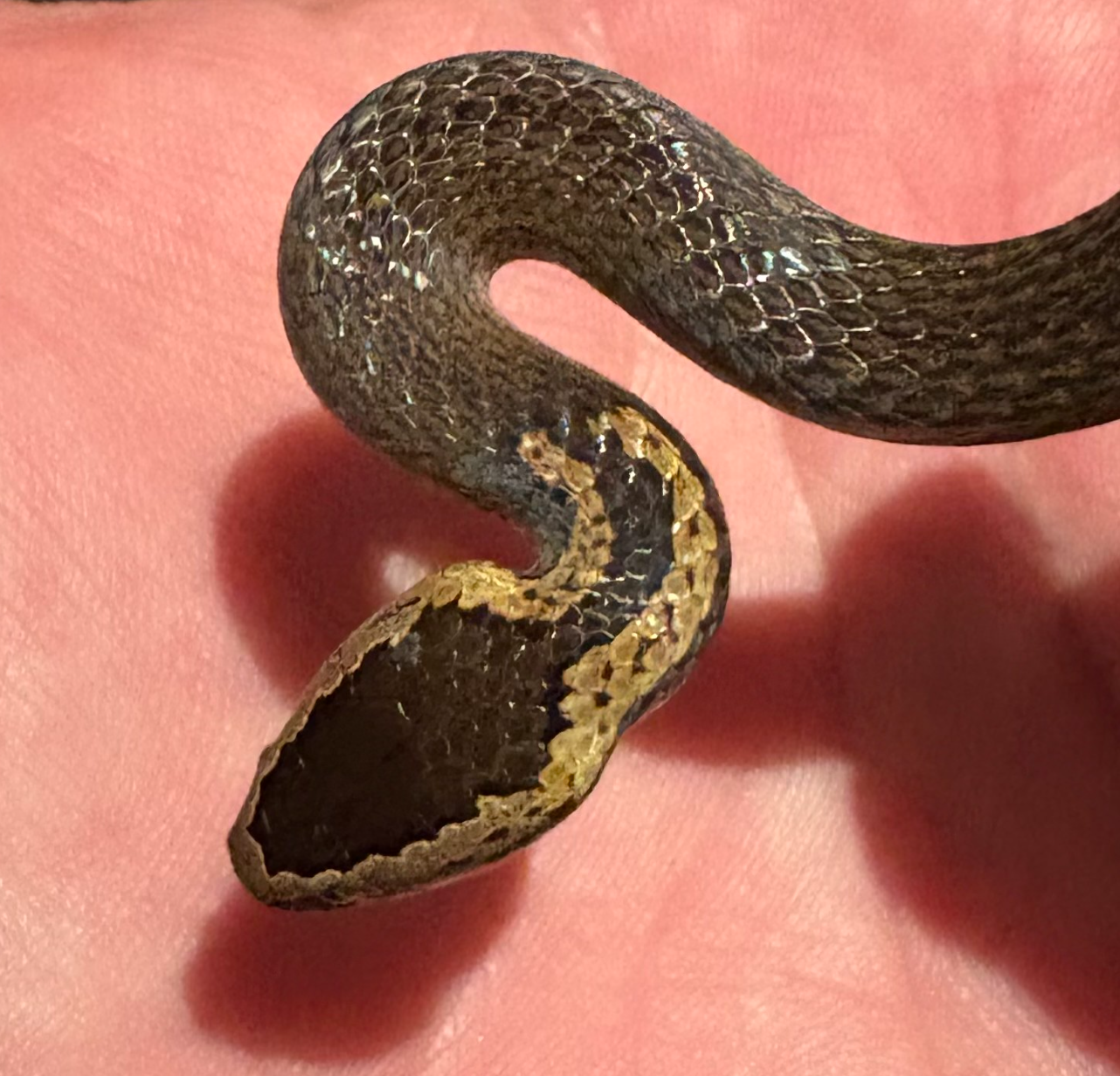
How to identify a Golden-crowned Snake
The Golden-crowned Snake has several distinctive features that, taken together, make identification reliable:
Small to medium-sized snake with a slender build
Smooth, glossy scales
Dorsal colour ranges from dark brown to dark grey
Yellowish or light tan band running from above each eye across the snout
Broader yellowish stripe across the nape of the neck — the "crown"
The crown markings do not form a complete collar — they remain as separate stripes
Distinctly angular head, broader than the neck
Strikingly reddish ventral surface, particularly toward the tail
Slim body shape with a moderate tail length
The combination of the angular head, the partial pale crown on the head and nape, and the reddish belly is unique to the species. The crown markings are particularly important — the pale stripes meet across the nape but do not form a complete ring, distinguishing this species from some superficially similar relatives.
How to tell a Golden-crowned Snake from similar species
The Golden-crowned Snake can be confused with a few species, but the differences are clear:
Dwarf Crowned Snake (Cacophis krefftii): Smaller overall, with a more complete and contrasting collar. Less common in suburban Sydney.
White-crowned Snake (Cacophis harriettae): Has a brighter, more contrasting white collar. Found mainly in northern NSW and Queensland.
Marsh Snake (Hemiaspis signata): Similar size, but has paired pale stripes running from the snout through the eye — no crown marking on the nape. Belly is dark, not reddish.
The reddish belly is one of the most useful confirmation features. Turn over a recently deceased specimen (or get a clear photograph of a live one in good light) and the reddish ventral surface confirms a Golden-crowned Snake.
Where do Golden-crowned Snakes live?
Golden-crowned Snakes have adapted remarkably well to urban environments — particularly the kinds of older, leafy suburbs that make up much of Sydney:
Natural habitats:
Dry sclerophyll forest
Wet sclerophyll forest
Riparian zones along creeks and gullies
Wet temperate forests
Open woodlands with good ground cover
Rocky outcrops and sandstone country
Urban habitats:
Established suburban gardens with mature trees and good ground cover
Mulch beds and compost heaps
Under garden debris and stacked timber
Suburban bushland reserves
Properties with sandstone retaining walls and rockeries
Damp garden corners with leaf litter
Drainage corridors through suburbs
They do particularly well in suburbs with mature gardens, dense ground cover and a healthy population of small reptile prey. The leafier parts of Sydney's North Shore, Inner West and Sutherland Shire are classic Golden-crowned Snake territory.
Behaviour and the famous head-raising display
Golden-crowned Snakes are nocturnal hunters with a quiet, deliberate temperament. They emerge at night to hunt across the suburban landscape, returning to cover by morning. The hunting pattern is most pronounced on warm, humid nights — particularly after rain when their prey is also active.
When threatened, they have a distinctive defensive display:
Raise the front portion of the body off the ground
Form a flat S-shape with the neck
Hold the head and front of the body almost vertical
Hiss
Sometimes deliver mock strikes with the mouth closed
The display is almost entirely bluff. Golden-crowned Snakes very rarely deliver real bites even when handled, and when they do, the small fangs and mild venom mean the effect is negligible. The display is intended to deter predators that have learned to respect larger, more dangerous snakes.
That said, the display can be alarming for homeowners who do not know what they are looking at. A small snake rearing up with its head off the ground looks more threatening than it is.
Diet and lifestyle
Golden-crowned Snakes are specialist hunters of small reptiles. Their diet is dominated by:
Small skinks (the main prey)
Skink eggs (a particular favourite)
Other small lizards
Frogs occasionally
Geckos
Very small snakes on rare occasions
The taste for skink eggs is one of the more interesting features of the species. They have specialised feeding behaviour that allows them to handle skink eggs effectively, and they will actively seek out skink nesting sites — including communal nest sites under rocks and in deep leaf litter.
This dietary specialisation is why they do so well in older suburban gardens. A garden supporting a healthy Eastern Water Skink, Bar-Sided Forest Skink or Garden Skink population is essentially providing a Golden-crowned Snake buffet — particularly during summer when skink eggs are being laid.
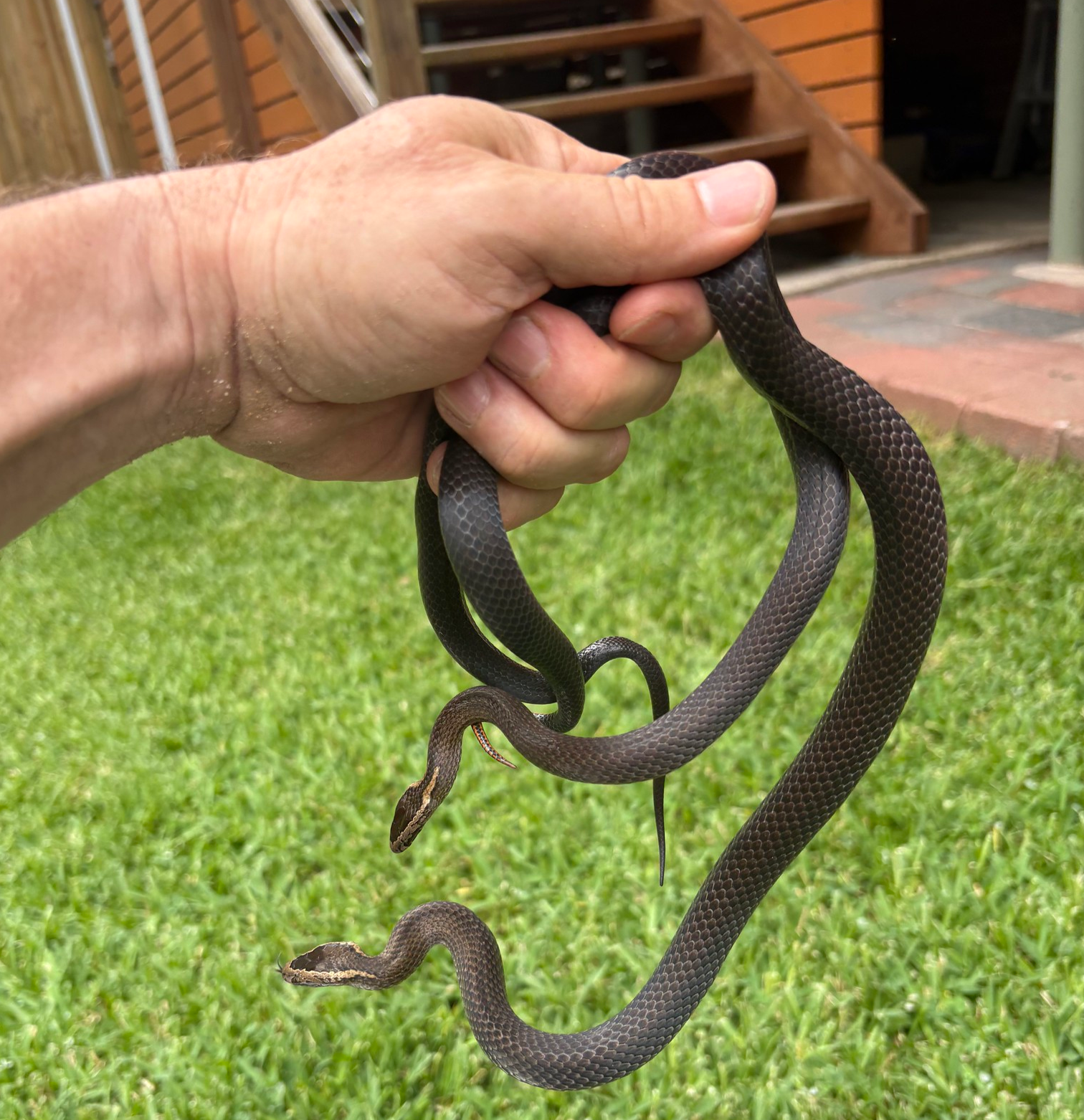
This breeding pair of Golden Crowned Snakes were located while mating under a roof tile in Normanhurst, NSW
Are Golden-crowned Snakes dangerous?
Golden-crowned Snakes are mildly venomous, but their venom is weak, their fangs are small (and rear-positioned), and their temperament is gentle. Bites to humans typically produce:
Localised pain at the bite site
Mild swelling and redness
Occasional itching or transient discomfort
No significant systemic effects in healthy adults
They are not considered dangerous to humans. There are no recorded human deaths from Golden-crowned Snake bites in Australia, and serious complications are extremely rare.
That said, all snake bites should be treated carefully:
Apply pressure immobilisation bandaging in case of misidentification
Seek medical attention
Do not attempt to identify or capture the snake responsible
Allow medical staff to assess the bite
The reason for caution is straightforward: a small dark snake in poor light at night is easy to misidentify. A bite presumed to be from a Golden-crowned Snake could turn out to be from an Eastern Small-eyed Snake (also small, dark and nocturnal) or even an unusually small Red-bellied Black. Medical assessment is always the right response.
The risk to pets is generally low. Dogs and cats bitten by Golden-crowned Snakes typically show only mild local symptoms, but veterinary attention is still warranted.
Breeding and reproduction
Golden-crowned Snakes have a reproductive cycle suited to the warm-temperate climate of the Sydney region:
Mating: Spring
Egg laying: January (mid summer)
Clutch size: Up to 15 eggs per female
Nest sites: Moist, sheltered locations — under rocks, in deep leaf litter, in soil cavities
Hatching: March (early autumn)
Hatchling size: Around 130-150mm at hatching
Hatchling independence: Fully independent at hatching
Hatchlings are tiny replicas of the adults, with the same partial crown pattern and reddish belly. They are easily mistaken for earthworms in poor light, and many are killed by gardeners who do not realise what they are looking at.
What to do if you find a Golden-crowned Snake at your home
If you are confident in the identification, the right response is to leave it alone. Golden-crowned Snakes are beneficial — they help control skink populations naturally and pose no genuine risk to humans.
If you are not confident in the identification, treat it as a potentially dangerous snake until proven otherwise:
Keep your distance — at least three metres
Photograph it from a safe distance using a phone with flash
Keep children, pets and family members clear of the area
Send the photo to a licensed reptile catcher for confirmation
If the snake is in a problem location (inside a building, garage or laundry), call Urban Reptile Removal for removal
What you should not do:
Do not approach a snake you cannot identify with certainty
Do not try to capture or kill it. Most snake bites in Australia happen to people attempting to interact with the snake
Do not assume a small dark snake is harmless without proper identification
Do not relocate it yourself. Golden-crowned Snakes are protected and have specific habitat needs
The driveway problem
One particular issue worth flagging is the driveway problem. Golden-crowned Snakes are frequently encountered crossing driveways and paths on warm humid nights, particularly after rain. They are small, dark, and move slowly — and they are easily killed by cars reversing out of garages at night.
If you have Golden-crowned Snakes around your property:
Be cautious on warm humid nights when reversing out of driveways
Use external lights and look down before walking out at night
Keep dogs on lead during their final evening walk on Golden-crowned Snake nights
Teach children to recognise the species and avoid handling
How to live alongside Golden-crowned Snakes
If you have Golden-crowned Snakes on your property and want to coexist successfully:
Maintain good ground cover — leaf litter, mulch, low shrubs
Keep some part of the garden untidy with logs, rocks and dense vegetation
Avoid pesticide use, which reduces their prey base and accumulates in the food chain
Encourage a healthy skink population — they need this prey base
Keep cats indoors at night, when Golden-crowned Snakes are active
Use a torch when walking around the garden at night
A garden with Golden-crowned Snakes is a garden with a healthy small-reptile population — itself a sign of good environmental health. The species' presence is generally a positive indicator, not a problem to be solved.
Summary
The Golden-crowned Snake (Cacophis squamulosus) is one of Sydney's most commonly encountered nocturnal snakes — small, dark, mildly venomous but not dangerous to humans, and well-adapted to the leafy suburban gardens that characterise so much of the city. With around 47 Golden-crowned Snake call-outs in 2025 alone, they sit comfortably among the species we work with most often, and they are one of the calmer and easier species to relocate when needed. If you find one in your garden, the right response is to identify it carefully, leave it alone if it is just passing through, and call a licensed reptile catcher if it is in a problem location. Their presence is a sign that your local environment is supporting a functioning native ecosystem.
Found a Golden-crowned Snake or another reptile at your home? Urban Reptile Removal operates 24/7 across the Greater Sydney region. We are fully licensed and insured, and we can identify and safely manage any reptile you encounter. Call 0418 633 474.
https://www.inaturalist.org/taxa/35046-Cacophis-squamulosus
https://bie.ala.org.au/search?sortField=score&dir=desc&q=Cacophis+squamulosus

Interested in Sydney Reptiles?
You can buy the book, featuring full page descriptions on over 70 species
https://sydneysnakecatcher.com.au/product/city-wildlife-guide-reptiles-of-sydney/

For the most up to date information on snakebite first aid, visit, snakebitefirstaid.com.au
