Marsh Snake
The Marsh Snake (Hemiaspis signata) — Sydney's Quiet Wetland Specialist
If you have spent any time around a creek, pond, swamp edge or damp suburban garden in the Sydney region, you may have crossed paths with a Marsh Snake (Hemiaspis signata) without even realising it. They are small, dark and often go unnoticed — slipping through wet leaf litter and pond margins in pursuit of frogs and tadpoles.
At Urban Reptile Removal we get occasional calls about Marsh Snakes, usually from homeowners with backyard ponds, water features or creek frontages. People are often unsure what they are looking at — the snake is too small to be a Red-bellied Black, too dark to be a Whip Snake, and the distinctive pale stripes on the head are the giveaway. The good news is they are mildly venomous and not considered dangerous to humans.
What is the Marsh Snake?
The Marsh Snake (Hemiaspis signata) is a small elapid native to eastern Australia, common in wet habitats from southern Queensland through New South Wales and into Victoria. Despite being a true elapid — related to brown snakes and tiger snakes — they are not considered medically significant in human envenomation terms.
Venom rating: Mildly venomous, normally causes only local symptoms in humans
Total length: Up to 700mm
Conservation status: IUCN Least Concern
Urban Adaptation Rating: ★★★★★
Activity: Diurnal, most active in spring and summer, particularly after rain
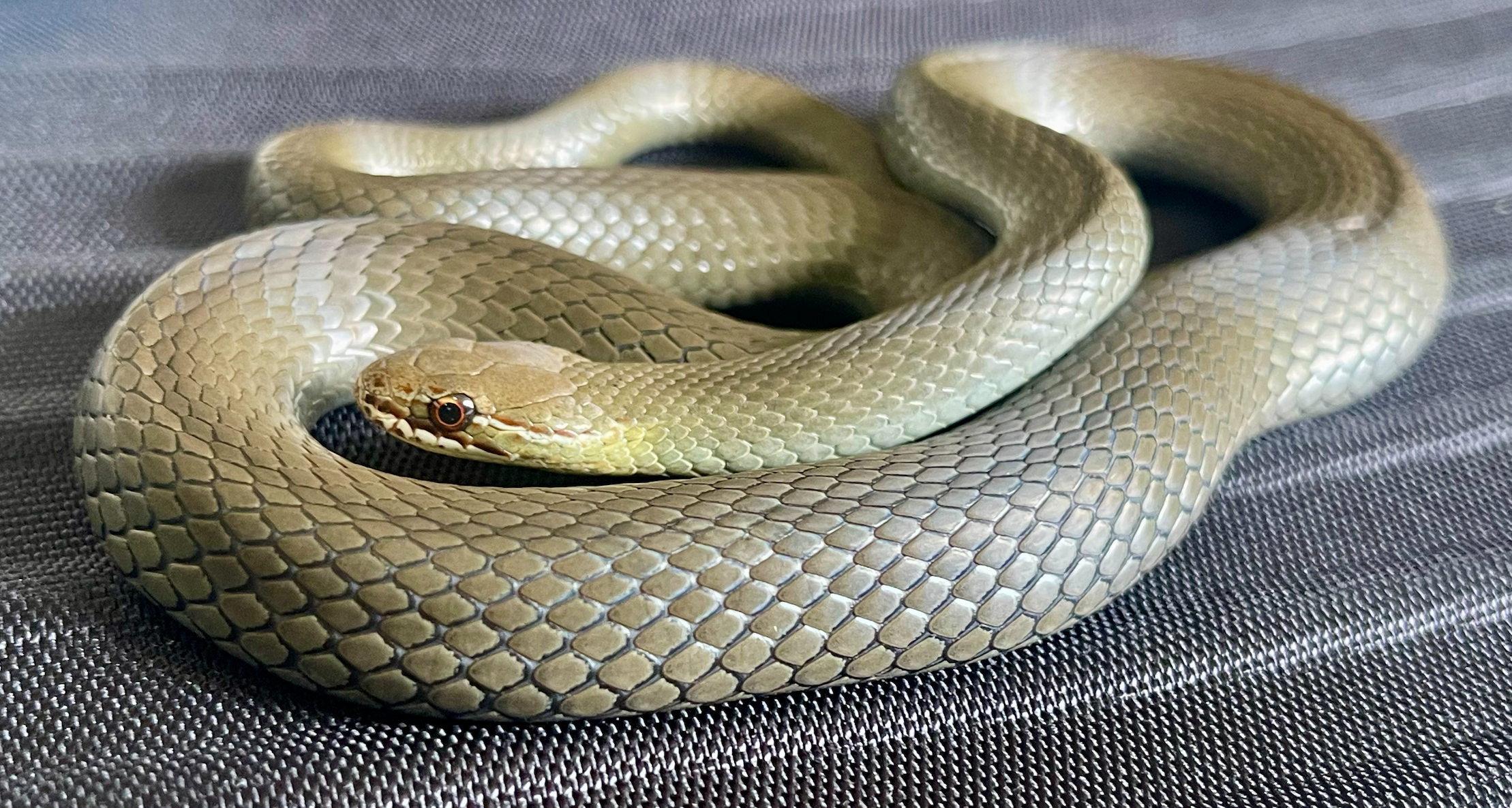
This attractive Marsh Snake was relocated for a laundry in Belrose, NSW.
How to identify a Marsh Snake
The Marsh Snake has several distinctive features that, taken together, make identification reliable:
Small to medium-sized snake with a slightly slender build
Dorsal colour varies from grey to dark brown or olive, sometimes with a reddish tinge
Ventral surface dark, often black or dark grey
Two distinct pale stripes on each side of the head:
One runs from the snout through the eye to the side of the neck
The other curves along the upper lip to the corner of the mouth
Head only slightly distinct from neck
Smooth scales with a slight gloss
Moderately built body without the heavy musculature of larger elapids
The paired head stripes are the diagnostic feature. No other Sydney snake has quite this pattern, and even on a dark-coloured Marsh Snake the pale stripes stand out clearly in good light.
How to tell a Marsh Snake from other Sydney snakes
The Marsh Snake can be confused with a few species, but the differences are clear:
Red-bellied Black Snake (Pseudechis porphyriacus): Much larger, glossy black above with a vivid red belly. No pale head stripes. Marsh Snakes have a dark belly, not red.
Eastern Small-eyed Snake (Cryptophis nigrescens): Uniformly glossy black with no facial markings, smaller eyes, and a pink to red belly with dark markings.
Mustard-bellied Snake (Drysdalia rhodogaster): Similar build, but the underside is mustard-yellow to orange, not dark. The head markings differ.
Common Bandy-bandy (Vermicella annulata): Distinctive black-and-white banding throughout the body — completely different.
The combination of dark colouration, paired pale head stripes and a dark belly is unique to the Marsh Snake among Sydney's smaller elapids.
Where do Marsh Snakes live?
The Marsh Snake is a wetland specialist, found in habitats where water and damp ground combine with good frog populations:
Natural habitats:
Swamps and marshes
Creek edges and pond margins
Wet sclerophyll forest
Floodplains and seasonally inundated areas
Damp gullies and rainforest margins
Riparian zones along rivers
Urban habitats:
Backyard ponds and water features
Suburban gardens with damp corners
Parks with creeks, lakes or wetlands
Properties bordering bushland with watercourses
Stormwater drainage corridors
Wet, mulched garden beds
They have a clear preference for damp environments. A garden with a pond, a thriving frog population and some dense ground cover is far more likely to support Marsh Snakes than a dry, manicured suburban block.
Behaviour and the rain link
Marsh Snakes are most often encountered after rainfall and during humid periods. Several factors drive this:
Frogs become highly active after rain, drawing snake predators
Damp conditions allow snakes to move further from cover without dehydrating
Marsh Snakes themselves are more comfortable in moist conditions than dry
Flooded burrows and refuges sometimes force snakes to the surface
When threatened, their typical responses are:
Flatten the body to look larger
Raise the head slightly
Strike defensively if cornered
Attempt to flee into water or dense cover
They are not aggressive snakes. The default behaviour when approached is to retreat into the nearest available cover — pond margins, leaf litter or a deep crack in the soil.
Diet and lifestyle
Marsh Snakes are specialist hunters of small wet-habitat prey. Their diet is dominated by:
Frogs (the main prey)
Tadpoles
Small skinks and other lizards
Very occasionally small fish
Their dietary specialisation is part of why they are tied so closely to wetland habitats. Where there are frogs, there are Marsh Snakes. Where there are no frogs, there are no Marsh Snakes — even if the habitat otherwise looks suitable.
Are Marsh Snakes dangerous?
Marsh Snakes are venomous, but their venom is mild and their fangs are small. Bites to humans typically produce:
Localised pain at the bite site
Mild swelling and redness
Occasionally itching or transient discomfort
No significant systemic effects in healthy adults
They are not considered dangerous to humans. There are no recorded human deaths from Marsh Snake bites in Australia.
That said, all snake bites should be treated carefully:
Apply pressure immobilisation bandaging in case of misidentification
Seek medical attention
Do not attempt to capture or identify the snake responsible
Allow medical staff to assess the bite
The reason for caution is simple: a small dark snake in poor light is easy to misidentify. A bite that the patient thinks came from a Marsh Snake may turn out to be from an Eastern Small-eyed Snake or even a juvenile Red-bellied Black. Treating all snake bites as potentially serious until medically assessed is the only safe approach.
The risk to pets is generally low. Dogs and cats bitten by Marsh Snakes usually show only mild local symptoms, but veterinary attention is still warranted if a bite is suspected.
Breeding and reproduction
The Marsh Snake has an unusual reproductive strategy among Sydney snakes — they are live-bearing rather than egg-laying:
Live-bearing: Females give birth to live young rather than laying eggs
Litter size: Up to 20 offspring per litter
Frequency: One litter per year
Timing: Late summer
Independence: Young are fully independent at birth
The live-bearing strategy is shared with several other Australian elapids and is thought to be an adaptation to cooler, wetter conditions. By carrying developing young internally, the female can thermoregulate them through her own basking behaviour — a significant advantage in the variable weather of southeastern Australia.
What to do if you find a Marsh Snake at your home
If you are confident in the identification, the right response is to leave it alone. Marsh Snakes are beneficial — they help control frog populations naturally and pose no genuine risk to humans.
If you are not confident in the identification, treat it as a potentially dangerous snake until proven otherwise:
Keep your distance — at least three metres
Photograph it from a safe distance
Keep children, pets and family members clear of the area
Send the photo to a licensed reptile catcher for confirmation
If the snake is in a problem location (inside a building, garage or pool area), call Urban Reptile Removal for removal
What you should not do:
Do not approach a snake you cannot identify with certainty.
Do not try to capture or kill it. Most snake bites in Australia happen to people attempting to interact with the snake.
Do not assume a small dark snake is harmless without proper identification.
Do not relocate it yourself. Marsh Snakes are protected and have specific habitat needs — a relocated animal often does not survive.
How to live alongside Marsh Snakes
If you have Marsh Snakes around your property and want to coexist successfully:
Maintain your pond or water feature but keep the immediate surrounds reasonably clear
Wear closed shoes when working in damp garden areas
Keep small dogs on lead in known Marsh Snake habitat
Use a torch when walking around the garden at night, particularly after rain
Teach children to avoid all snakes and report sightings rather than approach
Maintain a healthy frog population — Marsh Snakes are part of a functioning wetland food web
A garden with Marsh Snakes is a garden with healthy frogs, which is itself a sign of good environmental health. The species' presence is generally a positive indicator, not a problem to be solved.
Summary
The Marsh Snake (Hemiaspis signata) is a small, mildly venomous native snake that specialises in wet habitats and frog prey across the Sydney region. They are not considered dangerous to humans, and their distinctive paired pale head stripes make identification possible with a good photograph. If you have a pond, a creek or a damp garden corner with active frogs, you may well have Marsh Snakes — and that is a sign of a healthy local ecosystem, not a problem requiring intervention. If in doubt about identification, photograph from a safe distance and call a licensed reptile catcher.
Found a Marsh Snake or another reptile at your home? Urban Reptile Removal operates 24/7 across the Greater Sydney region. We are fully licensed and insured, and we can identify and safely manage any reptile you encounter. Call 0418 633 474.
https://www.inaturalist.org/taxa/35245-Hemiaspis-signata
https://bie.ala.org.au/search?sortField=score&dir=desc&q=Hemiaspis+signata

Interested in Sydney Reptiles?
You can buy the book, featuring full page descriptions on over 70 species
https://sydneysnakecatcher.com.au/product/city-wildlife-guide-reptiles-of-sydney/
For the most up to date information on snakebite first aid, visit, snakebitefirstaid.com.au
