
Yellow-faced Whip Snake
The Yellow-faced Whip Snake (Demansia psammophis) — Sydney's Speedy Daytime Hunter
If you have ever caught a glimpse of a long, slender, grey-blue snake streaking across an open patch of ground in the middle of the day and thought "Brown Snake!" — there is a reasonable chance you actually saw a Yellow-faced Whip Snake (Demansia psammophis). They are one of the most commonly misidentified snakes in the Sydney region, frequently mistaken for Eastern Brown Snakes because of their speed, alertness and habit of being out and about during the warmer parts of the day.
At Urban Reptile Removal we field a steady stream of calls about Yellow-faced Whip Snakes, particularly from properties near bushland edges in Sydney's western and outer suburbs. The good news is they are far less dangerous than the species they are often confused with — but they are still venomous, and proper identification matters.
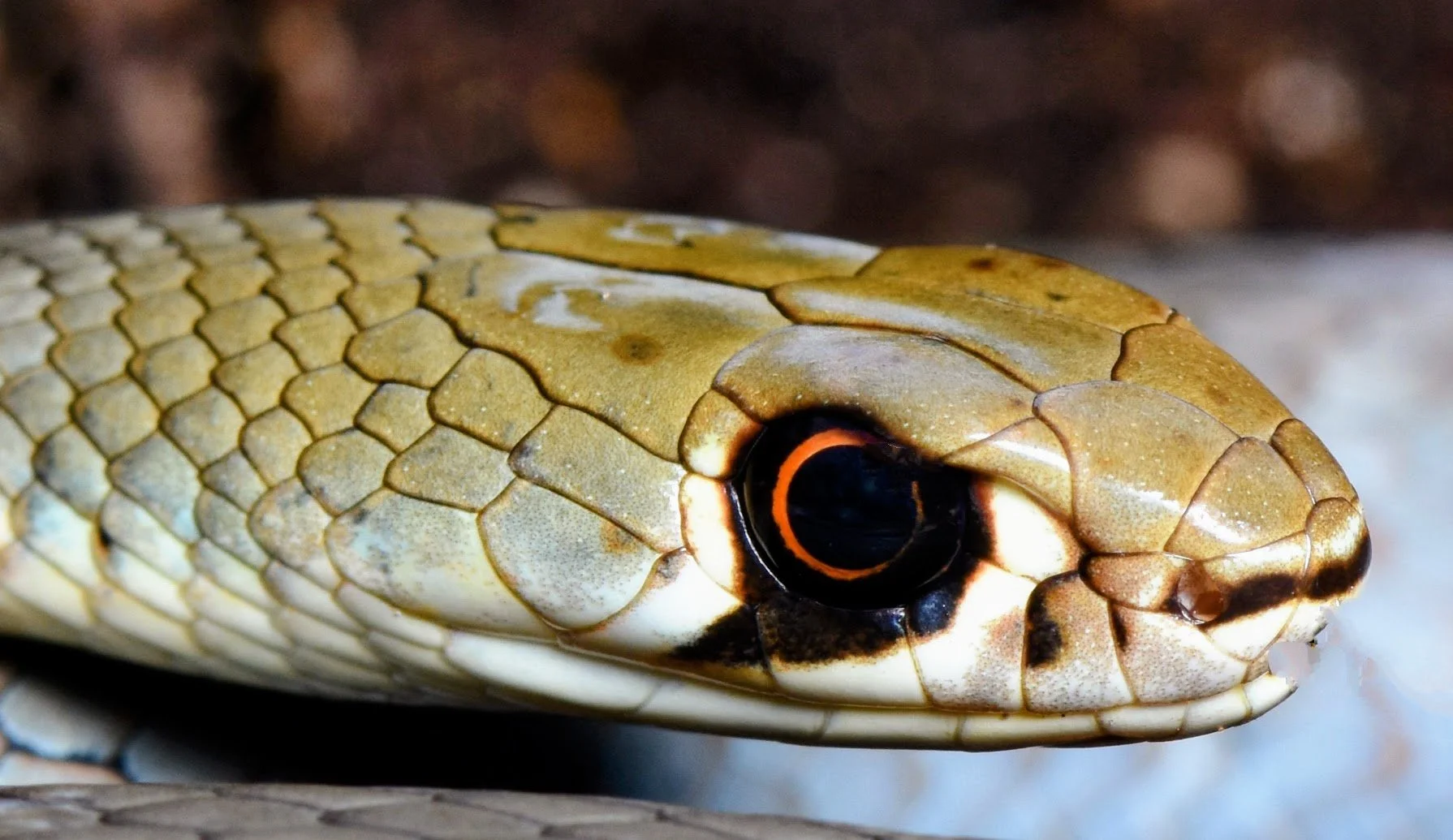
This distinct comma around the eye is the easiest way to identify a Yellow Faced whip Snake. This one was relocated from yard in Frenchs Forrest, NSW.
What is the Yellow-faced Whip Snake?
The Yellow-faced Whip Snake (Demansia psammophis) is a small to medium-sized elapid native to a vast portion of eastern and central Australia. Despite the "whip" name, they are not related to the legless whip snakes of other countries — they are true elapids, related to brown snakes, tiger snakes and other Australian venomous species. The "whip" name comes from their lightning-fast movement and slender, whip-like body shape.
Venom rating: Mildly venomous, normally causes only local symptoms in humans
Total length: Up to 1,000mm
Conservation status: IUCN Least Concern
Urban Adaptation Rating: ★★★★★
Activity: Diurnal, most active during warmer months
Distribution in Sydney: Zones 1, 4 and 5
How to identify a Yellow-faced Whip Snake
The Yellow-faced Whip Snake has several distinctive features that, taken together, make identification reliable once you know what to look for:
Slender, fast-moving snake with a long, whip-like profile
Pale grey, blue-grey or olive base colour
Two reddish stripes often running from behind the neck to about the front third of the body
Large brown margin around each eye
Bold pale edges in front of and behind the eye that sweep back toward the mouth, forming a distinctive comma-shape
Thin dark line running across the snout between the nostrils
Smaller and more delicate head than an Eastern Brown Snake
Large, prominent eyes with round pupils
Long, very slender body and tail
The comma-shaped pale marking around the eye is the most reliable identification feature. No other Sydney snake has quite this pattern. Combined with the dark line across the snout and the often-present reddish neck stripes, it makes the species relatively easy to identify from a clear photograph.
How to tell a Yellow-faced Whip Snake from an Eastern Brown Snake
This is the question that matters most. Eastern Brown Snakes are one of the most dangerous snakes in the world. Getting this identification right has real consequences.
Head markings: Yellow-faced Whip Snake has the distinctive comma-shaped pale eye markings and dark line across the snout. Eastern Brown Snake has a plain head with no facial markings.
Body colour: Yellow-faced Whip Snake is usually pale grey to blue-grey or olive. Eastern Brown Snake is brown or tan, often more uniform in colour.
Build: Yellow-faced Whip Snake is notably more slender and "whip-like." Eastern Brown Snake is heavier-bodied.
Eye size: Yellow-faced Whip Snake has proportionally larger, more prominent eyes.
Movement: Both species are fast, but the Yellow-faced Whip Snake's movement has a more darting, fluid quality. Eastern Browns tend to be more direct and powerful.
Defensive behaviour: Eastern Browns will often rear up and form an S-shape in defence. Yellow-faced Whip Snakes more commonly try to flee, though they will defend themselves if cornered.
If you are not absolutely certain, treat any unidentified snake as venomous and dangerous. Photograph it from a safe distance and send the image to a licensed reptile catcher for identification before approaching.
Where do Yellow-faced Whip Snakes live?
The Yellow-faced Whip Snake is a generalist that thrives in dry, open habitats with good visibility for hunting:
Natural habitats:
Coastal heath
Dry sclerophyll forest
Inland woodland
Open scrubland
Rocky hillsides
Grassy clearings within bushland
Areas with scattered logs, rocks and ground cover
Urban and semi-urban habitats:
Suburban gardens immediately adjacent to bushland
Rural and semi-rural properties
Properties bordering national parks and reserves
Vacant blocks with established ground cover
Sandstone outcrops and rock gardens
Bush-edge developments on Sydney's outer fringe
They are not really inner-city snakes. The species is most often encountered on the bush-edge fringes of Sydney — properties where the back fence ends and the bush begins.
Behaviour and the speed factor
The Yellow-faced Whip Snake is one of the fastest snakes in Australia. They are visually-oriented hunters with excellent eyesight, and they rely on sheer speed to catch fast-moving prey and to escape predators.
Their behaviour patterns include:
Active foraging during the warmer parts of the day
Basking on warm rocks, bitumen and sandy patches
Streaking across open ground between cover at high speed
Climbing low vegetation occasionally
Resting in shallow burrows, rock crevices and under cover during cool weather
When threatened, their primary response is to flee at speed. Cornered, they may:
Raise the head and front of the body
Strike repeatedly with mouth open
Hiss
Attempt to escape upward, over or through any available gap
They are far less likely to stand their ground than an Eastern Brown Snake, but they will defend themselves if no escape is available.
Diet and lifestyle
Yellow-faced Whip Snakes are specialist hunters of fast-moving lizards. Their diet is dominated by:
Small skinks (the bulk of the diet)
Other small lizards including dragons
Lizard eggs
Occasionally frogs
Very rarely small mammals
Their excellent eyesight, fast strike and slender build are all adaptations to this prey preference. They hunt by sight, chase down lizards with extraordinary speed, and use their mild venom to subdue prey quickly.
The dietary specialisation is part of why they are common in habitats with high skink populations — and part of why they often turn up in gardens with thriving Eastern Water Skink or Bar-Sided Forest Skink populations.
Are Yellow-faced Whip Snakes dangerous?
Yellow-faced Whip Snakes are venomous, but their venom is mild and their fangs are small. Bites to humans typically produce:
Localised pain at the bite site
Swelling and redness
Occasionally itching or mild bruising
No significant systemic effects in healthy adults
They are not considered dangerous to humans in the medical sense. There are no recorded human deaths from Yellow-faced Whip Snake bites in Australia, and serious complications are very rare.
That said, bites should still be treated carefully:
Apply pressure immobilisation bandaging in case of misidentification (the bite pattern can be similar to that of a Brown Snake)
Seek medical attention
Do not attempt to identify or capture the snake responsible
Allow medical staff to assess the bite properly
The reason for taking any snake bite seriously is straightforward: in the heat of the moment, people misidentify snakes. A bite that looks like a Yellow-faced Whip Snake bite may turn out to be from a juvenile Eastern Brown Snake. Treating all snake bites as potentially serious until medically assessed is the only safe approach.
The risk to pets is variable. Small dogs and cats bitten by Yellow-faced Whip Snakes usually develop local swelling and may need veterinary attention, but bites are rarely fatal.
Breeding and reproduction
Yellow-faced Whip Snakes have a reproductive cycle suited to the warm-temperate climate of the Sydney region:
Mating: Late winter and spring
Egg laying: Early summer
Clutch size: Up to 10 eggs per female
Communal nesting: Females share nest sites, with some used over multiple seasons
Spectacular records: One documented communal nest contained more than 500 eggs, accumulated over multiple seasons from many females
Nest sites: Moist, sheltered locations — under rocks, in soil cavities, in deep leaf litter
Hatching: Late February and March
Hatchling independence: Fully independent at hatching
The communal nesting habit is one of the more interesting features of the species. Like Green Tree Snakes, Yellow-faced Whip Snakes return to proven nest sites generation after generation, and a single good site can accumulate enormous numbers of eggs over time.
What to do if you find a Yellow-faced Whip Snake at your home
If you are confident in the identification, the right response is to leave it alone. Yellow-faced Whip Snakes are beneficial — they help control skink populations and are not dangerous to humans.
If you are not confident in the identification, treat it as a potentially dangerous snake until proven otherwise:
Keep your distance — at least three metres
Photograph it from a safe distance
Keep children, pets and family members clear of the area
Send the photo to a licensed reptile catcher for confirmation
If the snake is in a problem location (inside a building, in an aviary, in a garage), call Urban Reptile Removal for removal
What you should not do:
Do not approach a snake you cannot identify with certainty. Even a small Eastern Brown Snake can deliver a fatal bite.
Do not try to capture or kill it. Most snake bites in Australia happen to people attempting to interact with the snake.
Do not assume it is "just a whip snake" without proper identification.
How to reduce encounters
If you live on a bush-edge property and want to reduce the chances of Yellow-faced Whip Snake encounters around the house:
Keep grass short within a few metres of the house
Remove rock piles and clutter from immediately around buildings
Address skink populations by reducing dense ground cover near the house (though this will also reduce the beneficial skinks)
Seal gaps in foundations, brickwork and around pipework
Keep firewood piles well away from the house
The trade-off is that the same garden features that support whip snakes also support a rich native ecosystem. Many bush-edge homeowners decide that having a few whip snakes around is a fair price for the broader wildlife their property supports.
Summary
The Yellow-faced Whip Snake (Demansia psammophis) is one of the most commonly misidentified snakes in the Sydney region — fast, slender and often mistaken for an Eastern Brown Snake. They are mildly venomous but not dangerous to humans, and they play a useful ecological role by controlling skink populations. The distinctive comma-shaped pale eye markings, combined with the slim build and grey-blue colouring, make identification possible once you know what to look for. If in doubt, photograph from a safe distance and call a licensed reptile catcher — getting the identification right is more important than guessing.
Found a Yellow-faced Whip Snake or another reptile at your home? Urban Reptile Removal operates 24/7 across the Greater Sydney region. We are fully licensed and insured, and we can identify and safely manage any reptile you encounter. Call 0418 633 474.
https://www.inaturalist.org/taxa/35046-Cacophis-squamulosus
https://bie.ala.org.au/search?sortField=score&dir=desc&q=Demansia+psammophis

Interested in Sydney Reptiles?
You can buy the book, featuring full page descriptions on over 70 species
https://sydneysnakecatcher.com.au/product/city-wildlife-guide-reptiles-of-sydney/

For the most up to date information on snakebite first aid, visit, snakebitefirstaid.com.au
