Snake Catcher Bungarribee
Snake in Bungarribee? Call 0418 633 474. If you've spotted a snake around your home in Bungarribee, call Urban Reptile Removal on 0418 633 474. Until we arrive, the most useful thing you can do is keep watching the snake. Stay well back and don't try to catch it, move it or get close enough for a photograph. Just keep track of where it goes. If it disappears beneath a fence, into landscaping or behind something stored against the house, watch that spot. A snake that's been watched is much easier for us to locate than one that disappeared somewhere in the yard 20 minutes before we arrived.
Bungarribee was built in snake habitat
Bungarribee is different from many of the older Sydney suburbs we service. It's a relatively new residential suburb developed within a landscape that previously provided habitat for snakes and other native wildlife. It also sits alongside significant open space associated with the Western Sydney Parklands. So when a snake turns up in a Bungarribee backyard, it's worth looking at the situation from the animal's perspective.
The snakes haven't suddenly encroached on our homes. We've built our homes within theirs.
Roads, houses, fences and landscaped gardens have changed the environment enormously, but snakes that have occupied the broader Western Sydney landscape for generations haven't simply disappeared. Remaining grassland, parkland, drainage corridors and undeveloped areas allow wildlife to continue moving through the district. Occasionally those movements now take snakes through residential streets and backyards. That's simply part of living in a newly developed suburb on the edge of substantial remaining habitat.
What snakes do we find around Bungarribee?
The reptiles we encounter around Bungarribee reflect its Western Sydney location and the habitat that existed before residential development. The important species include Red-bellied Black Snakes, Eastern Brown Snakes, Diamond Pythons, Golden-crowned Snakes and Lace Monitors. The first two deserve particular attention because both are venomous and occur across Western Sydney.
Red-bellied Black Snakes are one of the snakes we regularly deal with across the Blacktown area. They're strongly associated with water and particularly with frogs. Drainage corridors, wetlands, detention basins and low-lying areas can all provide suitable feeding habitat. A Red-bellied Black Snake may travel through several properties while moving between these areas. They're venomous, but they're generally shy snakes. Given room, a red-belly will normally attempt to move away rather than confront a person. Problems arise when people try to catch, corner or kill them, or when dogs investigate too closely. If you've got a Red-bellied Black Snake around the house, keep your distance, maintain visual contact and call Urban Reptile Removal on 0418 633 474.
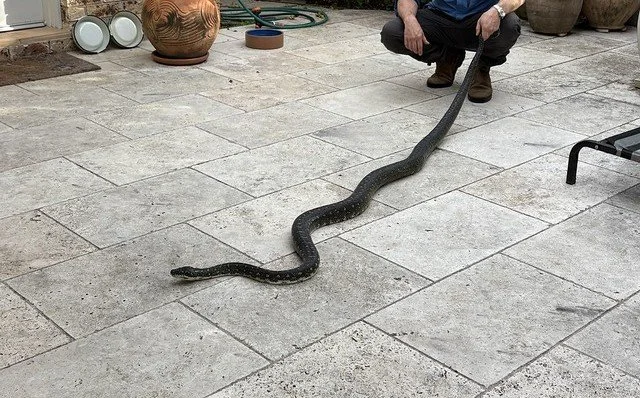
Diamond Pythons are large, non-venomous snakes and occasionally occur across the wider district. They feed predominantly on warm-blooded prey such as rats and mice. That becomes relevant in residential areas because rodents adapt extremely well to human environments. Garages, sheds, rubbish areas and roof spaces can provide food and shelter for rats and mice — and where prey exists, predators sometimes follow. Diamond Pythons are excellent climbers and pose little threat to people. If one is simply moving through an open area, it can usually be left alone. If it's entered a building or become trapped somewhere, relocation may be appropriate.
Eastern Brown Snakes are particularly relevant to Bungarribee. Western Sydney's historically open, grassy country provides excellent habitat for brown snakes. They're also well adapted to modified environments where rats and mice are available. Development doesn't necessarily eliminate that habitat overnight. Vacant blocks, construction areas, grassland remnants, drainage corridors and parkland can continue supporting both snakes and their prey while residential development expands around them. Eastern Brown Snakes are highly venomous and should always be treated seriously. Their colour is extremely variable, so trying to identify one purely because it's “brown” isn't particularly useful. Brown snakes can range from pale tan through various shades of brown to very dark animals. If you see a suspected Eastern Brown Snake, don't approach it. Keep everyone away, watch where it goes from a safe distance and call Urban Reptile Removal on 0418 633 474.
Golden-crowned Snakes are much smaller and more secretive. They're primarily nocturnal and spend much of the daytime hidden beneath rocks, timber, garden materials and other ground cover. Even a relatively new garden can develop suitable habitat once vegetation, mulch, retaining walls and landscaping become established. Golden-crowned Snakes are venomous but aren't considered dangerous to humans. If you uncover one while gardening, don't pick it up. Put down whatever you've moved and give the snake an opportunity to leave.
Lace Monitors, or goannas, aren't snakes, but they're another native reptile that can occur around the wider Bungarribee area. They're large animals, and an adult suddenly appearing in a suburban backyard can understandably get someone's attention. Despite their size, a Lace Monitor passing through an open area generally doesn't need to be removed. Give it room. We usually only need to become involved when an animal has entered a confined space, become trapped or created another situation that can't simply resolve itself.
What happens to snakes when suburbs are developed?
This is worth understanding in a place like Bungarribee. When native or semi-natural habitat becomes residential development, the wildlife doesn't all disappear on the day construction begins. Some animals move elsewhere. Some die. Others survive in remaining patches of habitat and adapt to the changed environment. Snakes can continue using creek lines, drainage reserves, parklands, roadside vegetation and undeveloped blocks as movement corridors. Then we build fences across those routes. We build houses. We put roads through them. We create gardens and retaining walls. From our perspective, a snake has suddenly appeared in someone's backyard. From the snake's perspective, it may simply be trying to move through a landscape its species occupied long before the suburb existed. That doesn't mean you should accept a venomous snake beside the back door. Snake removal in Bungarribee is entirely reasonable when an animal creates a genuine safety problem. But understanding why the snake is there gives the situation some perspective.
New houses aren't automatically snake-proof
Modern houses generally have fewer obvious entry points than many older Sydney homes, but that doesn't make the surrounding property snake-proof. Look particularly at:
gaps underneath boundary fences

retaining walls
drainage areas
pool equipment
garden sheds
materials stored against fences or buildings
dense ground-level landscaping
garages where rodents may be active
Snakes don't require much space to shelter or move through a property. A backyard can also simply be a route between two areas of better habitat.
Does every snake need to be removed?
No. If a snake is moving through an open area away from people, the best solution may simply be to let it continue. The situation changes when you've got a venomous snake beside the house, an animal inside a building, a snake that's trapped or one remaining in an area your family needs to use. That's when professional snake removal in Bungarribee makes sense. Our aim isn't to remove every reptile that appears in the suburb. It's to deal safely with situations where people and wildlife are now occupying the same space.
About Chris Williams
Chris Williams founded Urban Reptile Removal after more than three decades working professionally with Australian reptiles. His career has included working with reptiles at Taronga Zoo and the Australian Reptile Park, and he later founded Snake Ranch, which grew to become Australia's largest reptile breeding facility. Chris has written or co-authored eight books on Australian reptiles and amphibians, including Urban Reptiles and Reptiles of the Greater Sydney Region. He has served as President of the Australian Herpetological Society since 2014 and now works full-time catching and relocating snakes and other reptiles throughout Greater Sydney. Urban Reptile Removal — 0418 633 474
What can you do around your property?
You don't need to strip the garden bare. Concentrate on reducing unnecessary hiding places immediately around the house. Keep clutter off the ground. Store building materials properly. Control rats and mice. Don't leave pet food outside overnight. Keep vegetation manageable around doors, paths and areas that are regularly used. And don't waste money on commercial snake repellents. We don't recommend ultrasonic devices, powders or sprays. They don't provide a reliable barrier between your property and the surrounding environment. Good property management is far more useful.
Need a Snake Catcher in Bungarribee?
If you've found a snake somewhere that genuinely requires removal, don't chase it and don't try to catch or kill it yourself. Stay a safe distance away and maintain visual contact. Then call: Urban Reptile Removal — 0418 633 474 Professional snake catching and snake removal in Bungarribee, seven days a week.