
The Lace Monitor
The Lace Monitor (Varanus varius) — Sydney's Largest Goanna
There is no mistaking a Lace Monitor (Varanus varius) when one strolls into view. At well over two metres in total length, with powerful limbs, formidable claws and a flickering blue forked tongue, the Lace Monitor is the largest reptile most Sydneysiders will encounter in the wild. They are one of Australia's two largest native lizards, and they are still relatively common across the bush-edge fringes of the Greater Sydney region.
At Urban Reptile Removal we get fewer Lace Monitor calls than we used to — habitat loss has reduced their numbers in the more urbanised parts of the city — but they still turn up regularly in semi-rural Sydney, particularly around bushland reserves, picnic areas and properties bordering national parks. When they do appear in a backyard, the reaction from homeowners is usually a combination of awe and mild panic. Both are reasonable. Because we cover all native reptiles, not just snakes, monitor removal is part of what we do.
What is the Lace Monitor?
The Lace Monitor (Varanus varius) is a large native goanna (monitor lizard) found across eastern Australia. They are second only to the Perentie (Varanus giganteus) in size among Australian monitors and are by far the largest lizard you are likely to see in the Sydney region.
Snout-vent length: up to 800mm
Total length: up to 2,100mm (over two metres)
Conservation status: IUCN Least Concern
Urban Adaptation Rating: ★★★★★
Activity: Diurnal, most active from spring to early autumn
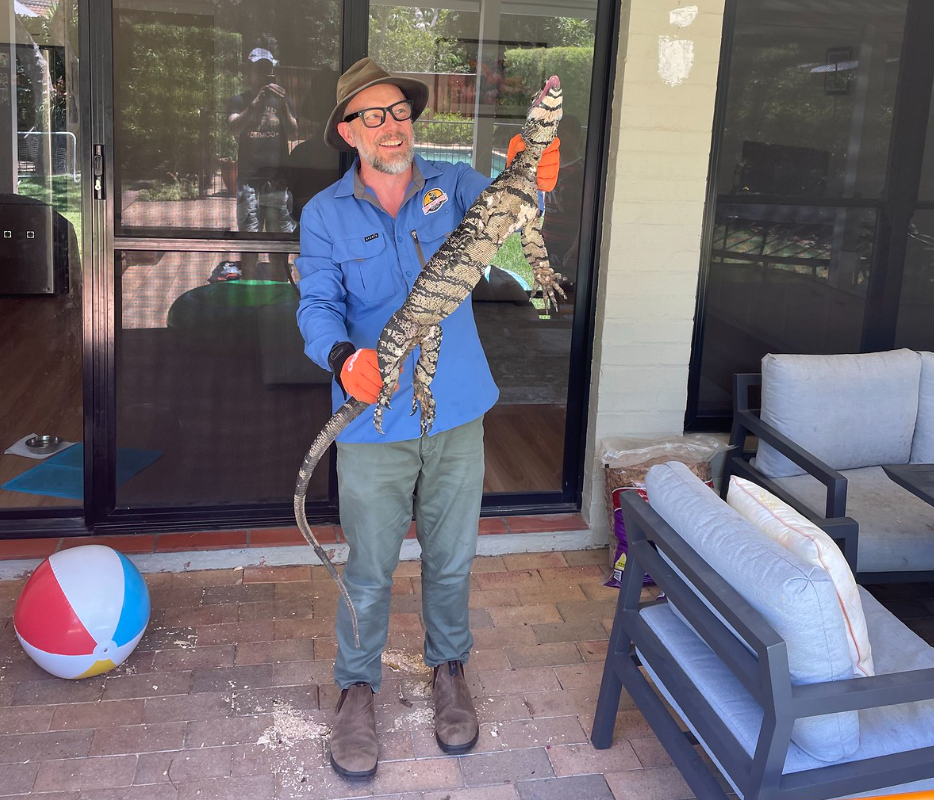
This Lace Monitor was relocate from a backyard in St Ives, NSW. In the 2025/26 season we relocated 8 from St Ives alone.
How to identify a Lace Monitor
The combination of size and pattern makes Lace Monitors unmistakable in the Sydney region:
Very large lizard with a strong, heavy build
Long, powerful limbs with sharp, curved claws built for climbing
Long, laterally compressed tail — more than half the total length
Two main colour forms occur, with intermediates:
Lace form: Black or dark grey with cream or yellow spots and reticulations
Bell's form: Bold black and cream banding, with tail bands becoming broader toward the tip
Dark stripe running from the snout through the eye, bordered above and below by pale yellow
Long, slender, deeply forked blue tongue
Powerful, slightly flattened head
The lateral compression of the tail is striking once you see it. Where most lizards have round tails, a Lace Monitor's tail is flattened side-to-side, almost blade-like — useful for swimming and as a defensive weapon.
Where do Lace Monitors live?
Lace Monitors occupy a wide range of habitats, but they need space and structure to thrive:
Natural habitats:
Open forests and woodlands
Dry sclerophyll forest with mature trees
Coastal heath and scrubland
Rocky outcrops and sandstone country
Riparian zones near creeks and rivers
Urban and semi-urban habitats:
Bushland reserves and national park edges
Properties bordering bush
Picnic areas and campgrounds — they have learned where the easy food is
Walking trails through bushland
Semi-rural properties on Sydney's western and northern fringes
Golf courses near bush
Royal National Park, Ku-ring-gai Chase National Park and Garigal National Park populations
They are not really inner-city animals. The presence of Lace Monitors is a good indicator that a property still has access to a meaningful patch of bush.
Behaviour and the climbing escape
Lace Monitors are confident, intelligent reptiles. They are scavengers and active predators, and they have learned over generations how to take advantage of human activity — particularly around picnic areas, campgrounds and rural properties where food scraps and unsecured bins offer easy meals.
When threatened, a Lace Monitor's first response is usually to head for the nearest tree. They are exceptional climbers, using those powerful limbs and sharp claws to ascend even smooth-barked trunks at impressive speed. Once up a tree, they will often stay still on the opposite side of the trunk from the perceived threat, watching with one eye and ready to move higher if needed.
If they cannot reach a tree, they may bluff:
Stand high on all four legs
Inflate the throat
Hiss loudly
Lash the tail
Open the mouth in a threat display
These displays are almost always bluff. A Lace Monitor will run or climb long before it will fight. The exception is if cornered — then the claws, the bite and the tail can all do real damage.
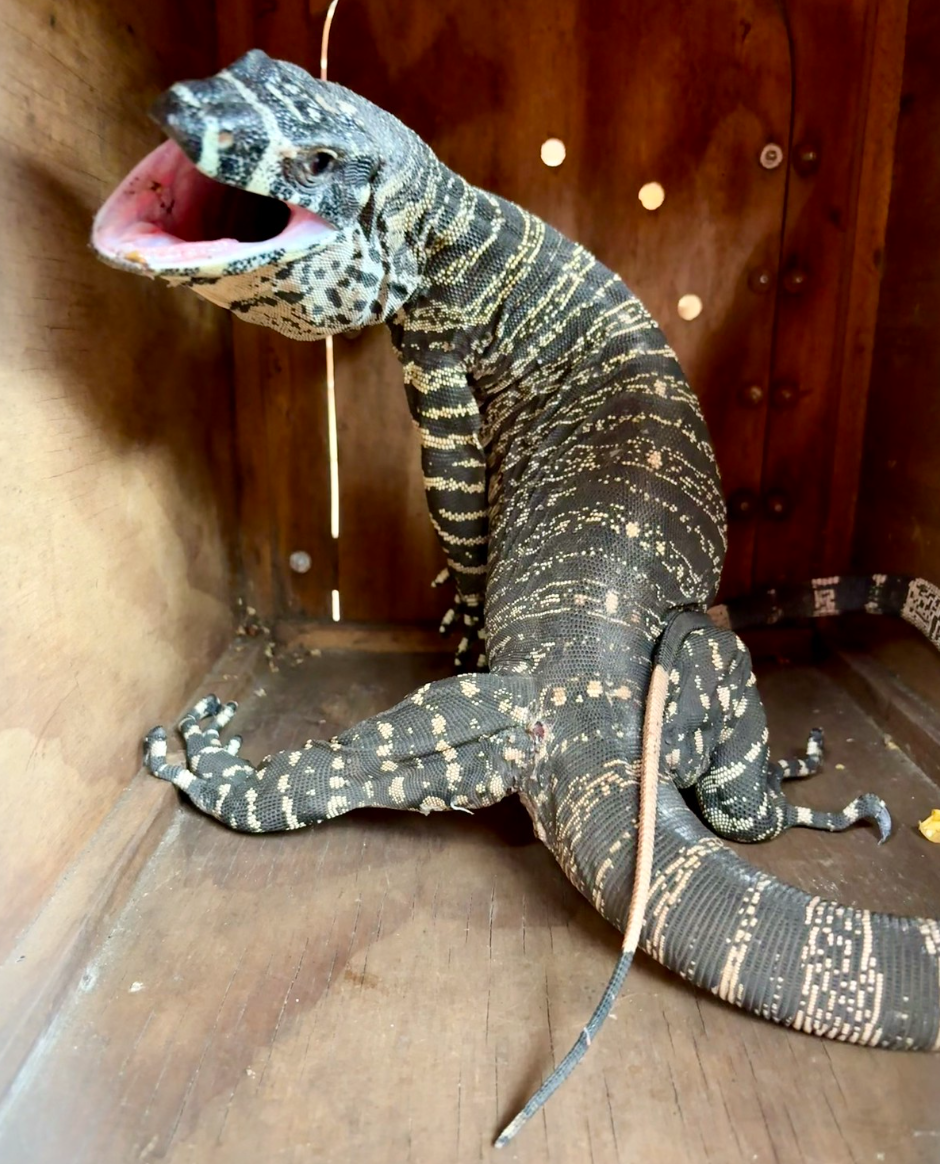
This Lace Monitor was found in a roof cavity in Dural, NSW.
Diet and lifestyle
Lace Monitors are opportunistic omnivores with a particular taste for protein:
Insects and other invertebrates
Birds and bird eggs (they are notorious nest raiders)
Mammals up to rabbit size, both as prey and carrion
Reptiles, including smaller monitors and snakes
Frogs
Carrion of all kinds, including road-killed wildlife
Eggs of other reptiles
Food scraps and unsecured rubbish in human-modified areas
Their willingness to scavenge is what makes them such a common sight at picnic areas. A Lace Monitor that has learned campers leave food unattended will visit the same site repeatedly, year after year. Some individuals at well-known camping spots are genuinely tame around people, though this is not a relationship anyone should encourage.
Are Lace Monitors dangerous?
Mostly no — but with significant caveats. Lace Monitors are not venomous in the way snakes are, but they do produce mild oral venom (a feature of many monitor species, only recently discovered). The bite itself can be quite serious due to the sheer size of the animal, the strength of the jaws, and the bacterial load in the mouth — bites can cause infection.
In practice, bites are extremely rare. Lace Monitors only bite when handled, cornered or threatened directly. They have no interest in biting people who give them space.
The bigger risks are:
Claws: Long, sharp and capable of inflicting deep scratches if the animal climbs you mistaking you for a tree. This has happened to people who got too close at picnic areas.
Tail: A two-metre Lace Monitor swinging its tail in defence can break skin and bruise badly.
Dogs: Cornered Lace Monitors can injure dogs significantly. Most encounters between dogs and Lace Monitors end with the dog losing.
The straightforward rule: give them space, do not feed them, do not corner them. They are not aggressive to people who behave sensibly.
Breeding and reproduction
Lace Monitors have one of the most unusual breeding strategies in the Australian reptile fauna:
Mating: Spring, with male combat that can be remarkably violent — males stand on hind legs and wrestle
Nest site: Active termite mounds — they dig into the mound and lay eggs inside
Clutch size: Typically 10 to 12 eggs
Incubation environment: Termites repair the mound and reseal it, creating a perfectly temperature- and humidity-controlled nest chamber
Incubation period: Eggs incubate over the warmer months
Hatching: Late summer or early autumn
Emergence: Hatchlings remain in the mound for weeks or months, sometimes overwintering before digging out
Maternal return: Females are believed to return to help the hatchlings emerge — one of the few known cases of parental care in reptiles
The termite mound nesting strategy is brilliant. The termites maintain stable temperature and humidity, defend the mound against predators that would otherwise find the eggs, and the chamber is essentially burglar-proof. The cost is that Lace Monitors need a landscape with active termite mounds large enough to accommodate a clutch — yet another reason their distribution is tied to bushland.
What to do if you find a Lace Monitor at your home
If you have a Lace Monitor visiting your property, you live somewhere with genuine bush access — and that is generally a privilege rather than a problem.
Practical steps:
Keep your distance. A Lace Monitor walking through your garden is just passing through.
Bring small pets and food bowls inside. Lace Monitors will take dog food, cat food, chicken pellets and any other easy protein source.
Secure rubbish bins. An unsecured bin is an open invitation.
Keep chicken coops well sealed. Lace Monitors will take eggs and even adult chickens.
Do not feed them. A Lace Monitor that learns to associate humans with food is a problem in waiting — both for the lizard and for the next homeowner.
If one climbs a tree on your property, leave it alone. It will come down in its own time.
What you should not do:
Do not kill them. They are protected native wildlife.
Do not attempt to capture or handle them. They are large, strong, fast, and they have claws and a powerful bite.
Do not feed them. This is the single most important rule.
Do not let dogs harass them. The dog will lose, and the monitor may be injured in the process.
If a Lace Monitor is in a genuinely problematic location — inside an enclosed space, trapped in a garage, or persistently raiding livestock — call Urban Reptile Removal. We are licensed to handle monitors and can relocate them safely.
Summary
The Lace Monitor (Varanus varius) is Sydney's largest lizard and one of the most impressive reptiles in the region. They are still common across Zones 1 to 4, particularly in areas bordering bushland and national parks. They are intelligent scavengers and predators, generally peaceful around humans who give them space, and an important part of the ecology of Sydney's bushland fringe. The proper response to finding one in your yard is to enjoy the sight, take a photo from a respectful distance, and let the animal go on its way.
Found a reptile you need identified or removed in Sydney? Urban Reptile Removal operates 24/7 across the Greater Sydney region. We are fully licensed and insured, and we can identify and safely manage any reptile you encounter. Call0418 633 474.
https://www.inaturalist.org/taxa/39469-Varanus-varius
https://bie.ala.org.au/search?sortField=score&dir=desc&q=Varanus+varius

Interested in Sydney Reptiles?
You can buy the book, featuring full page descriptions on over 70 species
https://sydneysnakecatcher.com.au/product/city-wildlife-guide-reptiles-of-sydney/
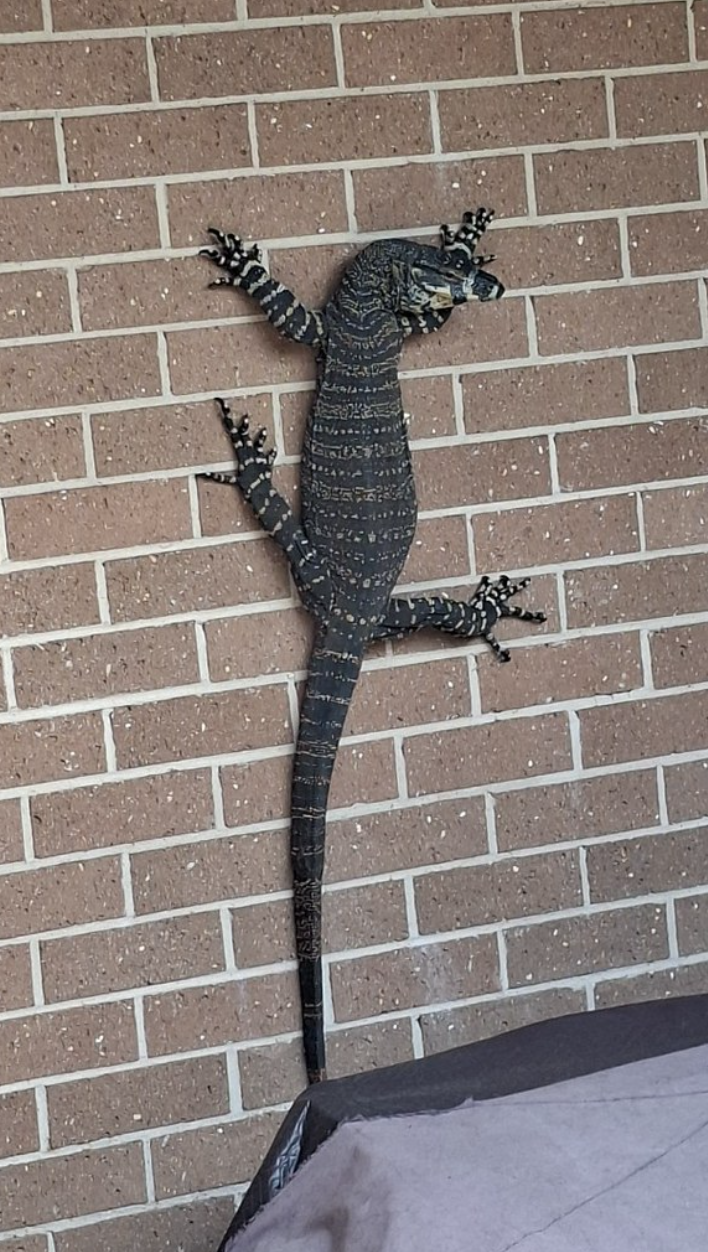
We still don’t know how this lizard ended up in a backyard in Birrong, NSW.
Saurophobia is the fear of lizards, and we can assure you — it’s very real.
Catching snakes seemed like the obvious direction for a business like Urban Reptile Removal. But over time, we began receiving a steady stream of calls from people needing help with lizards as well — everything from tiny skinks through to large goannas.
That led us to establish a second business focused specifically on lizard removals, making it much easier for people searching for this service to find the help they needed.

For the most up to date information on snakebite first aid, visit, snakebitefirstaid.com.au
