Blackish Blind Snake
The Blackish Blind Snake (Anilios nigrescens) — Sydney's Underground Resident
If you have ever turned over a paving slab, dug into a compost heap, or stepped onto your patio after a heavy summer downpour and seen what looked like a large, glossy purple-black earthworm sliding across the concrete — you have probably found a Blackish Blind Snake (Anilios nigrescens). They are one of Sydney's most common but least seen reptiles, spending almost all of their lives underground and only emerging when rain or disturbance forces them to the surface.
At Urban Reptile Removal we get a steady stream of calls about blind snakes, particularly after summer storms. People are often genuinely uncertain whether they are looking at a worm, a snake or something in between. The good news is that whatever they are looking at, the animal is completely harmless.
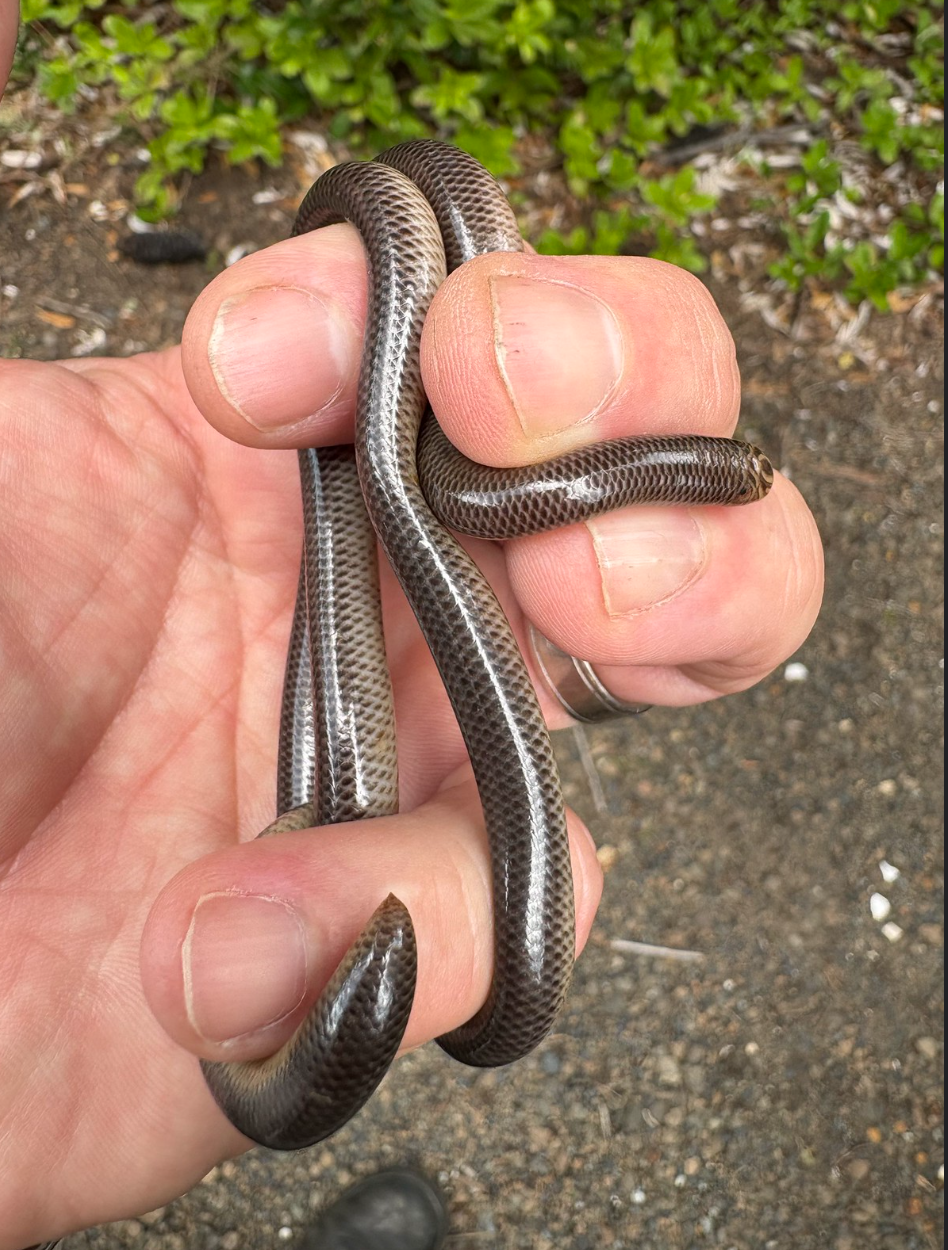
This Blind Snake was found in a pool filter box in Manly, NSW.
What is the Blackish Blind Snake?
The Blackish Blind Snake (Anilios nigrescens) is one of about 40 species of Australian blind snakes — a family of small, worm-like, burrowing snakes that look almost nothing like their venomous cousins. Despite the name, they are true snakes, fully evolved members of the snake suborder Serpentes, just adapted for an entirely subterranean lifestyle.
Venom rating: Non-venomous, completely harmless to humans
Total length: Up to 750mm
Conservation status: IUCN Least Concern
Urban Adaptation Rating: ★★★★★
Activity: Mostly nocturnal and subterranean, surface activity peaks in summer after rain
Distribution in Sydney: All five zones — Sydney Basin, Illawarra, Southern Highlands, Blue Mountains and Central Coast
How to identify a Blackish Blind Snake
The Blackish Blind Snake has a very distinctive look once you know what to look for:
Small, worm-like snake with a cylindrical body
Smooth, glossy scales — the body looks almost polished
Colour ranges from dark brown to nearly black
Often a noticeable purple sheen in good light
Blunt head that merges seamlessly with the neck — no distinct neck constriction
Sharp point on the tail tip
Tiny vestigial eyes that appear as dark specks beneath the skin
Mouth set far back on the underside of the rounded snout, making it almost invisible
May have a small dark mark near the vent
Males are noticeably smaller than females
The lack of a visible neck, the polished appearance, the tail spike and the barely visible eyes are the key features. These features separate blind snakes from earthworms (which have segmented bodies and no tail spike) and from juvenile elapid snakes (which have proper eyes, visible mouths and distinct heads).
How to tell a Blind Snake from a worm
This is the most common question. The differences:
Body texture: Blind snake has smooth, dry, glossy scales. Earthworm has a wet, segmented body that looks like a series of rings.
Head: Blind snake has a clear (if blunt) head with eye spots and a hidden mouth. Earthworm has no head, no eyes and no mouth visible on the outside.
Tail: Blind snake has a small spike at the tail tip. Earthworm has a similar-looking tapered end with no spike.
Movement: Blind snake moves with the smooth side-to-side undulation of a snake. Earthworm moves by extending and contracting body segments.
Length: A 750mm blind snake is much longer than any earthworm you are likely to see in a Sydney garden.
How to tell a Blind Snake from a venomous snake
This is the question that matters more. The differences from a small juvenile elapid:
Eyes: Blind snakes have tiny vestigial eyes that look like dark specks under the skin. Venomous snakes have proper visible eyes with pupils.
Head shape: Blind snake's head merges with the neck without a defined boundary. Venomous snakes have a distinctly separate head and neck.
Mouth: Blind snake's mouth is set so far back on the underside of the snout that it is essentially invisible from above. Venomous snake's mouth is clearly defined.
Body shape: Blind snake is uniformly cylindrical with no narrowing. Venomous snakes taper from neck to tail in a more elongated profile.
Movement: Blind snakes move slowly and almost worm-like. Venomous snakes are faster and more elongated in their movement.
If you are not sure, photograph it from a safe distance and send the image to a licensed reptile catcher.
Where do Blackish Blind Snakes live?
Blackish Blind Snakes are subterranean specialists. They live almost their entire lives below ground, in association with the soft, moist soils where their preferred prey lives.
Preferred habitats:
Moist, sandy soils
Termite nests and ant colonies
Decaying logs and rotting timber
Deep leaf litter
Compost heaps
Garden mulch beds
Suburban gardens with good organic matter
Urban greenspaces and parks
The species is genuinely widespread across the Greater Sydney region. Almost any garden with a compost heap, a mulched bed or a moist corner under a paver has the potential to support a blind snake population. The reason they are rarely seen is simply that they almost never come to the surface.
When and why they come above ground
Blackish Blind Snakes are most commonly encountered in summer, particularly after heavy rain. The trigger is straightforward: when their underground refuges flood, they are forced to the surface to avoid drowning.
The typical scenario:
Heavy rain saturates the soil
Water fills the burrow networks of ants, termites and the blind snakes that share them
Blind snakes surface to escape the flooding
They wander across patios, driveways and lawns looking for new shelter
By morning they have usually found new cover or been killed by birds, cats or cars
If you see one, the kindest response is to gently move it to a sheltered, moist area — under a paver, deep into mulch, or near a compost heap. They are extremely vulnerable above ground.
Diet and lifestyle
Blackish Blind Snakes are dietary specialists. They feed almost exclusively on the eggs, larvae and pupae of ants and termites. Their evolutionary adaptations are all geared to this:
Small but strong jaws designed to crush soft prey
Resistance to ant venoms and bites
Body shape suited to moving through ant and termite tunnels
Hidden mouth that prevents ants and termites from biting the snake's mouth lining
Behaviour adapted to entering occupied colonies without triggering full defensive responses
They are essentially specialised invertebrate hunters that happen to look like snakes. Their entire body plan is built around getting into and surviving inside social insect colonies long enough to eat the colony's brood.
Are Blackish Blind Snakes dangerous?
No. Completely harmless to humans and pets. Blind snakes have no venom, and their tiny mouths cannot even grip onto human skin, let alone bite. If handled, the only defence they have is to secrete a musky-smelling fluid from glands near the cloaca. The smell is not pleasant, but it is not dangerous either.
The risk runs the other way. Blind snakes are very vulnerable above ground:
Birds (kookaburras, magpies, currawongs) take them
Cats kill them
They are often run over on driveways and roads
They desiccate quickly in dry air, particularly on hot summer days
They are easily killed by humans who mistake them for venomous snakes or who simply don't like the look of them
Breeding and reproduction
Blackish Blind Snakes have a reproductive cycle suited to their underground lifestyle:
Mating: Late winter
Egg laying: Mid to late summer
Clutch size: Up to 15 eggs
Nest sites: Communal nest sites beneath logs, rocks or in well-protected burrows
Eggs: Soft-shelled and leathery, typical of egg-laying snakes
Communal nesting: Multiple females may use the same nest site
The communal nesting habit is one of the more interesting features of the species. Finding a single blind snake in a garden often means there is a small population using the property, and the kinds of habitats they prefer (compost heaps, mulched beds, paver bases) tend to encourage continued breeding.
What to do if you find a Blackish Blind Snake at your home
The answer in almost every case is to let it be — or, if it is in danger on a hot driveway or a hard surface, gently move it to a sheltered, moist area.
Practical steps:
Identify it first. Photograph it and confirm it is a blind snake before doing anything.
If it is in a safe location (mulched garden bed, compost heap, under cover), simply leave it alone.
If it is on a hard surface in the sun, on a driveway or somewhere exposed, gently move it with a stick or a piece of cardboard to nearby cover. They will not bite.
Encourage them in the garden by maintaining mulch beds, compost heaps and damp corners.
What you should not do:
Do not kill it. Blackish Blind Snakes are protected native wildlife.
Do not assume it is a worm and ignore it on a driveway. It will die in the sun.
Do not assume it is a venomous snake. Look at the eyes, the head shape and the size. If unsure, photograph and call a licensed reptile catcher.
Do not use insecticides on ants and termites in garden beds. Blind snakes depend on these prey species, and pesticide use indirectly removes their food source.
A quick note on identification
Identification of Australian blind snakes to species level is notoriously difficult. There are around 40 species in the genus Anilios, many of them visually similar, and the differences often come down to subtle features of scale count, head shield arrangement and the position of certain pores. The Blackish Blind Snake is the most common and widely distributed species in the Sydney region, but several other species do occur in the broader area.
For practical purposes — for the homeowner trying to work out what is on their patio at 11pm — knowing it is a blind snake is enough. Specific identification to species level is the job of a herpetologist with a hand lens, not a snake catcher with a torch.
Summary
The Blackish Blind Snake (Anilios nigrescens) is one of Sydney's most common but least visible native snakes. They live almost entirely underground, feeding on ant and termite brood, and only surface when heavy rain or disturbance forces them up. They are completely harmless to humans and pets, beneficial in the garden, and easily confused with worms or with juvenile venomous snakes. If you find one, the right response is to identify it carefully, move it to safety if it is exposed, and otherwise let it go about its quiet underground life.
Found a reptile you need identified or removed in Sydney? Urban Reptile Removal operates 24/7 across the Greater Sydney region. We are fully licensed and insured, and we can identify and safely manage any reptile you encounter. Call 0418 633 474.
https://www.inaturalist.org/taxa/539291-Anilios-nigrescens
https://bie.ala.org.au/search?sortField=score&dir=desc&q=Anilios+nigrescens

Interested in Sydney Reptiles?
You can buy the book, featuring full page descriptions on over 70 species
https://sydneysnakecatcher.com.au/product/city-wildlife-guide-reptiles-of-sydney/
For the most up to date information on snakebite first aid, visit, snakebitefirstaid.com.au
