Burton's Legless Lizard
The Burton's Legless Lizard (Lialis burtonis) — Sydney's Most Underestimated Reptile
The first time most people see a Burton's Legless Lizard (Lialis burtonis), they call us thinking they have found a snake. We get the photo, take a look, and have to break the news gently — what you have there is actually a lizard. A weird, evolutionary marvel of a lizard, but a lizard nonetheless.
At Urban Reptile Removal we get steady calls about these animals, especially in warmer months when they are out hunting at night and turning up on driveways, garden paths and back patios. They are one of the most misidentified reptiles in the Sydney region — and one of the most fascinating. Because we cover the full spectrum of Sydney's reptile fauna, we deal with these "is it a snake or a lizard?" calls week in and week out.
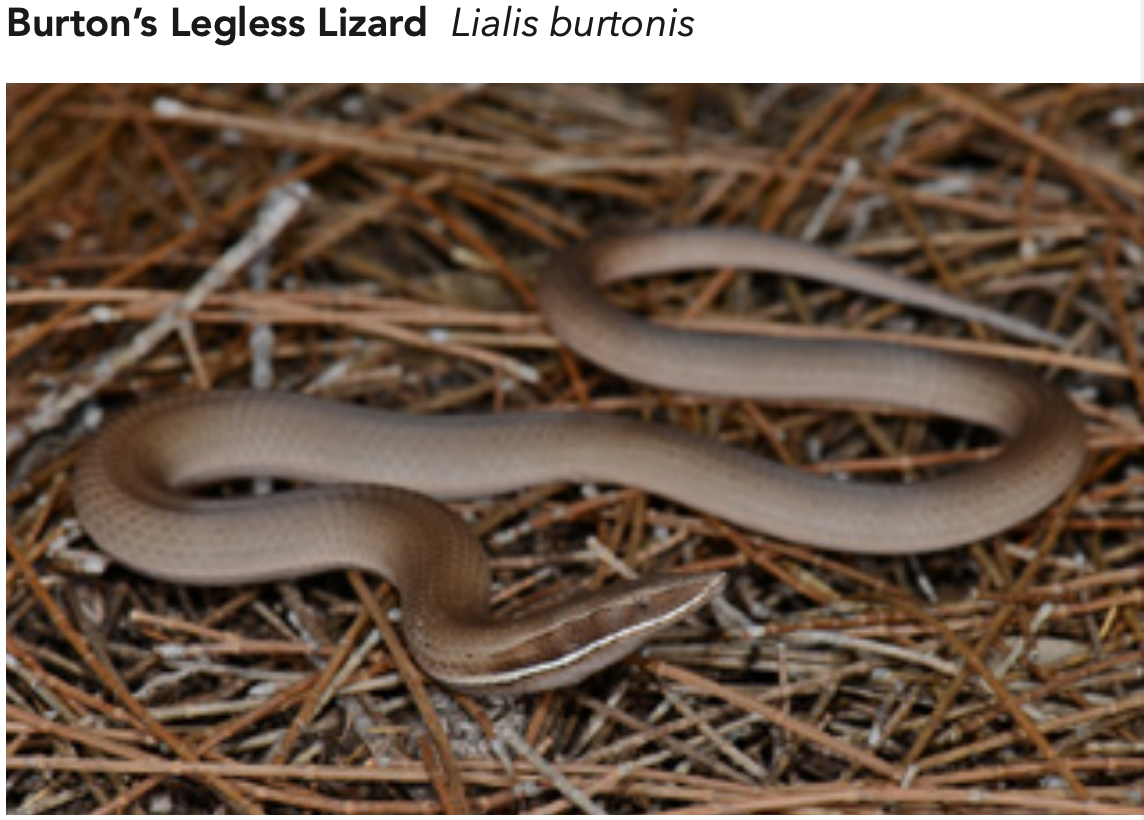
What is the Burton's Legless Lizard?
The Burton's Legless Lizard (Lialis burtonis) is the most widely distributed pygopodid in Australia — a member of the legless lizard family Pygopodidae, closely related to geckos. They are found across most of the continent and across all five distribution zones in the Greater Sydney region.
Snout-vent length: approximately 290mm
Total length: up to 800mm
Conservation status: IUCN Least Concern
Urban Adaptation Rating: ★★★★★
Activity: Primarily nocturnal, most active in warmer months
Distribution in Sydney: Zones 4 and 5
How to identify a Burton's Legless Lizard
The defining feature is the snout. No other reptile in the Sydney region has a head quite like a Burton's. It is long, pointed and unmistakably wedge-shaped — almost beak-like in profile. Once you have seen one, you will not confuse it with anything else.
Long, pointed, wedge-shaped snout
Fragmented head shields rather than the smooth scales of a snake
Vertical, oval-shaped pupils
Very small flap-like vestigial hind limbs (a snake has none)
Highly variable colour — grey, brown, yellow, red, or combinations
Variable patterning, with banded, striped, plain and speckled individuals all occurring in the same area
Can reach 800mm in total length, though most are smaller
The appearance variation is one of the things that makes them difficult to identify. Two Burton's from the same patch of bushland can look like completely different species. But the snout shape is consistent and diagnostic.
https://lizardremoval.com.au/skinks-lizard/
How to tell a Burton's from a snake
This is the question we field most often. The differences are clear once you know what to look for:
Snout shape: Burton's has the distinctive long wedge-shaped snout. No Sydney snake has this profile.
Tail: A Burton's tail is very long — often making up more than half of the total length. Snake tails are much shorter relative to body length.
Eyes: Vertical oval pupils. Most Sydney snakes have round pupils.
Ear openings: Burton's has visible external ear openings. Snakes do not.
Tongue: Fleshy and broad, not the forked tongue of a snake.
Limb flaps: Tiny vestigial flap-like remnants of hind limbs are present. You have to look closely to see them, but they are there.
Eyelids: Burton's has eyelids and can blink. Snakes cannot.
If you find one in your yard, the best move is to photograph it from a safe distance and send the image to a licensed reptile catcher for confirmation before doing anything else.
Where do Burton's Legless Lizards live?
This species is the most widely distributed member of its family in Australia, and that range continues throughout the Greater Sydney region. They occur in essentially every environment from coastal heathland to dry sclerophyll forest, through to suburban gardens.
Common habitats include:
Dry sclerophyll forest with leaf litter and ground cover
Coastal heathland
Grassland and scrubland
Bushland edges of suburbs
Suburban gardens with good ground cover, mulch and leaf litter
Areas with dense low vegetation that support skink populations
They are terrestrial — ground-dwellers — and rely on cover for both ambush hunting and shelter from predators.
A specialised predator — skinks for breakfast, lunch and dinner
The Burton's Legless Lizard is one of the most specialised predators in the Australian reptile fauna. It feeds almost exclusively on other lizards, particularly skinks. The wedge-shaped snout, the vertical pupils, the flexible skull joints — all of it is adapted for one job: hunting and swallowing other reptiles.
The hunting technique is impressive. Burton's are sit-and-wait ambush predators. They lie still in leaf litter or low vegetation, often with the head raised slightly and twitched in a specific way that mimics a small insect or worm — a behaviour called caudal luring when it is done with the tail, but Burton's also use the head and body to lure prey within striking range.
When a skink approaches, the Burton's strikes with surprising speed, grips the prey behind the head, and uses its highly flexible cranial joints to swallow lizards that look impossibly large for its head. The skull bones literally rearrange during swallowing. They can take prey almost as long as themselves.
Are Burton's Legless Lizards dangerous?
No. The Burton's Legless Lizard is completely harmless to humans and pets. They have no venom and no significant defensive behaviour. If you pick one up, the worst they will do is squirm vigorously and possibly nip — though even the nip is not painful and barely registers.
The bigger risk is to the animal, not from it. Burton's are frequently killed by people who mistake them for snakes. Cats also take a heavy toll on them, particularly in suburban areas.
Breeding and reproduction
Burton's Legless Lizards have a reproductive pattern well suited to the Australian climate:
Clutch size: Two eggs at a time
Frequency: Multiple clutches over the warmer months
Nest sites: Eggs laid in moist, hidden locations such as deep leaf litter, under rocks, or in soil cavities
Development: Like most pygopodids, eggs are leathery-shelled rather than hard
The multiple-clutch strategy means a single female can produce a reasonable number of offspring across a good season, though survival to adulthood is low given how many small reptiles eat each other in the bush.
Why we rarely target them, even though they are everywhere
This is worth flagging. Burton's Legless Lizards are abundant across their range — they are genuinely common throughout Greater Sydney, prolific in parts of northern Australia. But sightings in the Sydney region are almost always the result of chance encounters rather than deliberate searching.
Why? They are very good at being invisible. Their behaviour, colouration and habitat preferences mean that even experienced herpetologists find them difficult to locate on purpose. You are far more likely to encounter one crossing a driveway at night than by going out looking for one.
What to do if you find a Burton's Legless Lizard at your home
In almost every case, leave it alone. Burton's are native, harmless and beneficial — they help keep skink populations in balance and form part of a healthy garden ecosystem.
Practical steps if you encounter one:
Take a photo from a safe distance for identification
If you are not certain it is a Burton's and not a snake, contact a licensed reptile catcher
If your dog or cat is showing interest, bring the pet inside until the lizard moves on
Do not attempt to handle unfamiliar reptiles — even harmless ones can be stressed by handling and may shed their tail
What you should not do:
Do not kill it. Burton's Legless Lizards are protected native wildlife.
Do not assume it is a snake without confirmation. Photographs sent to a licensed catcher take seconds to identify.
Do not relocate it without licensing. Even moving a Burton's a short distance can be against wildlife regulations in NSW.
Summary
The Burton's Legless Lizard (Lialis burtonis) is one of those species that quietly proves how interesting Australian reptile diversity really is. It looks like a snake, hunts like a viper, and is built for a job no other animal in the Sydney region does. They are common across Greater Sydney but rarely seen, and almost always misidentified when they are. Knowing what one looks like — and being able to tell the difference between a Burton's and a snake — is one of the most useful pieces of reptile knowledge a Sydney homeowner can have.
Found a reptile you cannot identify in Sydney? Urban Reptile Removal operates 24/7 across the Greater Sydney region. We are fully licensed and insured, and we can identify and safely manage any reptile you encounter. Call 0418 633 474.
https://www.inaturalist.org/taxa/36978-Lialis-burtonis
https://bie.ala.org.au/search?sortField=score&dir=desc&q=Lialis+burtonis

Interested in Sydney Reptiles?
You can buy the book, featuring full page descriptions on over 70 species
https://sydneysnakecatcher.com.au/product/city-wildlife-guide-reptiles-of-sydney/
Saurophobia is the fear of lizards, and we can assure you — it’s very real.
Catching snakes seemed like the obvious direction for a business like Urban Reptile Removal. But over time, we began receiving a steady stream of calls from people needing help with lizards as well — everything from tiny skinks through to large goannas.
That led us to establish a second business focused specifically on lizard removals, making it much easier for people searching for this service to find the help they needed.
For the most up to date information on snakebite first aid, visit, snakebitefirstaid.com.au
