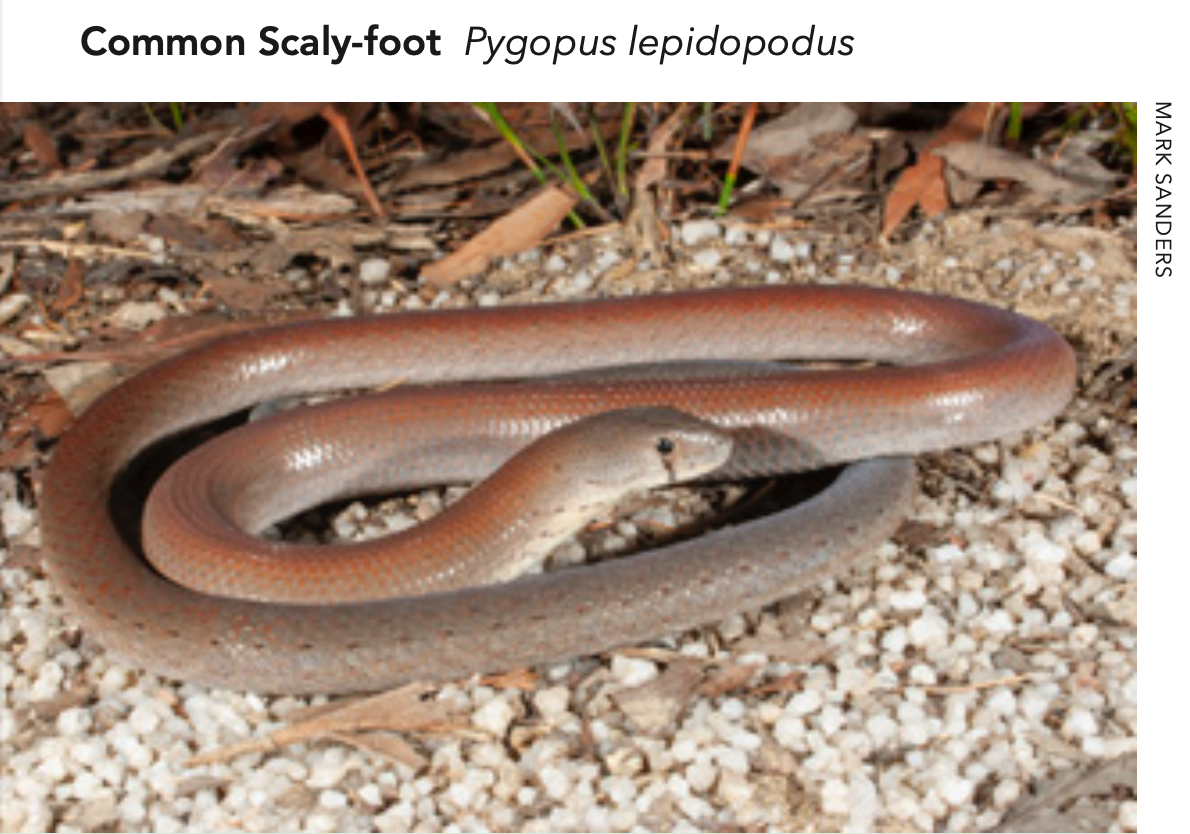
Common Scaly-foot
The Common Scaly-foot (Pygopus lepidopodus) — Sydney's Snake That Isn't
If we had a dollar for every Common Scaly-foot we have been called out to identify in Sydney, we would have retired years ago. The Common Scaly-foot (Pygopus lepidopodus) is the single most misidentified reptile in the Greater Sydney region — and it is misidentified for a reason. At first glance it really does look like a snake, and not just any snake. To an untrained eye, the colour and shape can pass for an Eastern Brown Snake on a driveway.
At Urban Reptile Removal we field these calls constantly. The good news is that the Common Scaly-foot is a completely harmless native lizard, and once you know what to look for, it is unmistakable.
What is the Common Scaly-foot?
The Common Scaly-foot (Pygopus lepidopodus) is a legless lizard in the family Pygopodidae — the same family as the Burton's Legless Lizard, and a group more closely related to geckos than to snakes. The scaly-foot name comes from the small flap-like remnants of hind limbs that all members of the genus Pygopus retain.
Snout-vent length: approximately 274mm
Total length: up to 840mm
Conservation status: IUCN Least Concern
Urban Adaptation Rating: ★★★★★
Activity: Nocturnal, most active in warmer months
Distribution in Sydney: Zones 1, 4 and 5
How to identify a Common Scaly-foot
The Common Scaly-foot in the Sydney region has a fairly consistent look once you have seen a few:
Grey or red-brown body colour
Grey head and tail
Faint markings overall
Some individuals display blotching, particularly on the tail where traces of blotching are usually still visible even on plainer animals
Distinct black line running under the eye — a useful diagnostic feature
Scales strongly keeled, giving the body a slightly rough or ridged appearance
Very long tail, often well over half the total length
Small scaly flaps near the cloaca — the remnant hind limbs that give the species its name
The strongly keeled scales are a particularly useful feature. Run a finger lightly along a Common Scaly-foot (if a licensed catcher has one in hand) and you feel a distinct texture. The keeling catches the light and gives the animal a slightly rougher, more textured appearance than the smooth scales of an Eastern Brown Snake.
How to tell a Common Scaly-foot from an Eastern Brown Snake
This is the question that matters. The Eastern Brown Snake is one of the most dangerous snakes in the world. Getting this identification right is genuinely important.
Ear openings: Scaly-foot has visible external ear openings on the sides of the head. Snakes do not have external ears.
Tongue: Scaly-foot has a broad, fleshy, pink tongue. Eastern Brown Snakes have a slender, dark, deeply forked tongue.
Tail length: Scaly-foot tail comprises a significant portion of its body length, often well over half. Eastern Brown Snake tail is much shorter relative to the body.
Limb flaps: Small flap-like vestigial hind limbs sit just before the tail in a Scaly-foot. Easy to see if you know where to look. Snakes have nothing.
Eyelids: Scaly-foot can blink. Snakes cannot.
Head shape: Scaly-foot has a relatively narrow head that does not flare distinctly from the neck. The Eastern Brown has a slightly more defined head when viewed from above.
Movement: Scaly-foot tends to move more stiffly and slowly than a Brown Snake, which is fast and fluid.
If you are not certain, do not approach. Photograph from a safe distance and send the image to a licensed reptile catcher for identification.
Where do Common Scaly-foots live?
The Common Scaly-foot inhabits a fairly specific set of habitats that overlaps neatly with the suburban-bushland edge of much of Greater Sydney:
Dry woodlands
Grasslands and grassy paddocks
Heathland and coastal heath
Areas with long grass and dense ground cover
Leaf litter under shrubs
Underneath rocks, fallen timber and dense vegetation
Properties bordering bushland reserves
They shelter during the day in deep cover — under rocks, in leaf litter, inside the base of dense grass tussocks — and become active at dusk. This nocturnal habit is why most encounters happen at night, often when they are crossing roads or moving through open ground between cover.
Behaviour and the snake mimicry
The Common Scaly-foot has evolved a defensive strategy that works against most predators and unfortunately also works to terrify Sydney homeowners. When threatened, they actively mimic snakes:
Flick the tongue in a forked-looking display
Raise the front portion of the body
Make jerky, snake-like movements
Sometimes hiss
This is straightforward predator deterrence. A predator that has learned that snakes are dangerous will hesitate when faced with something that looks and behaves like one. It is a clever strategy that works against birds of prey, cats and foxes. It also unfortunately means a lot of Common Scaly-foots get killed by people who genuinely believe they have a venomous snake on their property.
Diet and lifestyle
Unlike the Burton's Legless Lizard, which specialises in eating other lizards, the Common Scaly-foot is more of a generalist invertebrate hunter. They feed on insects, spiders, scorpions and other small invertebrates, hunting through leaf litter and at the base of vegetation at night.
The keeled scales may have evolved partly in connection with this habit — providing protection as they push through tangled grass and rough ground in search of prey.
Are Common Scaly-foots dangerous?
No. Completely harmless to humans and pets. The Common Scaly-foot has no venom and no significant defensive bite. The entire snake-mimicry routine is bluff. They can be picked up and handled safely, though as with any reptile, they should be left alone unless removal is genuinely necessary.
The danger, again, runs the other way. Common Scaly-foots are killed in significant numbers by people who mistake them for Eastern Brown Snakes, and by cats. Habitat loss through suburban expansion is the other ongoing pressure on the species.
Breeding and reproduction
The Common Scaly-foot has a reproductive strategy typical of pygopodids:
Clutch size: Two eggs at a time
Frequency: Multiple clutches in a single season
Nest sites: Hidden locations in soil, leaf litter or under cover
Communal nesting: Known to share nest sites, sometimes resulting in concentrations of eggs from multiple females
The communal nesting habit means that finding one Scaly-foot in a garden often indicates that more are nearby, and that breeding has likely occurred on or near the property.
What to do if you find a Common Scaly-foot at your home
The answer in almost every case is leave it alone. Common Scaly-foots are native, harmless and beneficial. They help control insect populations and form part of a healthy local ecosystem.
Practical steps if you encounter one:
Photograph it from a safe distance for identification
If you suspect it might be an Eastern Brown Snake, do not approach — contact a licensed reptile catcher immediately
If your dog or cat is interested, bring the pet inside until the lizard moves on
Once identified as a Scaly-foot, allow it to move on under its own power
What you should not do:
Do not kill it. Common Scaly-foots are protected native wildlife.
Do not assume it is a snake without confirmation. A photo and a phone call takes seconds.
Do not attempt to handle unfamiliar reptiles even if you think they are harmless.
A famous case of misidentification
There is a well-known piece of Australian reptile book history involving the Common Scaly-foot. When Professor Rick Shine's seminal Australian Snakes: A Natural History was first published in 1991, an edition went to print with a Common Scaly-foot on the cover — labelled as a snake. The error was caught, copies were pulled from shelves, and replacement editions were issued. A few escaped into the wild, and the misidentified-cover edition is now a sought-after collector's item.
Even a publisher can get this one wrong, I’m sure to the frustration of the author! So if you have looked at a Scaly-foot and called us thinking it was a Brown Snake, you are in good company.
Summary
The Common Scaly-foot (Pygopus lepidopodus) is a harmless native lizard that has evolved to look and act like a snake, and it does that job almost too well. They are widespread across Greater Sydney, common in the right habitats, and almost always misidentified when they are encountered. Learning to recognise them — ear openings, fleshy tongue, long tail, vestigial limb flaps — is one of the most useful pieces of reptile knowledge any Sydney homeowner can have.
Found a reptile you cannot identify in Sydney? Urban Reptile Removal operates 24/7 across the Greater Sydney region. We are fully licensed and insured, and we can identify and safely manage any reptile you encounter. Call 0418 633 474.

Interested in Sydney Reptiles?
You can buy the book, featuring full page descriptions on over 70 species
https://sydneysnakecatcher.com.au/product/city-wildlife-guide-reptiles-of-sydney/
Saurophobia is the fear of lizards, and we can assure you — it’s very real.
Catching snakes seemed like the obvious direction for a business like Urban Reptile Removal. But over time, we began receiving a steady stream of calls from people needing help with lizards as well — everything from tiny skinks through to large goannas.
That led us to establish a second business focused specifically on lizard removals, making it much easier for people searching for this service to find the help they needed.

For the most up to date information on snakebite first aid, visit, snakebitefirstaid.com.au
