Common Death Adder
The Common Death Adder (Acanthophis antarcticus)
The Common Death Adder (Acanthophis antarcticus) is the snake in the Sydney region that genuinely earns its name. Dangerously venomous, perfectly camouflaged, and built around a hunting strategy that no other Australian elapid uses — they sit motionless in leaf litter for days or weeks at a time, waiting for prey to come to them. That same strategy is what makes them dangerous to humans, because unlike every other venomous snake in Sydney, they don't flee when approached. They stay put, and they trust their camouflage.
We attend few Death Adder call-outs across the Greater Sydney region. The species has retreated from heavily urbanised parts of the city, and most of our Death Adder work now sits on the bush-edge fringes — the Central Coast, parts of the Hawkesbury, the Sutherland Shire, and properties bordering national parks. But where they do still occur, they require a different mindset to manage safely.
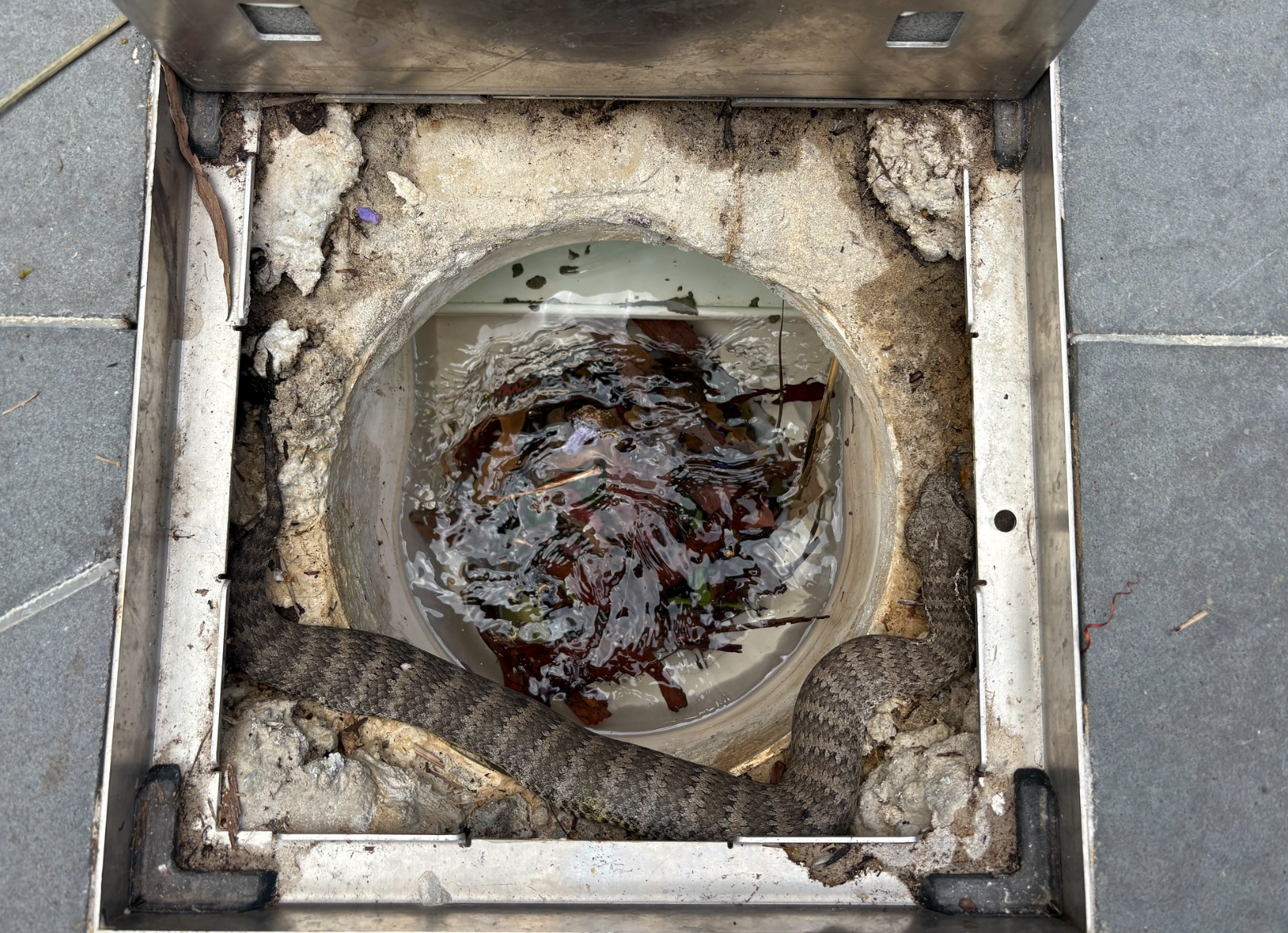
This Death Adder was a surprising find in a pool skimmer box in Bayview, NSW.
Identification
The Common Death Adder is one of the easiest Sydney snakes to identify by body shape alone. The silhouette is unmistakable:
Short, thick, heavily-built body — unlike any other Sydney snake
Distinctly triangular head, clearly wider than the neck
Very short tail relative to body length
Pale tail tip with a small curved spur
Heavy banded pattern across the body
Vertical pupils — unusual among Australian elapids
In the Sydney region, two colour morphs occur:
Grey morph — grey base with darker grey-black crossbands
Red morph — reddish-brown base with darker reddish-brown crossbands
Both morphs share the same banded pattern, body shape and pale tail tip.
The combination of the chunky body, triangular head, short tail and pale tail-tip is unique to Death Adders in the Sydney region. No other native snake here has this body plan.
What gets confused with a Death Adder
Honestly, not much, except maybe a Blue Tongue Lizard. The body shape settles the identification on its own. Death Adders look nothing like the other dangerously venomous snakes of the Sydney region — they are short, thick and stubby where Red-bellied Blacks, Eastern Browns and Tiger Snakes are all elongate and slender.
Where they live
Common Death Adders have specific habitat requirements that limit their distribution:
Sandy soils with good leaf litter cover
Coastal heath
Dense coastal scrub
Dry sclerophyll forest with leaf litter
Sandstone country with healthy understorey
Scattered logs and ground cover for ambush sites
Within the Sydney region, they are found primarily in:
The Central Coast
Parts of the Hawkesbury and Hawkesbury bushland fringes
The Sutherland Shire, particularly properties near the Royal National Park
Bushland in Ku-ring-gai Chase National Park
Properties bordering Garigal National Park
Some regions of the Nth Beaches with Bayview recording a few individuals.
They have largely disappeared from densely-developed suburbs. The species needs leaf litter, sandy soils and a healthy prey base of small lizards — features that don't survive intensive suburban development.
Behaviour
The Common Death Adder is unlike any other Sydney snake. Where Eastern Browns and Red-bellied Blacks are active hunters that move through their environment in search of prey, Death Adders are sit-and-wait ambush predators. Their hunting strategy has more in common with crocodiles than with their fellow elapids.
The typical hunting sequence:
Select an ambush site with cover and likely prey traffic
Settle into the leaf litter, often with only the head and tail visible
Remain motionless for hours, days, or weeks
Wriggle the pale tail tip slowly — a caudal lure that mimics a worm or insect
Strike when prey approaches
Hold the prey, inject venom, consume it
Return to ambush mode
This strategy has critical implications for human encounters. Unlike every other venomous snake in Sydney, Death Adders:
Don't flee when approached. They trust their camouflage.
Are often walked past unnoticed at close range
Will not move out of the way for a foot
Strike when stepped on or stepped over
Strike fast and accurately from a coiled position
Bite without warning
This is the central thing to understand about Death Adders: they are dangerous precisely because they don't move. Other venomous snakes give you a chance to back away. Death Adders don't. They wait, and if you put a foot in the wrong place, they bite.
How dangerous they are
Death Adder venom is highly neurotoxic, capable of causing rapid paralysis and respiratory failure. Their fangs are among the longest of any Australian elapid relative to body size, allowing effective venom delivery on contact.
What a bite involves:
Often relatively painless initially
Rapid onset of neurotoxic symptoms — drooping eyelids, difficulty swallowing, blurred vision
Progressive paralysis affecting respiratory muscles
Without treatment, death from respiratory failure
Symptom progression can be slow at first, sometimes giving 6 to 12 hours before serious effects
With antivenom and respiratory support, survival is the usual outcome
Antivenom is highly effective
Historically, Death Adders were a significant cause of Australian snakebite deaths. Modern antivenom has made fatalities rare, but untreated bites remain potentially fatal — and the species' ambush behaviour means bites can occur to people who never knew there was a snake present.
The important caveat: bites are uncommon. The restricted habitat, nocturnal and crepuscular activity, and tendency to remain hidden mean most Sydney residents will never see one. But where encounters do occur — on bush tracks, in properties bordering national parks, in leaf-littered campgrounds — the risk is real because the snake will not warn you.
The risk to dogs
The risk to dogs in Death Adder habitat is severe, though encounters are rare. Dogs that disturb a Death Adder while sniffing through leaf litter are at high risk. Bites typically land on the muzzle or front legs. Symptoms can develop slowly at first then become severe rapidly, and owners may not realise the dog has been bitten until symptoms appear.
If you have pets in Death Adder country, keep dogs on lead when walking through bush trails, and be aware that pets can be bitten without you knowing the snake was there.
Breeding
Death Adders are live-bearing rather than egg-laying. Mating is in spring and early summer, with up to 30 live young born in late summer. Neonates are fully independent at birth, fully venomous from day one, and behave the same way as adults — they remain motionless rather than flee.
Neonate Death Adders are tiny replicas of the adults, with the same banded pattern, stubby body shape and ambush behaviour. Death Adder hatchlings are among the more dangerous neonates in the Australian fauna because of their venom potency and the same refusal-to-flee behaviour that makes adults dangerous.
What to do if you find one at your home
The response needs particular care.
Immediately:
Stop. Don't move suddenly.
Identify exactly where the snake is. Death Adders are remarkably hard to see even when you know they're there.
Back away slowly. Aim for at least 5 metres.
Keep watching the spot until the catcher arrives — Death Adders may not move
Keep children, pets and other people clear
Then call us on 0418 633 474. We attend 24/7 across the Greater Sydney region. Stay on the phone — we'll talk you through what to do while the catcher is on the way.
What not to do:
Don't try to kill it. The refusal to flee makes attempted killings very dangerous.
Don't try to catch it. Death Adders are extremely fast strikers despite their slow demeanour.
Don't lose track of where it is. Once you take your eyes off a Death Adder for a few seconds, relocating it can be genuinely difficult.
Don't assume it has left. Death Adders often remain in the same location for days.
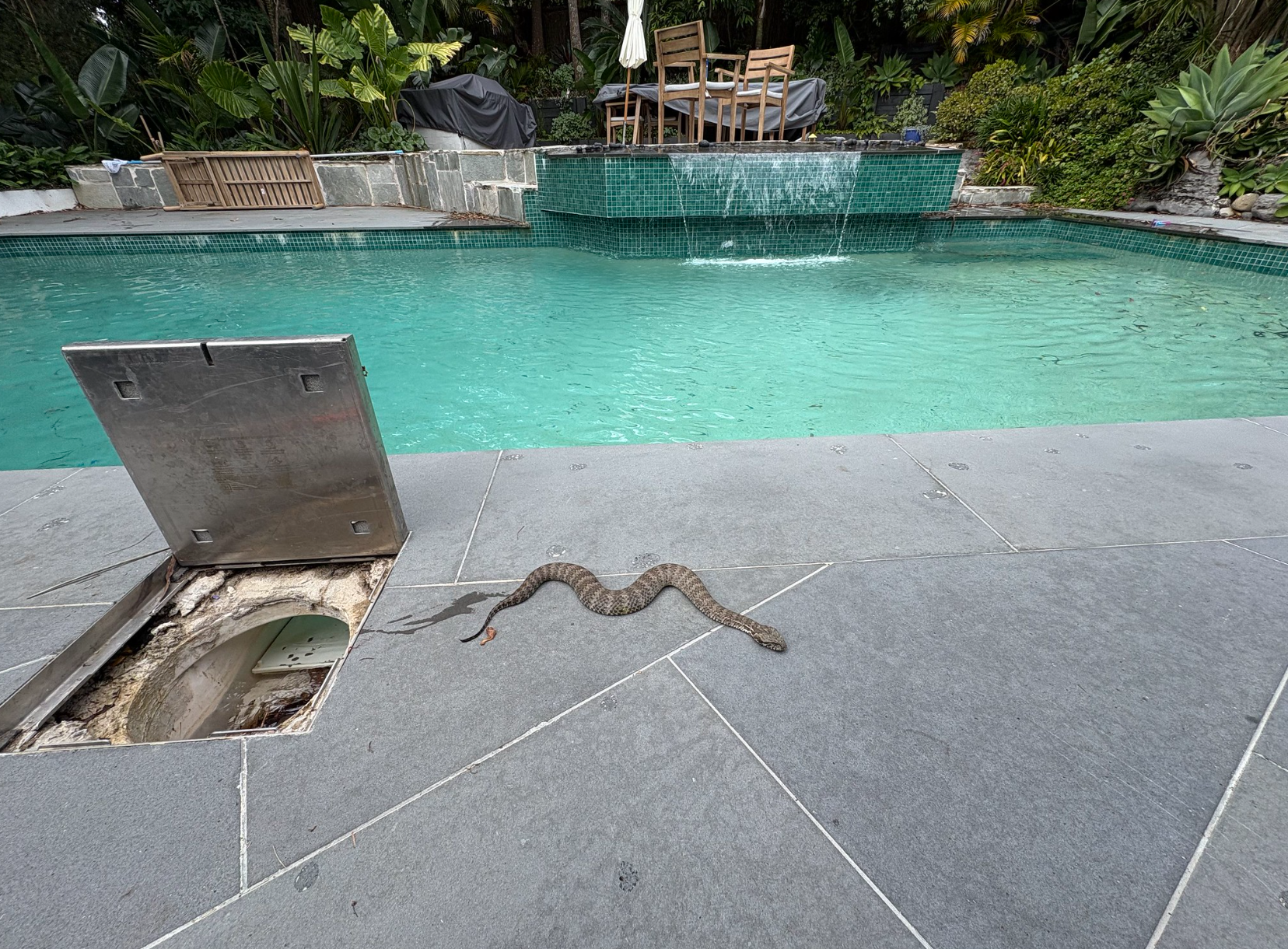
This Death Adder was a surprising find in a pool skimmer box in Bayview, NSW.
If someone is bitten
A Death Adder bite is a true medical emergency. The slow initial progression of symptoms is a trap — the bite is reliably severe and requires immediate intervention.
Call 000. Mention "Death Adder" if the identification is confident — it matters for antivenom selection.
Keep the patient still and calm. Movement spreads venom.
Apply pressure immobilisation bandaging — broad firm bandage at the bite site, wrapping along the limb in both directions, splint the limb.
Don't wash the bite — venom traces help antivenom selection.
Don't cut, suck or apply a tourniquet.
Don't give the patient anything to eat or drink.
Photograph the snake from a safe distance only if you can do so without delaying treatment.
Do not be lulled by a slow initial onset. Death Adder bites can develop gradually before becoming severe. Treatment is required regardless of how the patient appears in the first hour.
For pet bites, the same urgency applies. Get the animal to a 24-hour vet immediately and call ahead.
Reducing risk on your property
If you live in Death Adder habitat, sensible management of the property rather than aggressive clearing is the right approach:
Clear leaf litter from heavily-used parts of the garden
Maintain clear paths and walkways
Use a torch and watch where you step at night
Wear closed shoes and long pants when walking through bushland or leaf litter
Use proper boots when working in bush-adjacent areas
Keep dogs on lead in bushland areas
Teach children not to walk barefoot in leaf litter
Be especially careful in spring and early summer when neonates are present
A note on this: don't try to "tidy up" the whole property to solve a Death Adder problem. Death Adders are part of a functioning bushland ecosystem, and aggressive clearing destroys habitat for many beneficial native species. Clear paths, clear high-traffic areas, but leave the broader bushland intact.
A note about decline
The Common Death Adder has declined significantly across much of its range, including parts of the Sydney region. The main pressures:
Habitat fragmentation
Cat predation on neonates and juveniles
Road mortality
Loss of leaf litter habitat to suburban development
For homeowners on bush-edge properties in the Central Coast, Sutherland Shire and Hawkesbury, the species is something to manage carefully but also to respect. Their presence is an indicator of relatively intact bushland.
Summary
The Common Death Adder is one of Sydney's most distinctive and most dangerous snakes — a sit-and-wait ambush predator that does not flee when approached, delivers fast accurate strikes with highly neurotoxic venom, and is genuinely hard to see even when you know where it is. They are restricted to bushland habitats with sandy soils and leaf litter, particularly on the Central Coast, in parts of the Hawkesbury, and around the Sutherland Shire. Encounters are uncommon but consequential.
The right response to finding one is to stop, identify the exact location, keep it in sight, mark the spot, back away to 5 metres, and call a licensed reptile catcher. Don't try to handle, kill or interact with the snake. If anyone is bitten, treat it as a life-threatening emergency regardless of how mild the initial symptoms appear.
Found a Death Adder at your home? Urban Reptile Removal operates 24/7 across the Greater Sydney region, including the Central Coast, Hawkesbury and Sutherland Shire. Licensed, insured, and experienced with the species that requires the most caution. Call 0418 633 474 — day or night.

Interested in Sydney Reptiles?
You can buy the book, featuring full page descriptions on over 70 species
https://sydneysnakecatcher.com.au/product/city-wildlife-guide-reptiles-of-sydney/
https://www.inaturalist.org/taxa/35060-Acanthophis-antarcticus
https://bie.ala.org.au/search?sortField=score&dir=desc&q=Acanthophis+antarcticus
For the most up to date information on snakebite first aid, visit, snakebitefirstaid.com.au
