
Eastern Water Dragon
The Eastern Water Dragon (Intellagama lesueurii) — Sydney's Largest Urban Lizard
If you have ever sat by the pond in the Royal Botanic Garden, walked beside the Lane Cove River, or relaxed near a creek in Centennial Park, you have almost certainly seen an Eastern Water Dragon (Intellagama lesueurii). They are Sydney's largest native dragon, one of the most charismatic reptiles in eastern Australia, and one of the few species that has not just survived urbanisation but thrived in it.
At Urban Reptile Removal we get regular calls about water dragons — usually from homeowners with backyard ponds, pools or water features who have suddenly acquired a one-metre-long lizard sunning itself on the deck. The good news is they are completely harmless. The better news is that having water dragons on your property is a sign that your garden is genuinely supporting native wildlife.
What is the Eastern Water Dragon?
The Eastern Water Dragon (Intellagama lesueurii) is Australia's largest native dragon lizard, a member of the agamid family and the only species in the genus Intellagama. They are semi-aquatic by nature, equally at home in water as out of it, and one of the most successful urban reptile species in eastern Australia.
Snout-vent length: up to 245mm
Total length: up to 1,000mm (one metre)
Conservation status: IUCN Least Concern
Urban Adaptation Rating: ★★★★★
Activity: Diurnal, most active in spring and summer
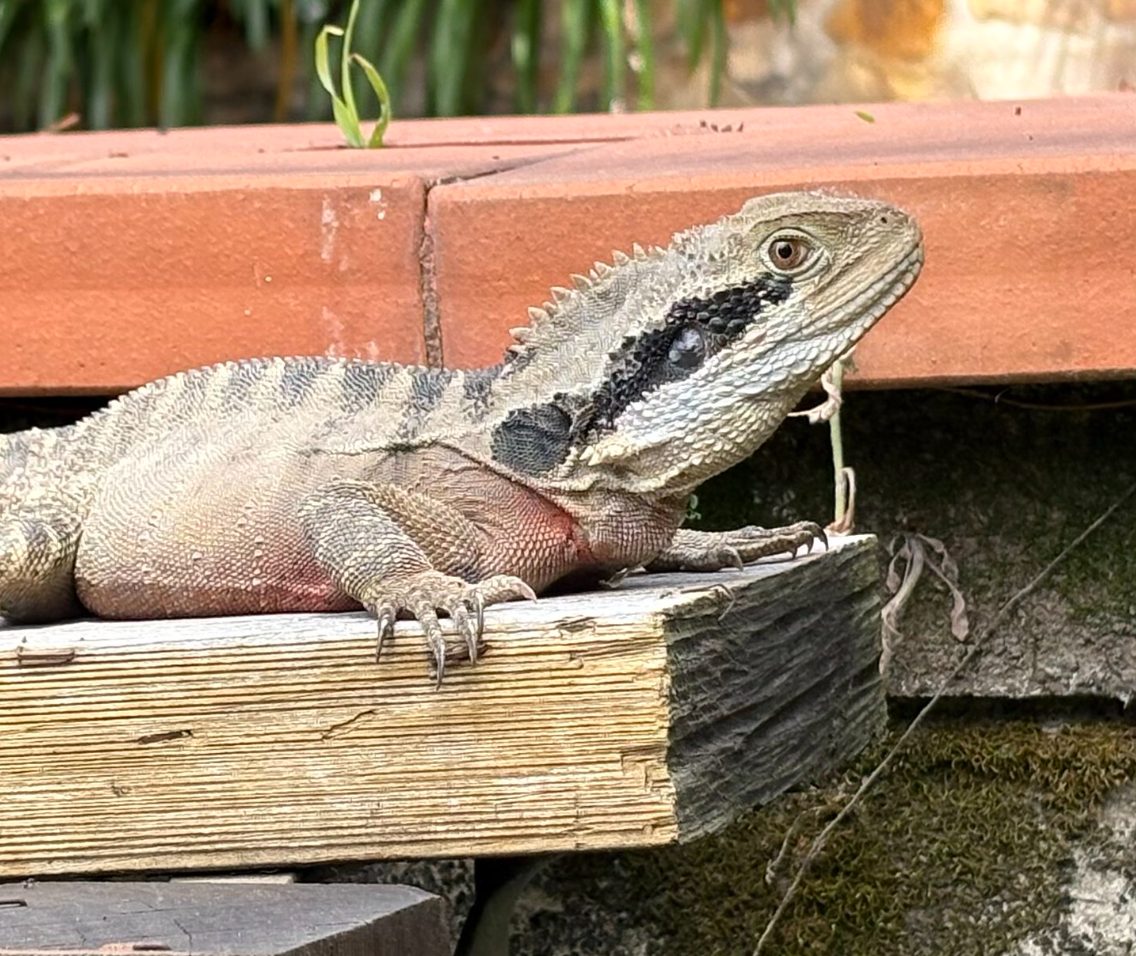
This adult male water dragon was living beside the pool in a Chatswood backyard.
How to identify an Eastern Water Dragon
The Eastern Water Dragon is one of the most distinctive reptiles in the Sydney region. The combination of size, build and colour makes it almost impossible to confuse with anything else:
Australia's largest dragon lizard — up to a metre in total length
Olive-brown to dark brown base colour
Dark stripe running from the eye back to the neck
Dark bands across the body and tail
Reddish tint on the chest, more pronounced in breeding males
Strong, muscular limbs built for climbing and swimming
Long, laterally compressed tail — flattened side-to-side for swimming
Prominent nuchal crest along the back of the neck — a row of enlarged spiny scales
Continuing low crest down the spine to the tail
Robust head with strong jaws
The laterally compressed tail is one of the easiest features to spot. Where most lizards have round tails, the water dragon's tail is flattened like a fish's, which makes it an excellent swimmer.
How to tell an Eastern Water Dragon from other Sydney dragons
There are two other dragon species you might encounter in the Sydney region. The differences:
Eastern Bearded Dragon (Pogona barbata): Much heavier built with a triangular head. Has a spiny beard that can expand and flush black. Always terrestrial, never associated with water. Found mainly on the western fringe.
Jacky Dragon (Amphibolurus muricatus): Much smaller and more slender. No nuchal crest. More heavily patterned. Tends to run on its hind legs when alarmed.
If a dragon is large, has a long flattened tail, and is anywhere near water, it is almost certainly an Eastern Water Dragon.
Where do Eastern Water Dragons live?
The Eastern Water Dragon is one of Sydney's great urban success stories. Their natural habitats centre around water, and they have adapted brilliantly to the human-modified version of that environment:
Natural habitats:
Freshwater creeks and rivers
Ponds, lagoons and wetlands
Rocky banks and sandstone outcrops near water
Rainforest streams
Coastal lakes and estuarine fringes
Urban habitats:
Backyard ponds and water features
Swimming pools (yes, regularly — they can climb out, unlike most reptiles)
Suburban creeks and stormwater drains
Botanic gardens, including the Royal Botanic Garden Sydney
Parks with lakes and ponds — Centennial Park is a famous stronghold
University campuses with water features
Cafe courtyards and restaurant terraces near water
Golf courses and reservoir margins
Some Sydney populations have become so accustomed to people that they will sit at outdoor restaurants waiting for food scraps. The water dragons at the University of Sydney, the Australian National Maritime Museum and Centennial Park are essentially semi-tame.
Behaviour and the dive escape
The Eastern Water Dragon's defining behavioural trait is its relationship with water. When threatened, they typically run for the nearest body of water, dive in and disappear. They can remain submerged for surprisingly long periods — up to 90 minutes in some cases — using a slow heart rate and reduced metabolism to stretch their oxygen supply.
This habit is why basking water dragons always sit in particular positions:
On rocks or branches that overhang water
On a creek bank with a clear run to the edge
On a fence near a pond
On a deck within a few quick steps of a pool
They are alert sun-baskers. Move slowly and you can often get within a few metres before they decide to leave. Move quickly and they are gone in a single splash.
Social structure and dominance
Water dragons have a complex social structure that is fascinating to watch once you know what is happening:
Dominant males defend territories that include the best basking sites and access to water
Each dominant male maintains a harem of females within his territory
Subordinate males are tolerated at the edges but cannot breed with the resident females
Confrontations between males involve head-bobbing, push-ups, throat expansion and chasing
Serious fights can result in significant injuries — torn dewlaps, bitten tails, scarred flanks
The brighter red chest colour of dominant breeding males is a visible status signal
If you have water dragons regularly visiting your garden, you are almost certainly being visited by the same individuals over and over — there will be a resident dominant male and a small group of females and juveniles using your property as part of a larger territory.
Diet and lifestyle
Eastern Water Dragons are opportunistic omnivores. Their diet is broad:
Insects of all kinds
Spiders and other arthropods
Frogs and tadpoles
Small fish
Small lizards
Crayfish and aquatic invertebrates
Fallen fruit, berries and flowers
Vegetation including new leaves and shoots
Carrion
Food scraps in heavily urbanised areas (not ideal, but it happens)
Juveniles tend to eat more insects and small invertebrates. Adults take a much wider range, including plant material and larger prey items.
Are Eastern Water Dragons dangerous?
No. Eastern Water Dragons are completely harmless to humans and pets. They have no venom, and while their bite can be painful (the jaws are strong for a lizard of this size), they almost never bite unless cornered or handled roughly. Their default response to a perceived threat is to dive into water or run for cover, not to fight.
The genuine risk is to dogs, particularly small dogs, where the size mismatch is closer. A water dragon defending itself from a small dog can deliver a serious bite or a tail whip that breaks skin. But this is the dog's problem to solve, not the dragon's — keep dogs under control around water and the issue does not arise.
A swimming pool consideration
Unlike water skinks, Eastern Water Dragons can usually get themselves out of swimming pools. They are strong swimmers and can climb most pool walls if there is anything to grip.
But two things to bear in mind:
They sometimes pick a pool as a regular swimming spot, which can lead to droppings in the pool and arguments with the pool cleaner
A small frog ramp or escape device benefits other wildlife (frogs, skinks, possums) that fall into pools and cannot get out
Breeding and reproduction
The Eastern Water Dragon's reproductive cycle is tied closely to the warm season:
Mating: Spring, with significant male territorial activity
Egg laying: November to December
Nest sites: Sandy or friable soil in sunny locations, often well away from water
Clutch size: Up to 18 eggs
Incubation: Approximately three months
Hatchling emergence: Late summer
Independence: Hatchlings are fully independent from the moment they emerge
The need for sandy nesting soil is one of the few constraints on their urban success. Females will travel surprisingly long distances overland to find a suitable nest site, which is when many female water dragons get killed on roads.
What to do if you find an Eastern Water Dragon at your home
Enjoy them. Eastern Water Dragons are one of the most rewarding native reptiles to share a property with. They are visible, charismatic, beneficial and they tolerate human presence much better than most native species.
Practical steps if you have them around:
Provide good basking sites near water — rocks, decking edges, low branches
Maintain dense vegetation near water for shelter and cover
Keep dogs under control, particularly small dogs around the water's edge
Do not feed them. It encourages aggressive begging behaviour and changes their natural diet
Install a frog ramp in any swimming pool to help other wildlife
Avoid pesticide use, which reduces their prey base
What you should not do:
Do not kill them. They are protected native wildlife.
Do not attempt to capture or relocate them without a licence. They have established territories and a relocated animal often does not survive.
Do not feed them processed human food. Bread, chips, biscuits and similar foods are not part of their natural diet and cause health problems.
Summary
The Eastern Water Dragon (Intellagama lesueurii) is Sydney's most successful urban dragon — a large, charismatic native lizard that has adapted brilliantly to suburban parks, botanic gardens, backyard ponds and restaurant terraces. They are present across all five distribution zones in the Greater Sydney region and remain a common, harmless and genuinely welcome part of the city's wildlife. If you have water on your property and good basking sites nearby, you very likely have water dragons — and that is one of the better outcomes you can have as a Sydney homeowner.
Found a reptile you need identified or removed in Sydney? Urban Reptile Removal operates 24/7 across the Greater Sydney region. We are fully licensed and insured, and we can identify and safely manage any reptile you encounter. Call 0418 633 474.
https://www.inaturalist.org/taxa/551938-Intellagama-lesueurii-lesueurii
https://bie.ala.org.au/search?sortField=score&dir=desc&q=Intellagama+lesueurii

Interested in Sydney Reptiles?
You can buy the book, featuring full page descriptions on over 70 species
https://sydneysnakecatcher.com.au/product/city-wildlife-guide-reptiles-of-sydney/
Saurophobia is the fear of lizards, and we can assure you — it’s very real.
Catching snakes seemed like the obvious direction for a business like Urban Reptile Removal. But over time, we began receiving a steady stream of calls from people needing help with lizards as well — everything from tiny skinks through to large goannas.
That led us to establish a second business focused specifically on lizard removals, making it much easier for people searching for this service to find the help they needed.

For the most up to date information on snakebite first aid, visit, snakebitefirstaid.com.au
