
Green Tree Snake
The Green Tree Snake (Dendrelaphis punctulatus) — Sydney's Harmless Garden Climber
If you have ever been working in your garden on a warm summer afternoon and watched a slender, alert snake glide effortlessly through the foliage of a shrub or along the top of a fence, you have probably had a visit from a Green Tree Snake (Dendrelaphis punctulatus). They are one of Sydney's most commonly seen daytime snakes — and one of the easiest to live alongside, because they are completely harmless.
At Urban Reptile Removal we get steady calls about Green Tree Snakes, particularly through the warmer months. Homeowners are often surprised to find that the snake in their hibiscus or hanging out near their pond is not only non-venomous but actively beneficial — they are voracious frog and skink hunters, and a healthy population of them is a sign that your garden has the right structure to support native wildlife.
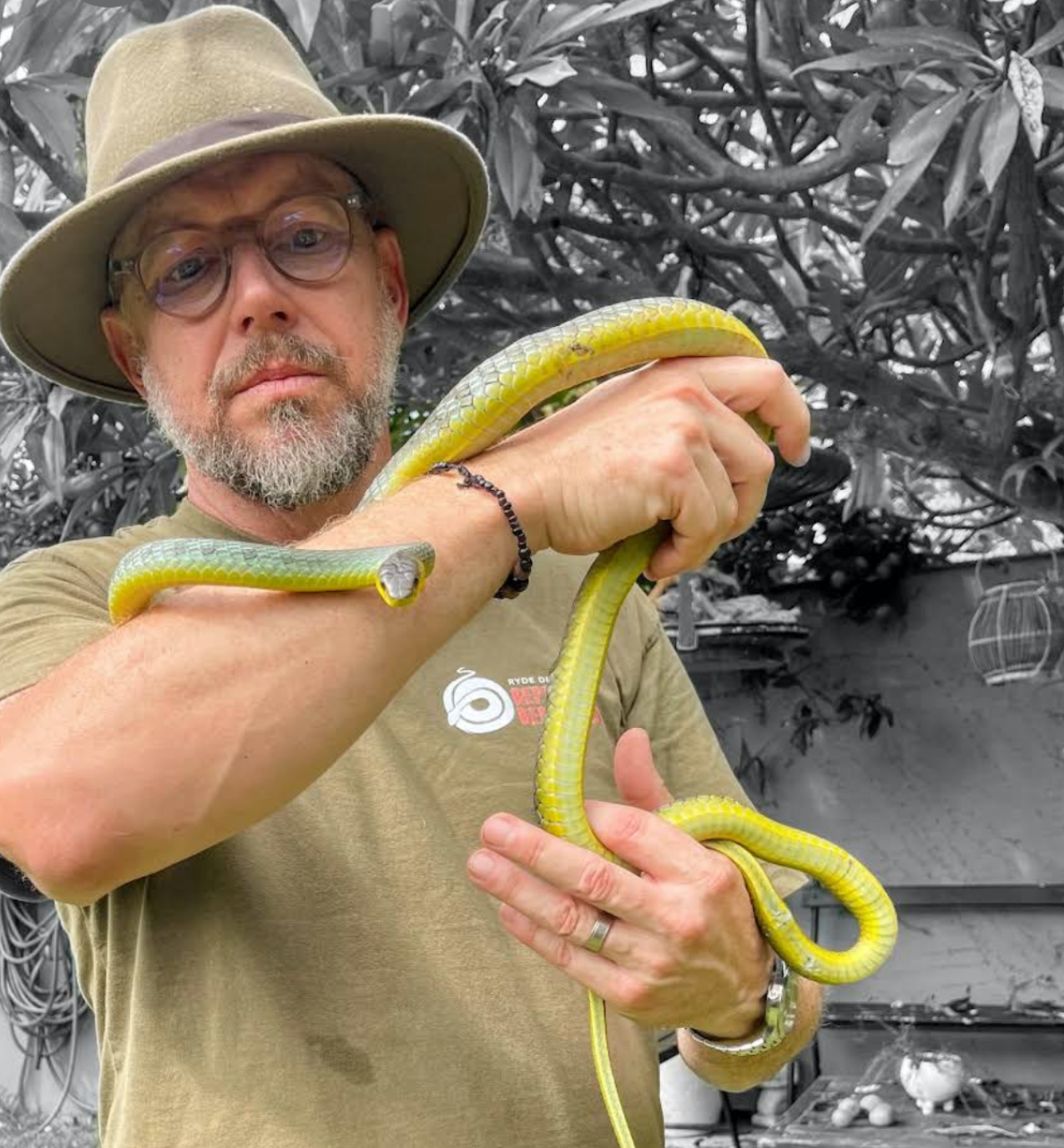
This snake deserved a photo. It’s about as large and vibrant as a common tree snake gets. The snake was relocated from Terry Hills, NSW.
What is the Green Tree Snake?
The Green Tree Snake (Dendrelaphis punctulatus) is a non-venomous colubrid snake found across northern and eastern Australia, with populations extending into the Sydney region. They are arboreal specialists — built for climbing through vegetation — and one of the few Australian snakes that is active primarily during the day.
Venom rating: Non-venomous, completely harmless to humans
Total length: Up to 1,800mm
Conservation status: IUCN Least Concern
Urban Adaptation Rating: ★★★★★
Activity: Diurnal, most active in warmer months
Distribution in Sydney: Zones 1, 2, 4 and 5
How to identify a Green Tree Snake
The Green Tree Snake is one of the easier species to identify in the Sydney region:
Slender, fast-moving snake with a long, elegant profile
Large eyes with round pupils — diurnal hunters with excellent vision
Narrow head clearly distinct from the neck
Colour highly variable across the species' range, but in Sydney typically:
Olive to dark green above
Bright yellow to cream underside
Some Sydney individuals can be brown, blue-black or grey
When threatened, the body expands to reveal iridescent pale blue skin between the scales
Long tail used for balance and grip while climbing
Smooth, slightly glossy scales
The big round eyes, slim build and bright yellow belly are the easiest features to spot. In good light, a Green Tree Snake moving through foliage looks almost luminous — the contrast between the green back and the yellow underbelly is striking.
How to tell a Green Tree Snake from other Sydney snakes
The Green Tree Snake can be confused with a few species, but the differences are clear:
Brown Tree Snake (Boiga irregularis): Vertical pupils, much larger eyes, nocturnal habits. The Brown Tree Snake's eyes are immediately distinctive.
Eastern Brown Snake (Pseudonaja textilis): Less slender, brown or tan rather than green, no yellow underbelly, much faster and more aggressive when threatened.
Diamond Python (Morelia spilota spilota): Heavily built, distinctive diamond patterning, much larger head.
The combination of slender build, bright green or olive back, yellow belly and round pupils makes the Green Tree Snake quite easy to separate from anything else in the Sydney region.
Where do Green Tree Snakes live?
Green Tree Snakes are habitat generalists with a clear preference for damp, vegetated areas with good prey populations:
Natural habitats:
Rainforests and rainforest margins
Wet sclerophyll forest
Damp woodlands
Riparian vegetation along creeks and rivers
Bushland margins
Urban habitats:
Suburban gardens with thick vegetation
Properties with water features, ponds and dampness
Bushland-adjacent backyards
Compost heaps and mulch beds
Hibiscus, frangipani and other dense garden shrubs
Pergolas, trellises and climbing plants
Rockeries with leaf litter and ground cover
They tend to do well in mature gardens with structural complexity — the kind of garden that has been allowed to develop some character over time, with shrubs, climbers, leaf litter and the occasional unkempt corner.
Behaviour and the blue display
Green Tree Snakes are alert, fast-moving and visually-oriented. They rely heavily on their excellent eyesight to hunt and to detect threats. When approached, they typically respond by:
Moving rapidly away through vegetation
Climbing higher into trees or shrubs
Freezing motionless, relying on camouflage
Inflating the body to display the iridescent pale blue skin between the scales
The blue display is one of the more spectacular reptile defensive displays in Sydney. By inflating the body and spreading the scales, the snake reveals a brilliant flash of pale blue normally hidden between scale rows. The effect is sudden and dramatic, and is intended to startle predators that have not seen the colour before.
They are also known to aggregate — particularly during cooler weather. It is not unusual to find several Green Tree Snakes sharing a roof cavity, a compost heap or a sunny rock in autumn and winter. This habit can lead to homeowners getting alarmed about "infestations" when what they are actually seeing is normal communal sheltering.
Diet and lifestyle
Green Tree Snakes are diurnal hunters with broad prey preferences:
Frogs of all sizes — a particular favourite
Tadpoles
Small fish
Geckos
Small birds and nestlings (less commonly)
Insects (juveniles)
The diet is focused on small, fast-moving prey that the snake's excellent eyesight and rapid strike can capture. They hunt by sight, moving through vegetation and along the ground, watching for movement and striking quickly when prey is detected.
Their fondness for frogs is one of the reasons they do so well near garden ponds and water features. A pond with a healthy frog population is a Green Tree Snake banquet.
Are Green Tree Snakes dangerous?
No. Green Tree Snakes are completely harmless to humans and pets. They have no venom, no fangs designed for envenomation, and no significant defensive bite. Their teeth are small and not capable of doing real damage even if a bite occurs — which is rare, because their default response to a threat is to flee rather than fight.
If handled, a Green Tree Snake may:
Release a foul-smelling musk from the cloacal glands
Defecate as a defensive response
Attempt to bite, though the bite barely registers
None of these are dangerous. The musk smell, however, is genuinely unpleasant and lingers — another good reason to leave wild snakes alone rather than trying to pick them up.
Breeding and reproduction
Green Tree Snakes have one of the more remarkable communal nesting habits among Australian snakes:
Egg laying: Spring and summer
Clutch size: Up to 12 eggs per female
Communal nests: Multiple females often use the same nest site
Spectacular records: One documented nest in a single hollow log contained more than 400 eggs, accumulated from multiple females over many years
Nest sites: Moist, protected locations — hollow logs, deep leaf litter, rock crevices, compost heaps
Hatchling independence: Fully independent at hatching
The 400-egg communal nest is one of the more astonishing reptile facts in Australia. It is essentially a generational maternity ward — successive cohorts of females returning to the same proven nest site over decades. If you have such a site on your property without knowing it (most likely in a hollow log or an old compost heap), you may have far more Green Tree Snakes living on your property than you realise.
What to do if you find a Green Tree Snake at your home
Leave it alone. Green Tree Snakes are exceptional garden residents — beautiful, harmless, beneficial and an indicator of good habitat structure.
Practical steps if you encounter one:
Enjoy the moment. Green Tree Snakes are genuinely beautiful animals and worth a closer (but respectful) look.
Photograph it from a sensible distance.
Keep dogs and cats away — not because the snake is dangerous, but because cats kill significant numbers of these snakes.
If it is in an enclosed space (a garage or shed) and you want it moved, call Urban Reptile Removal. Otherwise, leave a door open and it will find its own way out.
What you should not do:
Do not kill it. Green Tree Snakes are protected native wildlife.
Do not assume it is venomous and act in panic. They are completely harmless.
Do not handle it. Even though they cannot hurt you, the musk they release if frightened is genuinely unpleasant.
Do not relocate them. Green Tree Snakes have home ranges and a relocated animal often does not survive.
How to encourage Green Tree Snakes
If you want to encourage Green Tree Snakes on your property:
Maintain dense, mature garden vegetation
Keep a healthy frog population by installing a pond or water feature
Leave compost heaps and mulch beds undisturbed where possible
Avoid pesticide use, which reduces frog, skink and insect populations
Keep cats indoors, particularly at dawn and dusk
Leave hollow logs and dead timber rather than clearing them
A property with Green Tree Snakes is a property doing something right ecologically. They are at the top of a small but functioning food chain that includes frogs, lizards, insects and the plants that support all of them.
Summary
The Green Tree Snake (Dendrelaphis punctulatus) is one of the most welcome native snakes a Sydney homeowner can find on their property — slim, fast, brightly coloured, completely harmless and genuinely beautiful. They are diurnal, easy to identify with their bright green back and yellow belly, and they thrive in mature gardens with good vegetation, frogs and structural complexity. Their presence is a sign that your property is supporting a functioning native ecosystem, and the right response to finding one is to enjoy the sight and let the snake go about its business.
Found a Green Tree Snake or another reptile at your home? Urban Reptile Removal operates 24/7 across the Greater Sydney region. We are fully licensed and insured, and we can identify and safely manage any reptile you encounter. Call0418 633 474.
https://www.inaturalist.org/taxa/26638-Dendrelaphis-punctulatus
https://bie.ala.org.au/search?sortField=score&dir=desc&q=Dendrelaphis+punctulatus

Interested in Sydney Reptiles?
You can buy the book, featuring full page descriptions on over 70 species
https://sydneysnakecatcher.com.au/product/city-wildlife-guide-reptiles-of-sydney/

For the most up to date information on snakebite first aid, visit, snakebitefirstaid.com.au
