
Snake Catcher Kenthurst
Snake on your Kenthurst property? Call 0418 633 474 Living on acreage in Kenthurst means snakes are part of the landscape. The question isn't really whether snakes occur here, they do.
The more useful question is why one has turned up close to your house, stable, shed or pool, and whether there's anything you can change to make that area less attractive next time. If you have a snake that needs to be removed, call Urban Reptile Removal on 0418 633 474. While we're on the way, keep a safe distance but try to maintain visual contact. Don't chase the snake or try to photograph it. Just keep track of where it goes. If it disappears, watch the last place you saw it. Knowing there's a snake somewhere on a five-acre property isn't particularly helpful. Knowing it went underneath the third sheet of timber beside the machinery shed makes our job considerably easier.
Kenthurst is snake country
Kenthurst is very different from most suburban Sydney callout areas. Large blocks, horse properties, nurseries, dams, old sheds, paddocks and substantial stands of established vegetation remain throughout the suburb. There's also plenty of wildlife moving between properties and surrounding bushland. That's part of what makes Kenthurst such a good place to live. It's also why snake removal in Kenthurst is a regular part of our work. On a typical acreage property there may be several different habitats within a few hundred metres: a dam full of frogs, a dry paddock with mice, a heavily mulched garden, a feed shed, old timber, rock walls and mature trees. Different reptiles use different parts of that property.
What we actually find in Kenthurst
Red-bellied Black Snakes around dams and wet areas
If there's a dam on the property, Red-bellied Black Snakes shouldn't come as a great surprise. Red-bellies have a strong association with water because frogs are an important part of their diet. Dams, ponds, creek lines, drainage channels and permanently damp areas can all support them. We also find them around pool equipment, under materials stored close to the ground and moving through gardens between feeding and sheltering areas. They're venomous, but they're not animals looking for a fight. A Red-bellied Black Snake confronted by a person would much rather leave. Give it room and call Urban Reptile Removal on 0418 633 474 if it's somewhere it needs to be removed from.
Diamond Pythons around sheds and buildings
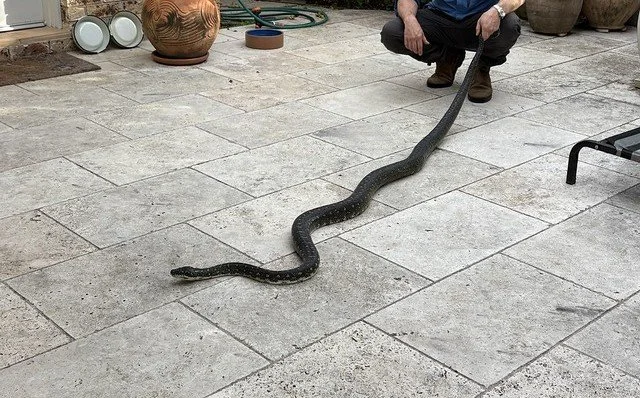
A Diamond Python has different requirements. It isn't interested in the frogs around your dam. Rats, mice, birds and other warm-blooded prey are far more interesting. That makes sheds, stables, feed rooms and roof spaces potentially attractive. Diamond Pythons are non-venomous and pose little threat to people. They're also superb climbers, so finding one above head height, across a beam or disappearing into a roof isn't unusual. If you've got rodents around a shed, you've effectively put out dinner for a python. Getting the python removed deals with today's problem. Getting the rodents under control deals with the reason another one may eventually arrive.
Brown Tree Snakes around outbuildings
Brown Tree Snakes are another species we encounter in the Kenthurst area. They're nocturnal, slender and excellent climbers. They feed on birds, lizards and small mammals, so properties with plenty of established vegetation, sheds and outbuildings can suit them well. They're mildly venomous but aren't regarded as dangerous to people. Brown Tree Snakes can, however, be defensive when cornered. Don't try to grab one because you've decided it isn't particularly dangerous. Leave it alone and let someone experienced deal with it if removal is necessary.
Green Tree Snakes are the easy ones. They're completely non-venomous and harmless to people. They're fast, active during the day and usually disappear very quickly once they realise they've been noticed. And despite the name, they're not necessarily green. We see animals ranging from olive and brown through to grey and occasionally beautiful blue individuals. If a Green Tree Snake is simply passing through the garden, there's normally no reason to do anything. And then there are the goannas Not every reptile call in Kenthurst involves a snake.
Golden-crowned Snakes in established gardens
Kenthurst has plenty of established gardens, and that's where some of the smaller species turn up. Golden-crowned Snakes are secretive, mostly nocturnal snakes that spend much of their time hidden at ground level. People commonly discover them when moving timber, rocks, pots or garden materials, or working through leaf litter and mulch. They're venomous, but aren't considered dangerous to people. They're small, shy snakes and usually want nothing to do with us. If you uncover one, put down whatever you've moved and give the snake an opportunity to leave.
are large goannas and are very much at home around the bushier parts of the Hills. An adult Lace Monitor walking across the lawn can look formidable, particularly if you've never encountered one at close range. They can exceed two metres in total length, but they're not wandering through your property looking for trouble. Give them space and they'll generally keep moving. Problems occasionally arise when one gets into a chicken enclosure, shed or other confined area and can't easily find its way back out.
The stable and feed shed problem
One thing worth paying particular attention to on Kenthurst properties is animal feed. Horse feed, chicken grain and bird seed don't directly attract snakes. They attract rats and mice. The rats and mice attract snakes. A bag of feed with a small hole in it can support rodents for months. Grain spilled behind containers or underneath shelving does the same thing. If we're repeatedly finding snakes around a particular shed, stable or chicken enclosure, rodents are one of the first things worth investigating. Use sealed containers, clean up spilled grain and don't leave bags accessible to rodents.
About Chris Williams
Chris Williams founded Urban Reptile Removal after more than three decades working professionally with Australian reptiles. His career has included working with reptiles at Taronga Zoo and the Australian Reptile Park, and he later founded Snake Ranch, which grew to become Australia's largest reptile breeding facility.
Chris has written or co-authored eight books on Australian reptiles and amphibians, including Urban Reptiles and Reptiles of the Greater Sydney Region. He has served as President of the Australian Herpetological Society since 2014 and now works full-time catching and relocating snakes and other reptiles throughout Greater Sydney. Urban Reptile Removal — 0418 633 474
Can you snake-proof a Kenthurst acreage?
No. And anyone telling you they can make several acres of semi-rural land completely snake-proof isn't being realistic. What you can do is create a much less attractive area immediately around the places where people spend their time. Think about the first 10–20 metres around your house, sheds, pool and outdoor areas. Keep grass under control. Don't leave sheets of tin or timber lying flat on the ground. Raise stored materials. Reduce clutter. Control rodents. Secure feed. Keep vegetation around frequently used buildings manageable. You're not trying to sterilise the property. You're simply removing easy hiding places and food sources close to the house.
Snake repellents aren't the answer We regularly get asked about commercial snake repellents. Our advice is straightforward: save your money. Ultrasonic devices, powders, sprays and other supposed snake deterrents aren't a substitute for good property management. A snake following the smell of a rat into a shed isn't going to turn around because somebody has plugged an ultrasonic gadget into the wall. Deal with what actually attracts snakes: food, shelter and access.
Need snake removal in Kenthurst?
If you've found a snake somewhere that creates a genuine problem, don't try to catch it yourself. Keep your distance. Keep watching it. Then call Urban Reptile Removal on 0418 633 474. We provide professional snake catching and snake removal throughout Kenthurst and the surrounding Hills District, seven days a week.