
Can Snakes Hear You? What Science Says (And Why It Matters in Sydney Backyards)
Can Snakes Hear You? What Science Actually Says, and Why It Matters in Sydney Backyards
By Chris Williams, Urban Reptile Removal
People are usually surprised to hear that snakes are deaf. The conversation on the phone tends to go: "Oh, I didn't know that." Then a pause. Then: "But they pick up vibrations, don't they?"
That's where it gets interesting. Snakes do detect vibration, but the version of that fact you'll see online and around backyard barbecues is oversimplified and often misleading. Modern research is clear. Snakes are not stone deaf, but they don't hear in anything like the way humans do. They're best described as vibration specialists, combining vibration detection, vision and scent to read what's happening around them.
That nuance matters once you start applying it to real-world situations: Sydney backyards, bushland edges, construction sites and suburban homes. Most of the popular advice about how to behave around snakes is based on a misunderstanding of how they actually perceive the world.
Are Snakes Deaf?
In the everyday meaning of hearing, yes. Snakes have no external ears, no ear openings and no eardrums. Those structures were lost during the evolution of snakes, most likely when their early ancestors adapted to burrowing or semi-aquatic life.
Internally though, snakes still have a functional inner ear with sensory hair cells, and a single middle-ear bone called the columella that connects to the jaw rather than to a tympanic membrane. They aren't picking up sound pressure waves moving through the air the way mammals do. They're picking up vibration that travels through the skull, jaw and body.
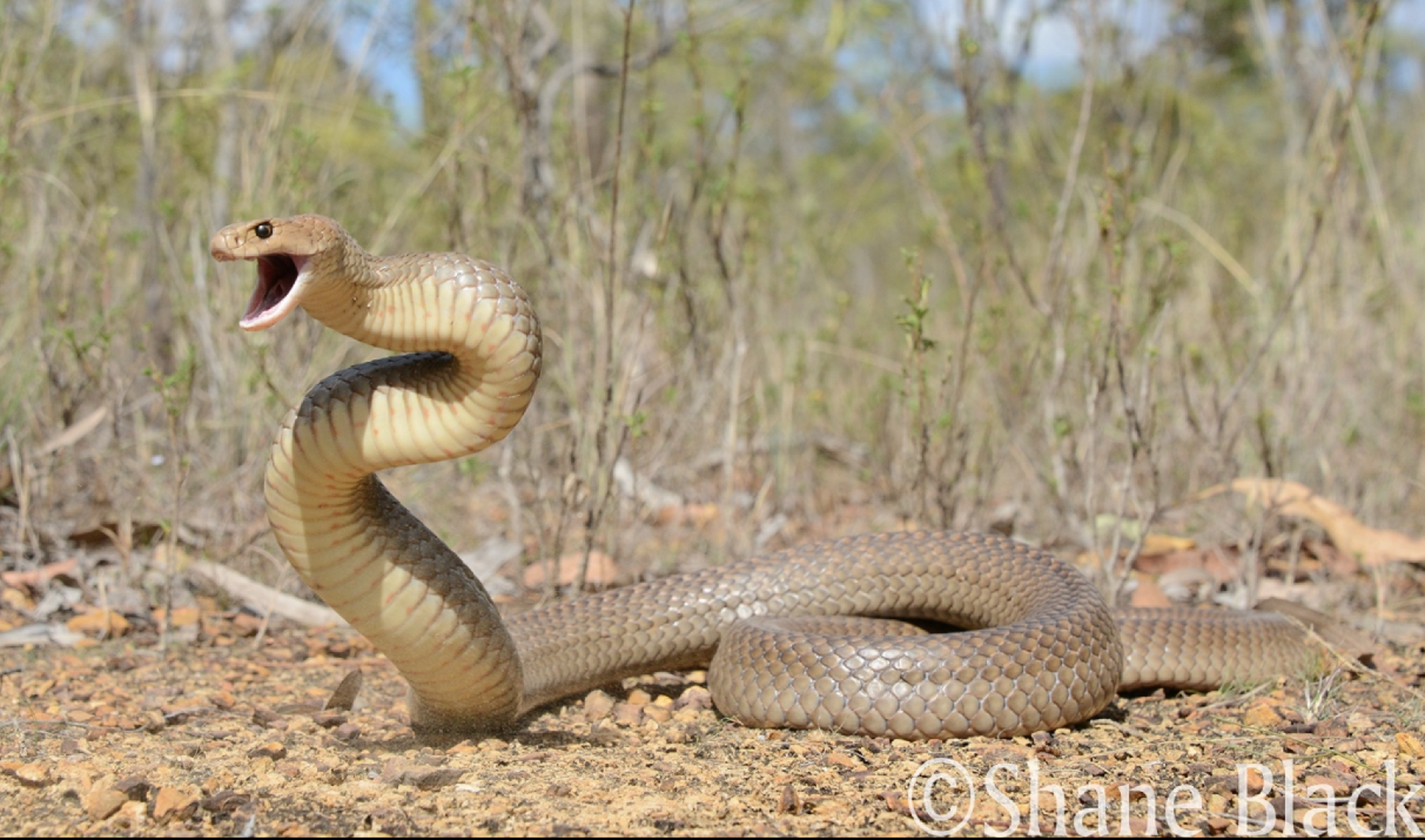
Eastern Brown Snakes, like this one, have excellent eye sight, but are deaf to airborne sounds.
So when people say snakes are deaf, that's broadly correct. When they add "but they feel vibrations", that's also correct, just incomplete.
What the Research Actually Shows
Two peer-reviewed papers are central to the modern understanding of snake hearing. The first is Young's 2003 paper on snake bioacoustics. The second is the 2012 study by Christensen and colleagues on hearing in the Royal Python, which has reshaped much of the field.
Between them, the research shows that snakes are most sensitive to low-frequency vibration, detect vibration through bone conduction rather than eardrums, and can respond behaviourally to both ground-borne vibration and airborne sound that causes the skull itself to vibrate. Christensen's work in particular demonstrated that what looks like a snake "hearing airborne sound" is actually the snake detecting sound-induced vibrations in its own head, not sound pressure as we'd understand it.
The short version: snakes don't hear sound. They detect vibration, including vibration caused by sound.
Why a Sydney Backyard Is Nothing Like a Laboratory
This is where popular understanding starts to come unstuck.
Laboratory studies of snake hearing are done under controlled conditions: uniform substrate, known vibration sources, measured frequencies, minimal background noise. A Sydney backyard is the opposite of all of that. Vibration transmission in a real-world environment depends heavily on the substrate type (soil, sand, grass, concrete, rock), how continuous that surface is, the distance from whatever's making the vibration, and what's actually generating it.
A footstep on concrete transmits vibration very differently from a footstep on grass or loose soil. A shoe on sand behaves differently again. Add garden beds, retaining walls, pavers, tree roots, decking and pool surrounds, and you end up with a highly fragmented vibration environment. A snake in that environment isn't receiving a clean, consistent signal. It's receiving fragments of information that often don't add up to a clear picture.
Why Stomping Doesn't Reliably Scare Snakes Away
The most common piece of bush-walker advice in Australia is to stomp your feet or bang a stick along the ground to "warn snakes" so they move away. The science doesn't support this idea in any reliable way.
Yes, snakes can detect vibration. No, that doesn't mean they interpret every vibration as a threat. Snakes live in a world of constant vibration: wind moving vegetation, birds landing and taking off, lizards and frogs and rodents moving nearby, other snakes, distant vehicles, human activity. If snakes reacted with fear to every vibration they detected, they'd be permanently stressed, and they wouldn't have survived as a lineage for tens of millions of years. Detection isn't the same thing as alarm. Most vibration gets categorised as background and ignored.
In cluttered urban environments, what stomping actually tends to do is push snakes deeper into cover. A snake under a slab or behind a retaining wall feels the vibration, decides the safest response is to stay where it is, and stays there. The myth of stomping snakes out into the open in front of you is exactly that, a myth.
Vision Is Often the Real Trigger
In real-world encounters, vision usually matters more than vibration. Snakes don't see fine detail, but they're good at detecting large moving shapes, sudden changes in light and shadow, and motion against a static background. In a lot of encounters, the snake has already seen the person and quietly retreated before the person even knew it was there.
When someone tells us "it just appeared out of nowhere", what almost always happened is that the snake saw them coming, stayed still in the hope of not being noticed, and only became visible once the person had closed the distance. Freezing in place is a classic predator-avoidance strategy, and it works well in the wild because most predators rely on movement to detect prey.
Smell Is the Most Important Sense
Neither hearing nor vision is a snake's primary sense. Smell is. Snakes flick their tongues to collect scent particles, which are analysed by the Jacobson's organ in the roof of the mouth. That system lets them identify prey, detect predators, recognise other snakes, and understand what has recently moved through an area.
Most snake decisions are made using a combination of scent, vision and general vibration awareness. Vibration alone is rarely the deciding factor.
What This Means for Footsteps Around the House
The practical answer to "can a snake hear me walking around the house?" comes down to a few specific factors. Footsteps on solid structures like concrete slabs, decks and paving can create vibration that a snake might detect. Footsteps on soft or broken ground often transmit very little usable signal. And even when a snake does detect a vibration, that detection doesn't automatically translate into fear or flight.
What matters more, in practice, is how close the person is, whether the snake has been seen, and whether the snake has an escape route. The default response of almost every Australian snake to a person is to avoid confrontation, not to seek it.
Why Snakes End Up Under Houses, Decks and Pathways
Understanding vibration sensitivity helps explain why snakes so often end up where they do in urban environments. Roof cavities, wall voids, under slabs and pathways, behind retaining walls. These spots offer stable temperatures, physical protection, reduced visual exposure, and crucially, vibration dampening. The snake feels less of whatever's happening outside, so it feels safer.
Ironically, attempts to "scare" snakes out of these spots with noise often push them further in, making them harder to locate. The instinct to make noise is the opposite of what actually works.
What This Means for Professional Snake Catching
At Urban Reptile Removal, this understanding shapes how we work. Experienced snake catchers move slowly and deliberately, avoid unnecessary banging or vibration, maintain escape routes for the snake rather than cornering it, and read the environment rather than relying on folk wisdom. That approach reduces stress for the animal and significantly improves safety for everyone on site.
A snake that feels it has somewhere to go behaves very differently from a snake that feels trapped. Reading that distinction correctly is most of the job.
Common Myths, Cleared Up
Do snakes hear music or TV? No. They might detect vibration from heavy bass through a floor, but they aren't processing the audio as sound.
If I stand still, can a snake still detect me? It probably won't detect you through vibration alone if you're standing still, but it may still see or smell you.
Are snakes constantly aware of every vibration? No. Like all animals, they filter incoming sensory information and ignore the bulk of it as background.
What to Do When You Find a Snake
Regardless of how a snake detected you, or whether it did, the rule when one turns up in your home, shed, roof, pool area or yard is simple. Don't try to deal with it yourself. Step back. Move children and pets to a safe area. Keep a visual on the snake if you can do so from a safe distance. And call a licensed snake catcher.
Urban Reptile Removal provides professional, licensed snake removal across Sydney and the wider New South Wales corridor, working from current science and real-world experience to do the job safely and humanely.
Urban Reptile Removal 0418 633 474. Licensed, insured, on call 24/7 across Sydney and New South Wales.
References
Young, B.A. (2003). Snake bioacoustics: toward a richer understanding of the behavioral ecology of snakes. Quarterly Review of Biology, 78(3), 303–325.
Christensen, C.B., Christensen-Dalsgaard, J., Brandt, C., & Madsen, P.T. (2012). Hearing with an atympanic ear: good vibration and poor sound-pressure detection in the royal python. Journal of Experimental Biology, 215, 331–342.
