Eastern Water Skink
The Eastern Water Skink (Eulamprus quoyii) — Sydney's Sunbathing Stream Specialist
If you have spent any time near a creek, pond or backyard water feature in Sydney during summer, you have almost certainly seen an Eastern Water Skink (Eulamprus quoyii). They are the lizards basking on the sandstone rock beside the stream, the ones that vanish in a flash when you walk too close, and the ones that pop up around backyard ponds, drains and damp garden corners.
At Urban Reptile Removal we get plenty of calls from homeowners who have noticed a "big striped lizard" near a pool or pond and want to know what it is. The answer is almost always an Eastern Water Skink — one of the most common, most visible and most successful native reptiles in the Greater Sydney region. Because we cover all native reptiles, not just snakes, we deal with lizard calls like these regularly.
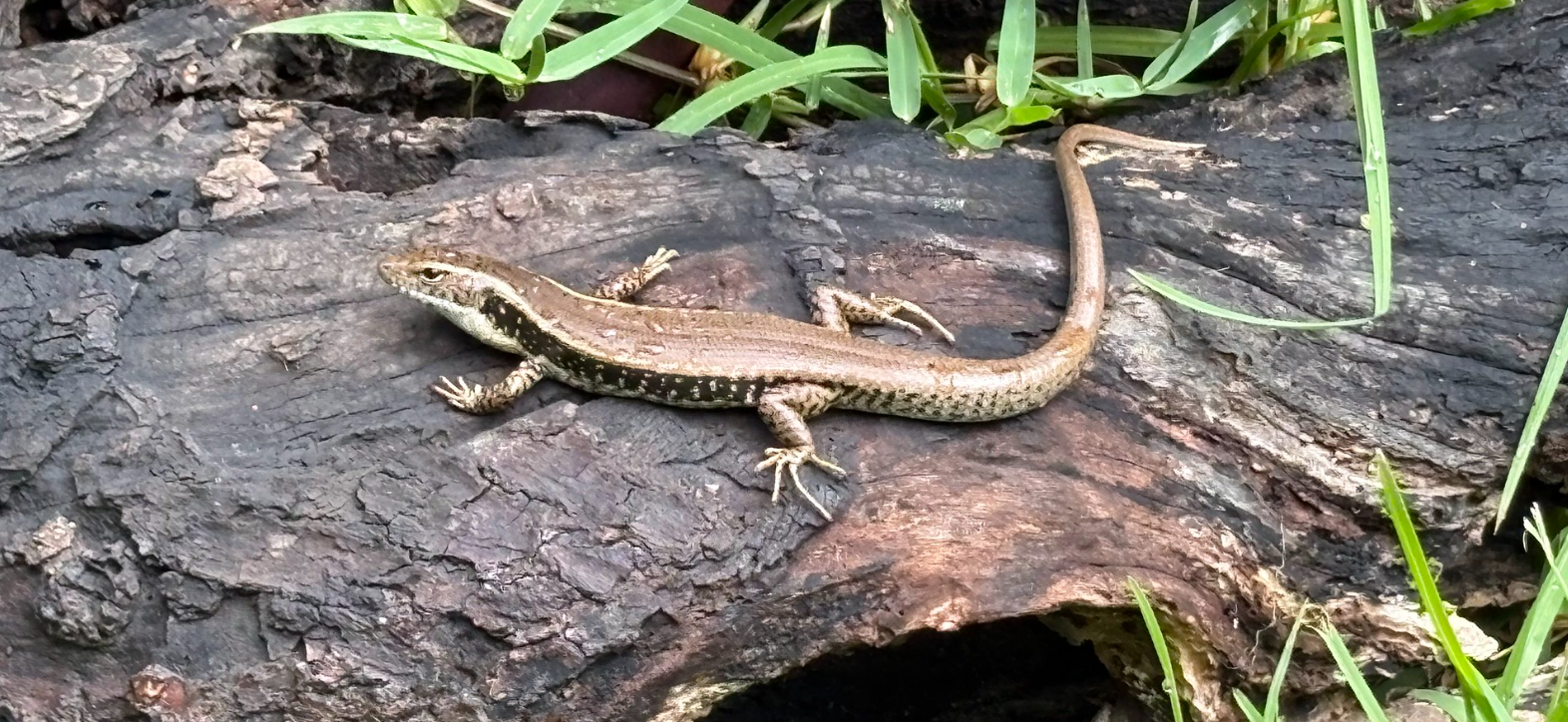
This Water Skink was spotted sunning itself beside a creek in Marsden Park, NSW.
What is the Eastern Water Skink?
The Eastern Water Skink (Eulamprus quoyii) is a medium-sized native skink, one of three water skink species in the broader eastern Australian region. It is the only one of the three that thrives in the immediate Sydney area, and is by far the most commonly observed.
Snout-vent length: approximately 115mm
Total length: up to 300mm
Conservation status: IUCN Least Concern
Urban Adaptation Rating: ★★★★★
Activity: Diurnal, most active in warmer months
Distribution in Sydney: All five zones — Sydney Basin, Illawarra, Southern Highlands, Blue Mountains and Central Coast
How to identify an Eastern Water Skink
The Eastern Water Skink has a distinctive look that, once learned, is easy to spot:
Olive-brown to dark brown base colour
Black speckling across the back and flanks
Pale dorsolateral stripes running along each side of the body
Stripes extend well beyond the shoulder — an important diagnostic feature
Darker flanks, sometimes with blotches
Belly cream to yellow, sometimes with a golden hue in breeding season
Long tail relative to body size
Sleek, streamlined body built for fast running and swimming
No throat marbling
The dorsolateral stripes are the key field mark. Where some related water skink species (E. heatwolei and E. tympanum) have stripes that fade or stop near the shoulder, the Eastern Water Skink's stripes run the length of the body. Combined with the longer tail and larger overall size, this makes Sydney's water skink relatively easy to separate from its less common cousins.
Where do Eastern Water Skinks live?
The Eastern Water Skink is one of the great success stories of Sydney's urban reptile fauna. Their natural habitats include the obvious waterway environments — but they have adapted brilliantly to human-modified landscapes:
Natural habitats:
Streams, creeks and rocky watercourses
Rainforest margins
Wet sclerophyll forest
Riverbanks and gullies
Rocky outcrops near water
Urban habitats:
Backyard ponds and water features
Suburban creeks and stormwater drains
Park lakes and ornamental water bodies
Garden retaining walls near damp ground
Bushland reserves throughout Greater Sydney
Damp rockeries and shaded garden corners
This adaptability is part of why they are so commonly encountered. A small water feature in a suburban garden is often enough to attract them, and once established they can persist for years.
https://lizardremoval.com.au/skinks-lizard/
Behaviour and the basking habit
Eastern Water Skinks are quintessential sun-baskers. On warm mornings and late afternoons, you will see them on flat rocks, concrete edges, fallen logs and brickwork — usually with quick access to water or thick cover.
Their behaviour is fast, alert and decisive. Approach one slowly and you might get to within a couple of metres before it moves. Move too quickly and it is gone — either into water with a splash or under cover in a streak of dappled brown. They are excellent swimmers and will readily dive and stay submerged for surprising periods to escape predators.
The basking is not just for show. Like all reptiles, they need to raise their body temperature for digestion, hunting and reproduction. The water-and-rock habit gives them the best of both worlds: warmth on the rock, instant escape into the water.
Diet and lifestyle
Eastern Water Skinks are opportunistic predators. They eat a wide range of small prey:
Insects of all kinds — flies, beetles, ants, crickets
Spiders
Earthworms
Smaller skinks (occasionally)
Tadpoles and very small fish (rare but recorded)
Plant matter and fruit occasionally
Carrion when encountered
This dietary flexibility is another reason for their urban success. A garden with insects, a pond with worms in the damp soil around it, and the occasional moth attracted to outdoor lights provides everything a water skink needs.
Are Eastern Water Skinks dangerous?
Not at all. They are completely harmless to humans and pets. They have no venom, no significant defensive bite, and they actively avoid contact. If handled (which should only be done by a licensed catcher or for genuine welfare reasons), they may nip and certainly drop their tail, but they cannot hurt you in any meaningful sense.
The risk goes the other way. Cats take a heavy toll on water skinks in suburban areas. Pesticide use in gardens reduces their prey base. And many die in swimming pools — falling in and being unable to climb the smooth sides.
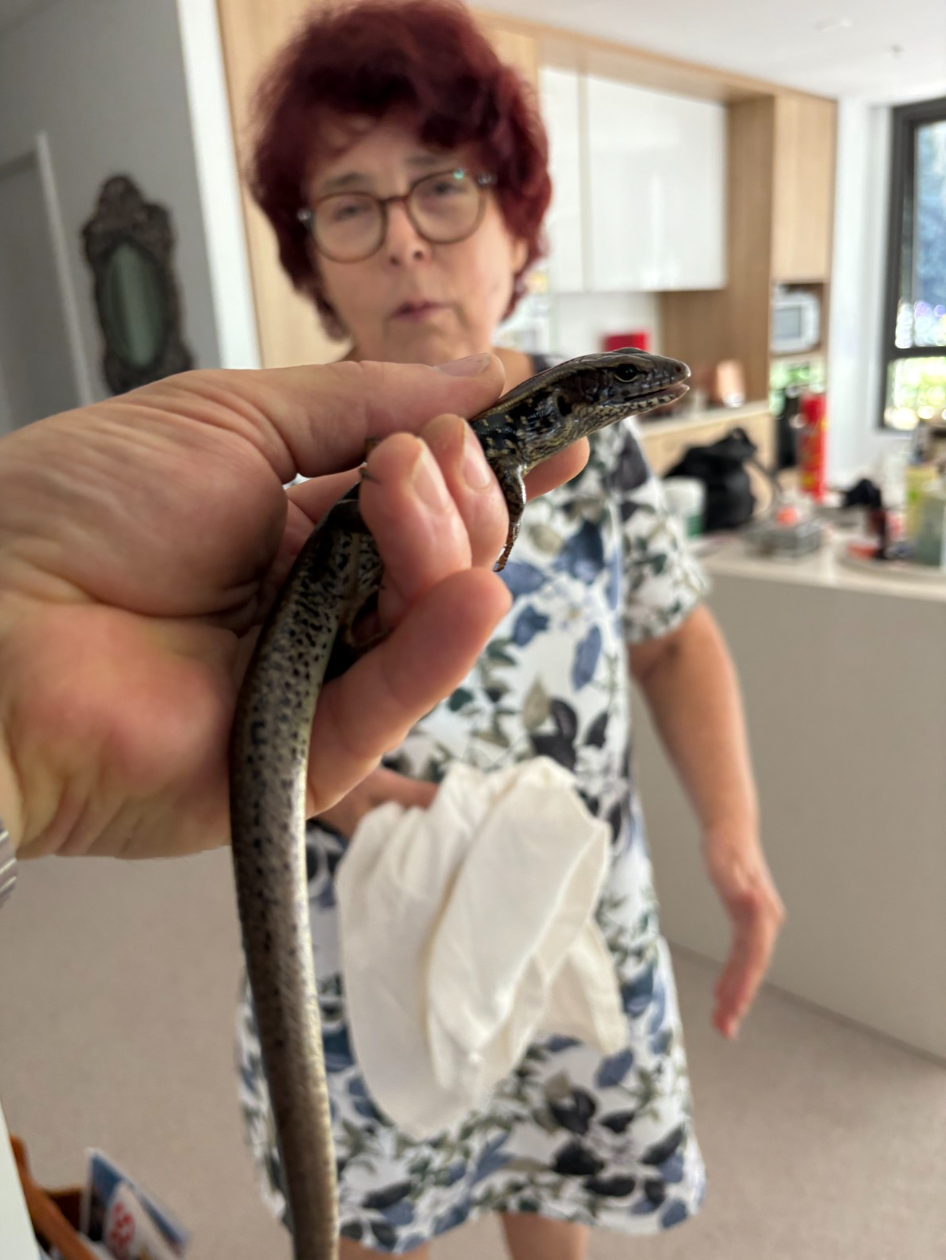
This water skink had entered a unit in Forestville, NSW, much to the owners distress. They are only dangerous to cockroaches and spiders, but we understand not everyone loves them as much as we do.
Breeding and reproduction
The Eastern Water Skink has a reproductive strategy that contributes significantly to its success:
Mating: Occurs in spring
Live-bearing: Unlike many skinks, water skinks give birth to live young rather than laying eggs
Litter size: Up to nine offspring
Birth timing: Summer
Independence: Young are fully independent at birth and disperse to find their own territories
The live-bearing strategy is an adaptation to cooler, wetter climates where eggs in soil would face higher risks of failure. By carrying developing young internally, the female can thermoregulate them through her own basking behaviour — a significant advantage in variable Sydney weather.
A pool problem
One issue worth flagging for Sydney homeowners with pools: Eastern Water Skinks frequently drown in backyard swimming pools. They are drawn to water for natural reasons, fall in, and cannot climb the smooth tiled or fibreglass sides.
Simple solutions:
A floating "frog ramp" or pool escape device gives skinks and other small wildlife a way out
A rough-surfaced object such as a brick or tile placed at the edge can also work
Check pool filters and skimmer baskets regularly for trapped wildlife
These small interventions save significant numbers of native reptiles, frogs and small mammals every year.
What to do if you find an Eastern Water Skink at your home
Leave it alone. The Eastern Water Skink is one of the best neighbours your garden can have. They eat insects and other small invertebrates, they pose no risk to people or pets, and they are a sign of a healthy local ecosystem.
Practical steps:
Enjoy them. They are genuinely beautiful animals when you take a moment to look properly.
If you find one trapped (in a pool, garage or shed), gently herd it toward an exit rather than trying to handle it.
If a cat keeps killing them, consider keeping the cat indoors. Cat predation is one of the major pressures on suburban skinks across Sydney.
Install a pool escape ramp if you have a swimming pool near skink habitat.
What you should not do:
Do not kill them. They are protected native wildlife.
Do not use insecticides in gardens with skinks. The poisons accumulate up the food chain.
Do not relocate them. Water skinks are highly territorial and a relocated animal usually does not survive.
How to distinguish from other water skinks
Sydney sits at the edge of the range of two other water skink species, Eulamprus heatwolei (Yellow-bellied Water Skink) and Eulamprus tympanum (Southern Water Skink). The differences:
Stripe length:E. quoyii has dorsolateral stripes that extend well beyond the shoulder. The other species have stripes that fade or stop near the shoulder.
Throat marbling:E. quoyii lacks the throat marbling pattern seen in the other water skinks.
Body size:E. quoyii is the largest of the three.
Tail length: Proportionally longer in E. quoyii.
In practice, in the Greater Sydney region, the vast majority of water skinks you encounter will be Eastern Water Skinks. The other two species occur more often at higher elevations and further south.
Summary
The Eastern Water Skink (Eulamprus quoyii) is one of Sydney's most successful and most visible native reptiles. Common across all five distribution zones of the Greater Sydney region, adapted to both natural waterways and urban garden ponds, and genuinely beneficial to have around, they are a species worth appreciating rather than dismissing. If you have a creek, pond or even a damp corner with good cover in your Sydney garden, you almost certainly have water skinks — and that is a good sign.
Found a reptile you need identified or removed in Sydney? Urban Reptile Removal operates 24/7 across the Greater Sydney region. We are fully licensed and insured, and we can identify and safely manage any reptile you encounter. Call 0418 633 474.
https://www.inaturalist.org/taxa/100709-Eulamprus-quoyii
https://bie.ala.org.au/search?sortField=score&dir=desc&q=%28Eulamprus+quoyii%29
Interested in Sydney Reptiles?
You can buy the book, featuring full page descriptions on over 70 species
https://sydneysnakecatcher.com.au/product/city-wildlife-guide-reptiles-of-sydney/
Saurophobia is the fear of lizards, and we can assure you — it’s very real.
Catching snakes seemed like the obvious direction for a business like Urban Reptile Removal. But over time, we began receiving a steady stream of calls from people needing help with lizards as well — everything from tiny skinks through to large goannas.
That led us to establish a second business focused specifically on lizard removals, making it much easier for people searching for this service to find the help they needed.

For the most up to date information on snakebite first aid, visit, snakebitefirstaid.com.au
