Snake Catcher West Pennant Hills
Urban Reptile Removal covers West Pennant Hills seven days a week, every day of the year. The most useful thing you can do before we arrive is maintain visual contact — a snake that has been watched is far easier to find. You don't need to take a photo or identify the species. Just watch where it goes, and if it disappears into cover, keep watching the spot where you last saw it. Snakes will often reappear within minutes once the area goes quiet. Do not try to catch, corner or kill it. Most snakebites occur when someone interferes with the animal. Give it space, call us immediately and let an experienced snake catcher deal with it safely.
About West Pennant Hills
West Pennant Hills is one of the most heavily vegetated residential suburbs in Sydney's northwest. The suburb combines large established blocks, mature gardens, swimming pools and substantial homes with several important bushland and creek corridors.
Cumberland State Forest occupies approximately 40 hectares in the centre of the suburb, while the Darling Mills Creek corridor runs through the southern side towards the Parramatta River. Richard Webb Reserve, Currawong Reserve and the New Farm Road bushland add further pockets of connected habitat. Together, these areas allow reptiles to move through the suburb without remaining entirely within the bush. Many West Pennant Hills streets sit directly beside bushland, while others contain mature trees, sandstone retaining walls and thick established gardens that reproduce the same conditions on a smaller scale. Even properties several streets away from a reserve can receive snakes moving along drainage lines, fence lines and vegetated easements.
The housing is equally important. Large homes with roof cavities, hedges that allow snakes to travel in the hedge and under it, extensive decking, pool equipment and detached sheds provide reliable shelter. Rodents living in roofs, garages and storage areas can attract diamond pythons, while frogs and skinks around pools, ponds and damp gardens attract smaller snakes. This combination makes West Pennant Hills one of the more consistently reptile-active suburbs in the Hills District.
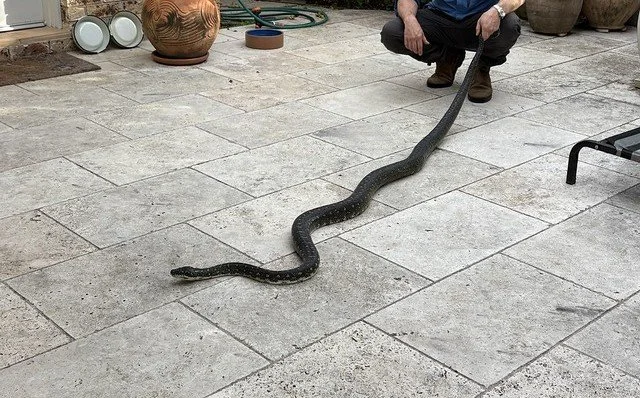
Diamond pythons, like this one, are common throughout West Pennant Hills.
What we see in West Pennant Hills
Diamond pythons are among the most frequently encountered snakes in West Pennant Hills. Cumberland State Forest and the surrounding bushland corridors sustain a substantial resident population.
Diamond pythons regularly move through trees, gardens, pergolas and roof spaces while searching for rats, possums and suitable shelter. Roof cavity callouts are particularly common in older homes and on properties adjoining bushland. They are non-venomous, but once a python disappears into a roof or wall cavity, locating and removing it can become extremely difficult.
Red-bellied black snakes are regularly encountered around Darling Mills Creek, drainage corridors and the damp gullies running through the suburb. Properties with swimming pools, ponds, shaded garden beds or poorly drained sections can also attract them.
Red-bellies are generally timid and will usually attempt to escape if given room. However, they are venomous and should never be approached or handled. Activity is strongest through spring and summer, particularly after rain when frogs and other prey become more active.
Eastern brown snakes occur in West Pennant Hills but are less strongly associated with the suburb’s densely forested sections. They are more likely to appear on drier, more open properties, cleared blocks and disturbed areas where ground cover is lower.
Eastern browns are fast, highly venomous snakes. If one is suspected, move away calmly, maintain visual contact from a safe position and call us immediately. Do not attempt to block its escape or force it into a confined space.
Blue-tongued lizards are common throughout established gardens, while Eastern water dragons occur around the creek corridors, pools and damp sections of the suburb. Many reported snake sightings turn out to be blue-tongues, water dragons or other harmless lizards moving through vegetation. That is never an issue. We are always happy to attend, identify the animal and confirm whether it poses any risk.
Golden-crowned snakes turn up in shaded gardens, sandstone landscaping and bushland-edge properties, particularly after warm summer rain. They are small, nocturnal snakes that spend much of their time beneath rocks, timber, leaf litter and garden materials.
Golden-crowned snakes are venomous, although their bites are generally considered medically minor. They are often mistaken for juvenile eastern brown snakes, which is another reason not to rely on a photograph or attempt your own identification.
Lace monitors are a familiar part of West Pennant Hills wildlife, especially around Cumberland State Forest and the larger bushland reserves. They may wander through yards, climb trees, investigate sheds or occasionally enter roof spaces while searching for food.
Although lace monitors are not snakes, a large animal appearing unexpectedly in a backyard can be confronting. They have powerful claws and should not be cornered or handled. Give them room and call us if one has entered a building or become trapped.
Where snakes go on West Pennant Hills properties
The hiding places reflect the suburb’s bushland-edge character and large residential blocks. Diamond pythons commonly enter roof cavities through gaps beneath tiles, eaves and service lines. They may also settle above garages, inside sheds or beneath decking where rodents are active.
At ground level, snakes shelter under decks and pergolas, behind hot water systems, around pool pumps and filtration equipment, beneath air-conditioning units, inside retaining walls and among stored garden materials. Thick hedges, shaded garden beds, woodpiles, outdoor furniture and gaps beneath sheds can all provide temporary cover.
Sandstone retaining walls are particularly difficult because they contain deep internal spaces that may connect with soil, drainage lines or adjoining gardens. A snake can disappear through a small gap and remain completely out of sight.
On bushland-edge properties, snakes frequently travel along the narrow zone between the home and the rear boundary. Leaf litter, fence gaps, fallen branches and dense vegetation provide a sheltered movement corridor. We search these areas methodically and use what you saw to narrow down the most likely hiding place.
After we leave
Every Urban Reptile Removal job ends with a brief walk-through of the property. We explain why the snake was likely there, what may be attracting it and what practical changes can reduce the chance of another encounter.
That may mean keeping grass short, removing clutter from fence lines, lifting stored materials off the ground, trimming dense vegetation away from buildings and sealing gaps used by rodents. Pet food should not be left outside overnight, and bird seed or unsecured rubbish should be managed carefully because anything that attracts rats and mice may eventually attract pythons.
We may also point out accessible roof spaces, damaged vents, gaps around plumbing or other entry points. No snake-repellent sprays and no gimmicks. Just sensible changes based on how snakes actually use a property.
About Chris Williams
Chris Williams has spent more than 35 years working with reptiles and amphibians throughout Australia and is widely recognised as one of the country’s leading herpetologists. Since 2014, he has served as President of the Australian Herpetological Society, helping to promote reptile education, research and conservation nationwide.
His professional background includes roles with the Australian Reptile Park and Taronga Zoo, as well as extensive field experience working with reptiles throughout New South Wales. Chris also founded Snake Ranch, which grew to become Australia’s largest reptile breeding facility and, at its peak, housed approximately 3,500 reptiles.
Chris has authored seven books on Australian reptiles, amphibians and wildlife and is regularly interviewed about snakes and human–reptile interactions.
Through Urban Reptile Removal, Chris continues to train and mentor snake catchers throughout New South Wales, helping ensure that the highest standards of safety, professionalism and reptile knowledge are maintained across the network.
For a snake catcher in West Pennant Hills, CALL NOW on 0418 633 474. Snake in the roof, snake beside the pool, snake in the garden or snake along the bushland boundary. Urban Reptile Removal — seven days a week, every day of the year.