

How an Australian Snake Changed an Entire Island
The Brown Tree Snake is a familiar native species across much of northern and eastern Australia. In its natural environment, it forms part of a functioning ecosystem.
But when several Brown Tree Snakes were accidentally transported to Guam after the Second World War, the consequences were extraordinary. Within decades, this adaptable nocturnal predator had driven most of Guam’s native forest birds to extinction, disrupted the island’s forests, caused an explosion in spider numbers and created an ongoing problem that authorities are still struggling to control.
Guam is a tropical island in the western Pacific covering approximately 540 square kilometres. That makes it only slightly smaller than Chicago and about one and a half times the size of Tasmania’s Bruny Island.
Despite its modest size, Guam once supported a distinctive community of birds, lizards, bats and other animals. Many had evolved in isolation without an efficient climbing snake as a predator. That changed during the late 1940s.
Brown Tree Snakes are native to Australia, Papua New Guinea and several neighbouring islands. The Guam population is believed to have originated around Manus Island in the Admiralty Islands, north of Papua New Guinea. The snakes were most likely concealed in cargo containing American military equipment transported to Guam shortly after the Second World War. As nocturnal animals that readily shelter inside vehicles, containers, buildings and stored materials, Brown Tree Snakes were particularly well suited to becoming accidental stowaways. Urban reptile removal regularly remove them from homes in Sydney, particularly on Sydney’s Northern Beaches, like this particular animal that was loose in a home for almost two weeks! https://au.news.yahoo.com/180cm-discovery-in-childs-bedroom-in-aussie-suburbs-after-almighty-thump-sparks-excitement-040012125.html
Only a small number may have made the journey. Unfortunately, that was enough. Guam provided abundant prey, warm conditions and few effective predators. The snakes spread across the island and eventually reached densities that have historically been estimated at up to 11,600 snakes per square kilometre in some locations.
The consequences for Guam’s wildlife were catastrophic. Brown Tree Snakes are agile climbers that feed on birds, eggs, nestlings, lizards and small mammals. Guam’s native birds had not evolved alongside a predator capable of reaching nests high in the forest canopy. The snakes contributed to the disappearance of nine of Guam’s 11 native forest bird species. Some were eliminated from Guam but survived on neighbouring islands or in captivity. Others, including the Guam Flycatcher, became globally extinct. Researchers even discovered Brown Tree Snakes using a previously unknown form of movement called “lasso locomotion”. The snake loops its body around a smooth trunk or pole and slowly works its way upwards. This allows it to overcome some barriers designed to protect nesting birds. The result is that forests once filled with birdsong are now remarkably quiet.
Removing birds from an ecosystem affects far more than the birds themselves. Many of Guam’s forest birds ate spiders and other invertebrates. Once the birds disappeared, that predation pressure was removed. Researchers comparing Guam with nearby snake-free islands found that spider-web densities were up to 40 times higher on Guam during the wet season. Even during the dry season, web densities were approximately 2.3 times higher. The snakes were not directly causing spiders to reproduce. Instead, they removed one of the spiders’ principal predators. This is known as a trophic cascade: changing one part of a food web produces a series of effects throughout the ecosystem. Bird losses have also reduced seed dispersal. Many native trees rely on birds to carry seeds away from parent plants. Without them, seeds frequently fall directly beneath the trees, where seedlings face greater competition and are less likely to survive. The long-term structure of Guam’s forests may therefore continue to change.
Brown Tree Snakes have also had a significant effect on Guam’s residents and infrastructure. The snakes regularly climb power poles and electrical equipment, causing short circuits and blackouts. These outages have cost Guam millions of dollars through repairs, lost productivity and damage to electrical systems. Snakes also enter homes, sheds and other buildings in search of prey.
Brown Tree Snakes are rear-fanged and mildly venomous. Although they are not generally considered highly dangerous to healthy adults, bites can be more serious for babies and small children. Authorities now use traps, night searches, detector dogs and cargo inspections to prevent snakes from leaving Guam and establishing populations on other Pacific islands.
The Guam invasion presented scientists with an interesting genetic puzzle. A population founded by only a handful of snakes should experience a severe genetic bottleneck. Limited genetic diversity generally increases inbreeding and reduces a population’s ability to respond to disease and environmental change. New research has revealed that Guam’s Brown Tree Snakes possess more hidden genetic variation than earlier methods could detect. Researchers identified more than 19,000 structural variations in their DNA, including duplicated, deleted and rearranged sections. Many of these variations occur in genes associated with immunity, stress responses and the sense of smell. This hidden diversity may help explain how such a small founding population survived, adapted and expanded so dramatically. The discovery may also have implications for endangered species. Some threatened animals could possess forms of genetic variation that standard measurements have previously overlooked.
The Brown Tree Snake’s impact on Guam does not make it a destructive species everywhere. In Australia, it is a native predator living alongside animals that have evolved with snakes. Its prey species, competitors and predators are all part of the same ecological system. Guam demonstrates what can happen when a native animal is transported beyond its natural range and introduced to an ecosystem that is unprepared for it. Brown Tree Snakes occur across northern and eastern Australia, from the Kimberley and Top End through Queensland and south along the NSW coast to approximately the Sydney region. Urban Reptile Removal regularly encounters and relocates Brown Tree Snakes, particularly around Sydney’s Northern Beaches in suburbs like Bayview, Davidson, Terrey Hills and Killarney Heights. They become progressively more common farther north along the east coast and are widespread across tropical northern Australia. They are mainly nocturnal and are excellent climbers. During the day they may shelter in roof spaces, sheds, thick vegetation, tree hollows and stored materials. Their colour varies considerably, meaning they are not always immediately recognisable.
If you find a Brown Tree Snake around your home, keep a safe distance, watch where it goes and contact a licensed snake catcher. Do not attempt to catch or kill it yourself. The story of Guam is not evidence that Brown Tree Snakes are inherently harmful. It is a powerful demonstration of why wildlife belongs within its natural range—and how the accidental movement of even a few animals can transform an entire ecosystem
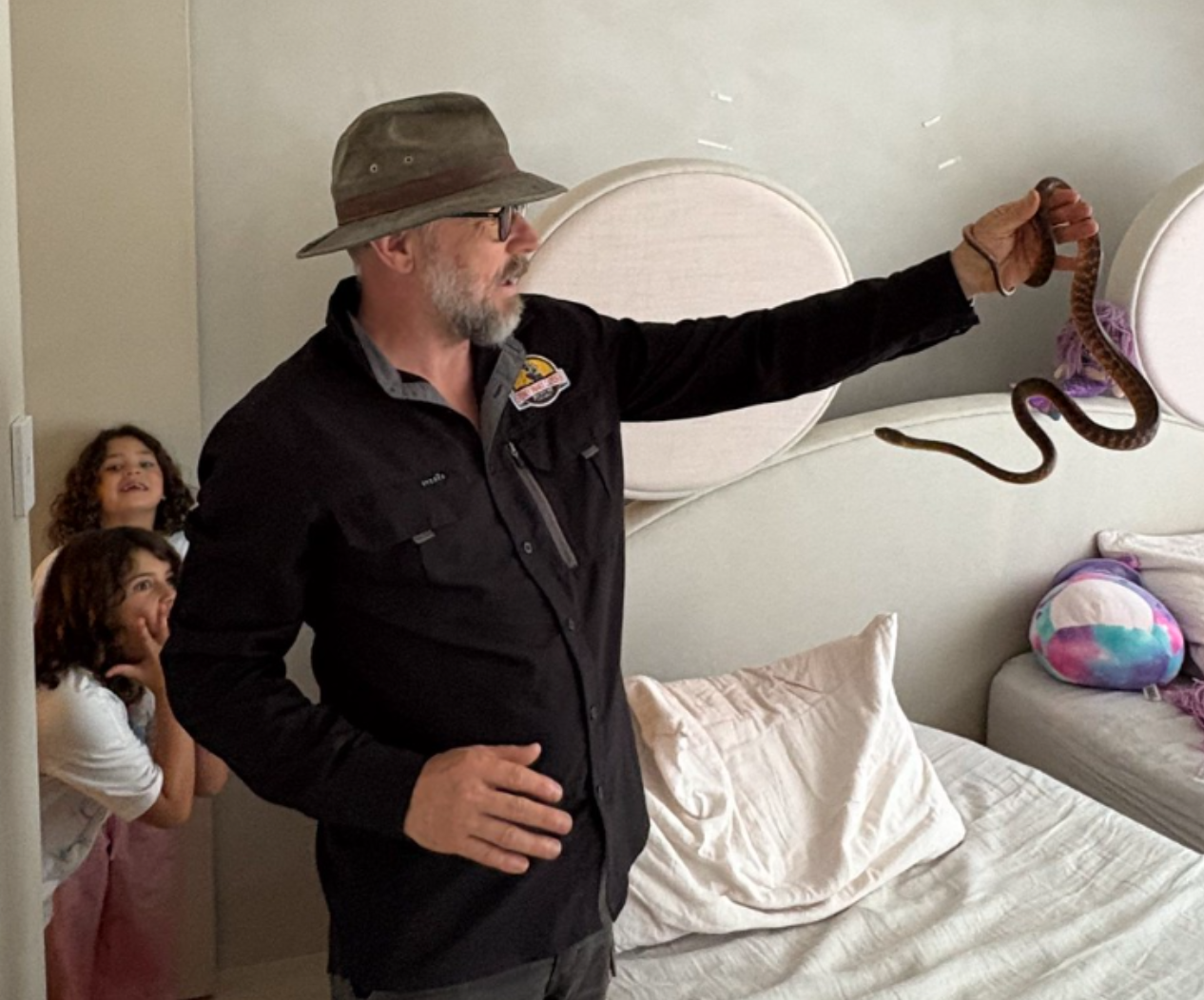
Chris Williams with a brown tree snake on Sydney’s Northern Beaches
