
Box Hill Snake Catcher
If there's a snake at your home, construction site, or property in Box Hill, call 0418 633 474.

Stay calm, step back, bring children and pets indoors, and let us handle the rest. You don't need to take a photo or identify the snake. Snakes almost always retreat to the nearest hiding place, and a trained catcher will locate it when we arrive. We stay on the phone with you and talk you through what to do until we get there.
About Box Hill
Box Hill has grown faster than almost any other suburb in The Hills Shire over the past decade. New estates, ongoing construction, landscaped yards, and remaining natural corridors create a particular kind of snake habitat — one where building activity displaces wildlife from established cover, drives prey species (rodents, frogs, skinks) into new locations, and produces a steady supply of leftover construction materials, timber piles, and quiet corners for snakes to use as cover.
Snakes aren't entering Box Hill to frighten people. They're moving through the landscape the way every other native animal does, and Box Hill happens to be a productive place for them — new gardens with established plantings, drainage lines, newly established waterways, and rodent populations that grow alongside any expanding suburb.
The species we see most often
Red-bellied black snake. The species we see most often in Box Hill. Glossy black with a red or pink underside. Common around drainage lines, grassed areas, frog habitat zones, and newly established waterways. They bask on concrete, driveways, and footpaths in the morning, then retreat into shade. Venomous, but shy. They flee if given space. Should only be handled by a professional.
Golden-crowned snake. Small, slender, and active mostly at night. Pale yellow marking across the head, pink or reddish underside. Often mistaken for baby brown snakes because of size and speed. Venomous, but bites usually produce only mild local symptoms. In Box Hill they hide in mulch beds, under construction timber, behind garden edging, and beneath leftover building materials. Most active after rain.
Green tree snake. Slim, fast, harmless. Olive, bright green, grey, or almost black, with a yellow underside. They move quickly through Box Hill gardens, fences, roofs, and garages. When startled, they flatten and show flashes of blue between the scales — alarming but not dangerous. Not venomous, but still need a trained catcher to safely relocate from a home.
Blue-tongued lizard. Not a snake, but the most common reason Box Hill residents call us thinking they've seen one. Heavy-bodied skinks that hiss, puff up, and display a bright blue tongue when threatened. Common across new estates — they move noisily through gardens, which alarms residents who aren't sure what they're looking at. They eat insects, snails, fruit, and pet food, and are excellent for the garden. We'd rather come out for a blue-tongue than not come out and find out it wasn't.

Where snakes hide in Box Hill properties
New-estate properties have their own pattern of snake habitat — different from leafy older suburbs because the cover is different. The places we find snakes most often:
Behind hot water systems and air conditioners
Under pot plants and raised tubs
In garages behind storage shelves
Beneath new retaining walls
In roof cavities and wall gaps
Behind piles of construction timber
Under leftover tiles, sheeting, or building materials
In garden beds, shrubs, and hedges
In compost heaps and mulch piles
Behind water features and decorative rockeries
Along fence lines and narrow side passages
Under outdoor furniture and tarps
Beneath decks, stairs, and raised garden structures
When you call us, you don't need to follow the snake. We use species behaviour, temperature, time of day, and property layout to work out where it's likely gone and locate it from there.
After we leave
We'll explain what brought the snake in and what can be done to reduce future visits. Chemical repellents, powders, and ultrasonic devices don't work — there's no evidence for any of them despite the marketing. On a Box Hill property, the most effective steps are: control rodents (especially around the construction-stage clutter common in new estates), remove unused construction materials and timber piles, mow regularly, lift stored items off the ground, secure outdoor pet food, organise garages and sheds, seal gaps where possible, and trim vegetation back from walls and fences.
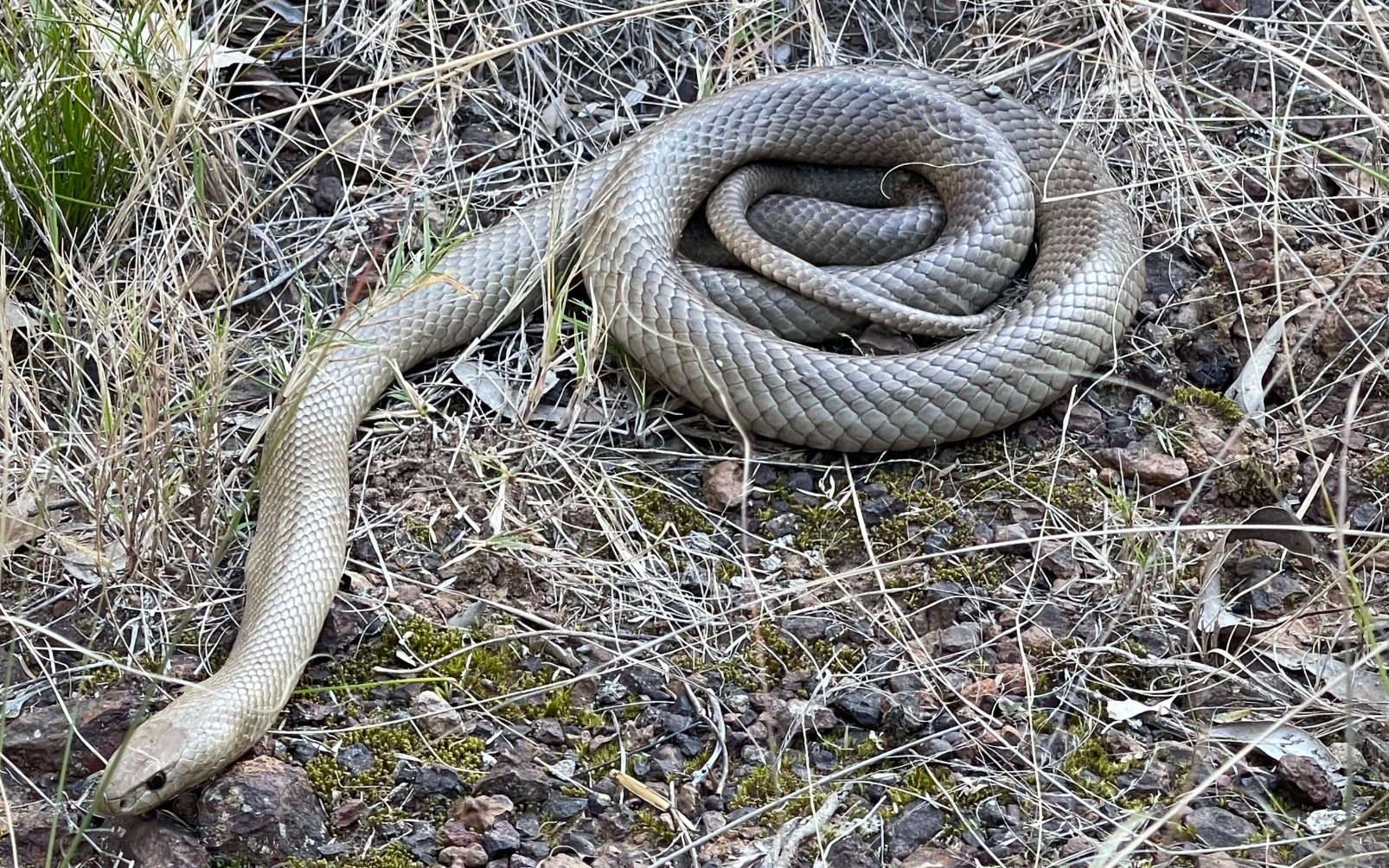
An Eastern Brown Snake from Box Hill
A few things people often ask
Did I do something wrong? No. Box Hill is in transition — bushland to suburb. Snakes move through the area as part of that. Your property isn't the reason. It's just on the route.
Does one snake mean there's a nest? No. Snakes don't form nests in suburban yards, don't live in groups, and don't travel in pairs. One sighting almost always means one snake.
What attracted it? Almost always rodents. New estates have higher rodent activity than established suburbs because of the construction clutter, food scraps from worksites, and the steady disturbance of natural rodent habitat in the surrounding bushland. The food drives the predator.
If a snake is inside the house
A snake indoors is an emergency. They get in through open sliding doors, garage gaps, gaps near pipework, ventilation openings, and damaged seals — common in new builds where the seals haven't been fully run-in yet. Leave the room, close the door behind you, and call 0418 633 474.
When in doubt, call
If something doesn't look right, if your dog or cat fixates on one part of the yard, or if you hear unusual movement near construction materials or garden beds, call 0418 633 474. Even just to check. We'd rather answer the question than have someone attempt to handle a snake themselves.
We work across Box Hill and the wider Hills District every day of the year.
About Chris Williams
Chris Williams has spent more than 35 years working with reptiles and amphibians throughout Australia and is widely recognised as one of the country's leading herpetologists. Since 2014, he has served as President of the Australian Herpetological Society, helping to promote reptile education, research and conservation nationwide.
His professional background includes roles with the Australian Reptile Park and Taronga Zoo, as well as extensive field experience working with reptiles across New South Wales. Chris is also the founder of Snake Ranch, which grew to become Australia's largest reptile breeding facility.
In addition to his field and zoo work, Chris has authored seven books on Australian reptiles, amphibians and wildlife. He is regularly interviewed regarding reptile interactions. Through Urban Reptile Removal, he continues to train and mentor snake catchers throughout New South Wales, ensuring the highest standards of safety, professionalism and reptile expertise are maintained across the network.
